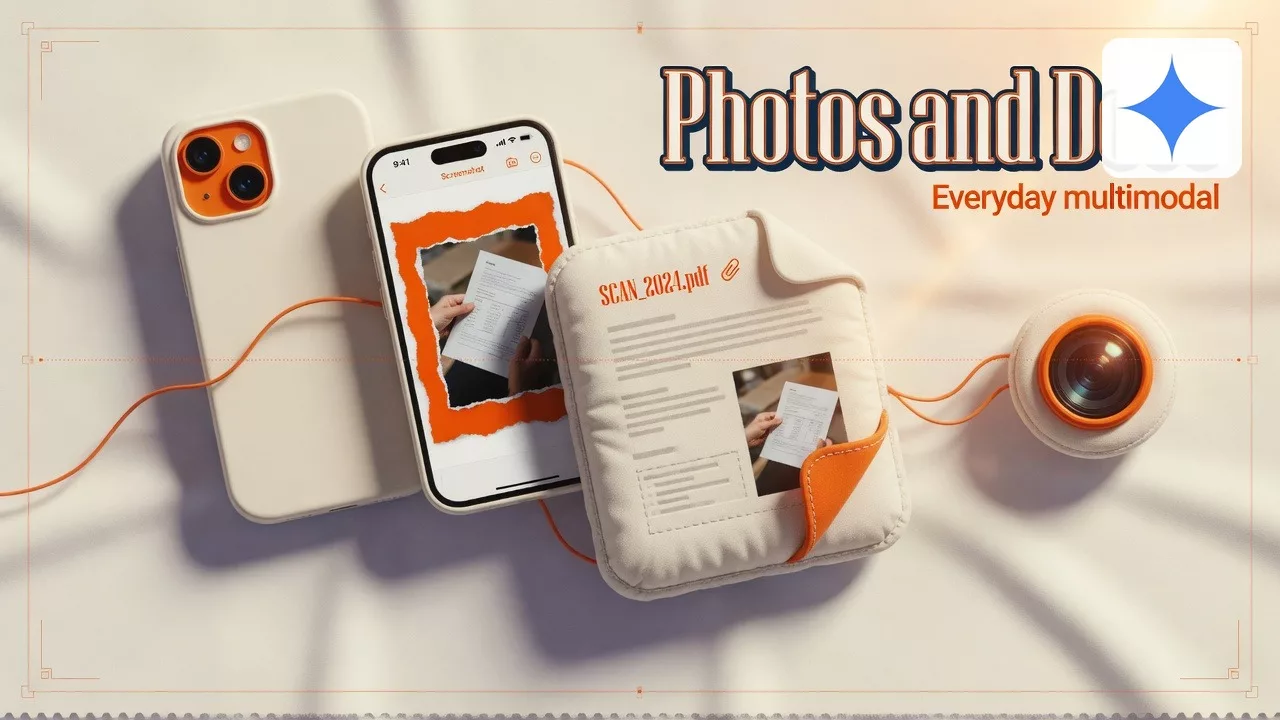
Maya photographed the packing list on the warehouse printer at 4:50 p.m. The crease through the first digit was obvious if you squinted. Gemini read 48 units as 18. She almost filed a rush PO for 30 extra cases before someone walked over and looked at the paper. The model was not being clever. It was filling a smudge. Photos and PDFs feel like a shortcut around typing. They are also a shortcut around noticing.
This is Part 4 of the Gemini everyday tutorial. Part 3 was the study loop. If you still need the from-scratch product tour of photos, screenshots, PDFs, and tables, use Learn Gemini: photos, screenshots, PDFs. This part is the weekday habit: which everyday files actually help, how to ask so the answer is checkable, and how not to turn a camera roll into a data incident.
Four everyday jobs where a photo or PDF
- Four everyday jobs where a photo or PDF beats retyping, and four where it does not
- Prompt patterns that force structure: lists, [UNCLEAR], and a verify step
- A short upload rule you can keep in your head
- A worked packing-list example with what the paper said versus what Gemini said
- When to type instead of shooting, and how this links to the paste ladder
Everyday multimodal, not a parlor trick
Multimodal here means you give Gemini pixels or a file plus a sentence, and you get text back. Whiteboard photos. A screenshot of an error. A PDF section you already own. Sometimes a small table export. The model does not see the way a person who was in the room sees. It produces a plausible reading. Plausible is useful. It is not a witness.
The everyday trap is speed. You shoot, you paste the bullets into Slack, you walk to the next meeting. The crease, the cropped axis, the badge in the corner of the photo, none of those get a second look. The first-week loop still applies: one real job, one revision, save the artifact outside the chat. A photo is just another input. It does not skip the revision.
Rule of thumb: If you would not trust a junior to copy that page by eye, do not trust a model to copy it from a photo. Ask for structure, then check the numbers on the paper.
Four jobs that actually help
Keep the list short. If the job is not on it, type.
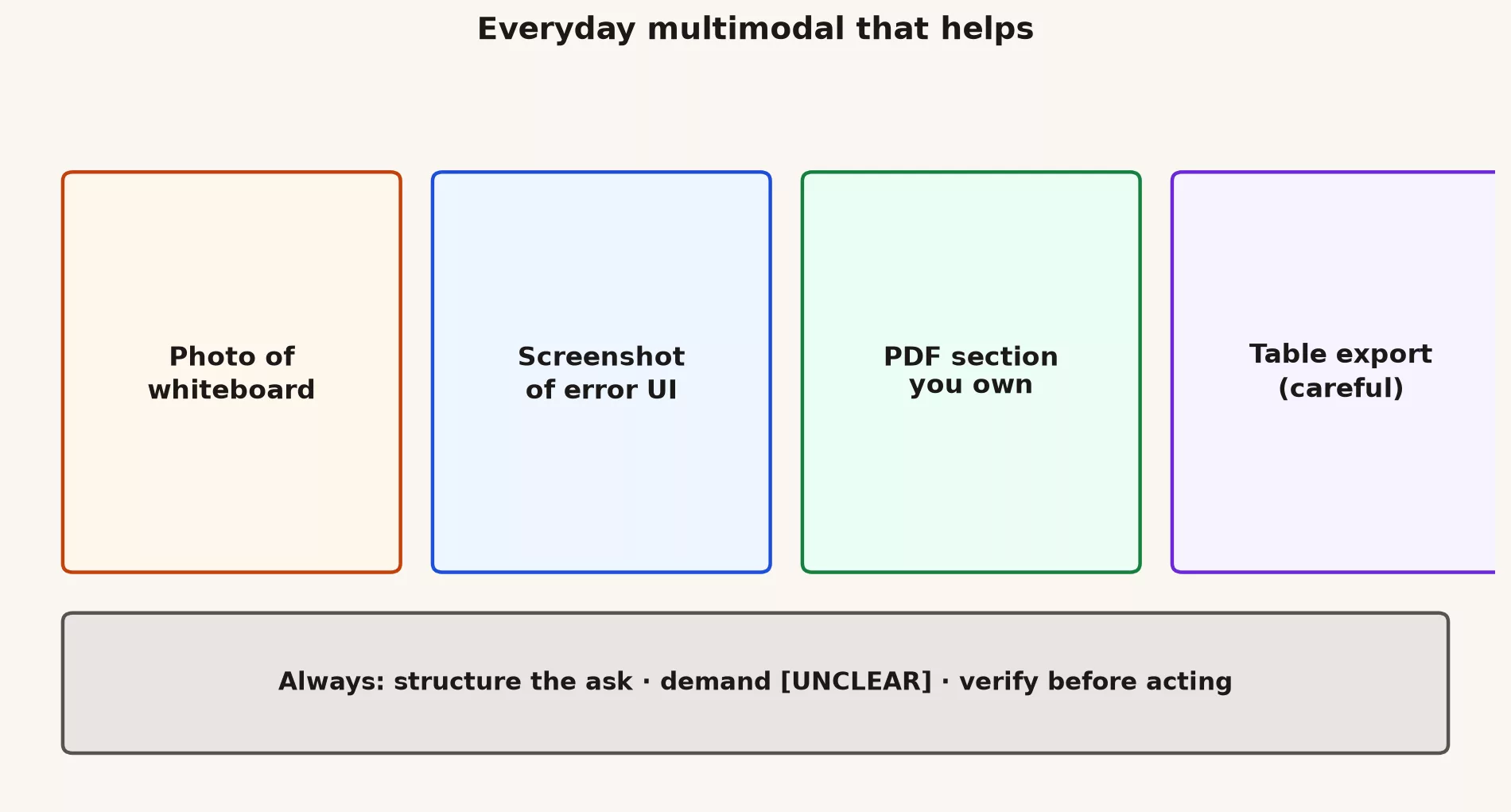
| Input | Good everyday job | Hard stop |
|---|---|---|
| Whiteboard photo | Bullets and owners you will clean | Do not treat it as the meeting record until you check names |
| Error screenshot | Exact error text plus the three lines around it | Cropped chrome hides the filter that caused it |
| PDF you own | Pull a section, quote page numbers | Vendor NDA, payroll, medical, kids |
| Tiny table export | Schema and three example rows, fake keys | Full customer dumps “for context” |
A packing list, a lab whiteboard, a CI error, a one-page policy you already published internally: those are the jobs. A 86-page packet, a badge on a lanyard in the frame, a dashboard screenshot with no axis labels: those are how Maya almost ordered 30 extra cases, or how a “crash” turns out to be a zoomed y-axis. For chart screenshots specifically, the multimodal charts post is the longer treatment. Here the rule is smaller: if you cannot see the axis in the photo, do not ask for a percent change.
Prompts that force structure
Vibe prompts (“what does this say?”) invite fluent padding. Everyday prompts name the output shape and the refusal.
Whiteboard or handwritten list
Here is a photo of a whiteboard after standup.
Return:
1. Bullets only. One action per line.
2. Owner if a name is fully visible, else [UNCLEAR].
3. Dates only if fully written. Do not guess from smudges.
4. A last line: what you could not read.
Do not invent people. Do not tidy this into a project plan.
Screenshot of an error or UI
Here is a screenshot.
Transcribe the exact error text in quotes.
List visible filters, dates, and the screen name if shown.
Say [UNCLEAR] for anything cropped or too small.
Then give two likely causes that match the visible text only.
Do not invent a stack trace I cannot see.
PDF section you own
Here is a PDF I own. Stay on pages 2 to 4.
Quote the sentence that defines [term].
Give page numbers for every quote.
If the definition is not there, say so. Do not borrow from training data.
I will open the file and check the quotes before I reuse them.
The [UNCLEAR] line is the whole trick. Models prefer to complete. You are paying them to stop. If the reply has no [UNCLEAR] on a messy photo, that is a smell. Ask again, or look at the paper.
Upload rules you can keep in your head
The long paste ladder lives in Privacy when pasting data into chat tools. Everyday multimodal needs a pocket version, because people photograph first and think later.
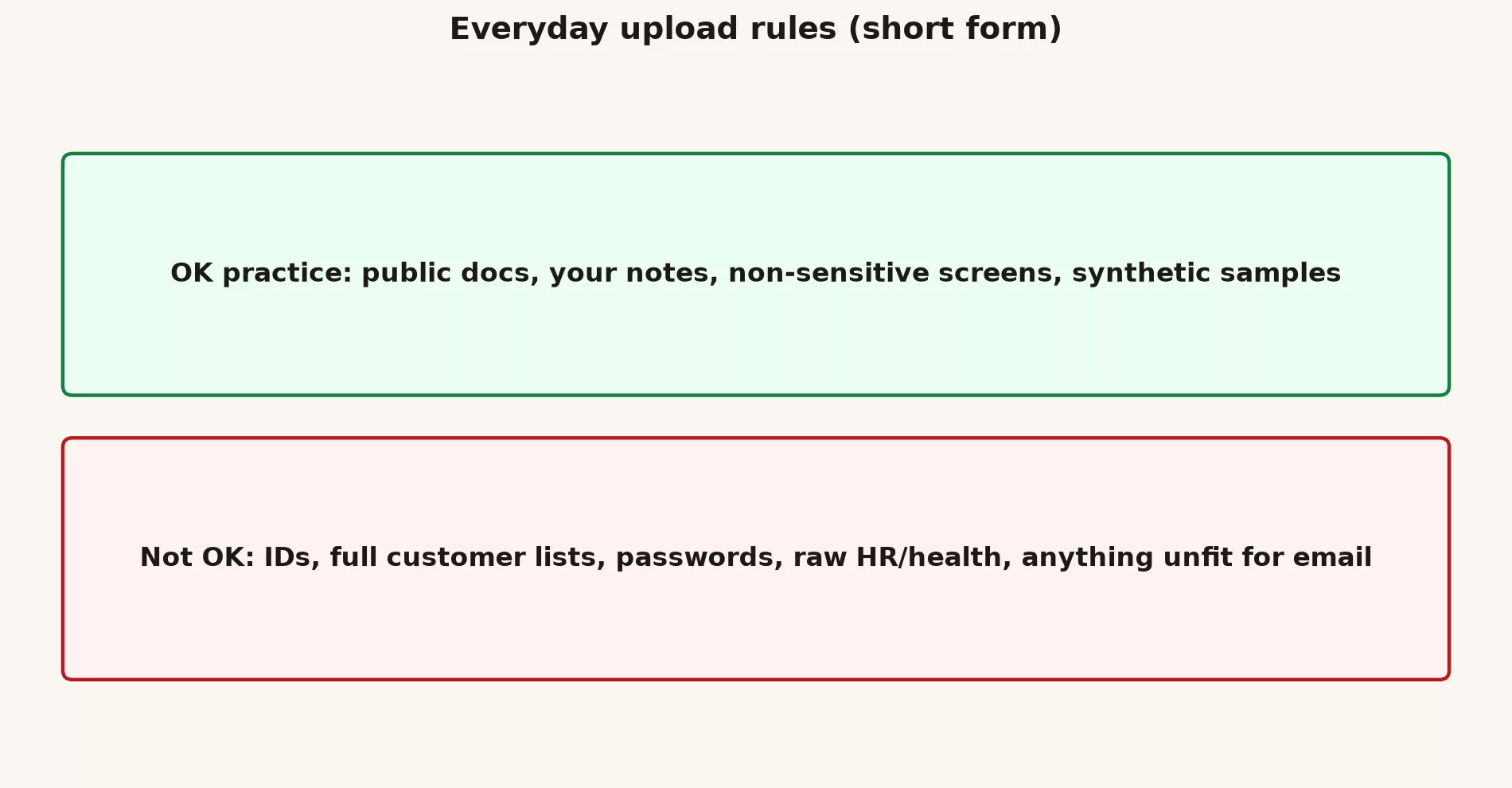
- Never: badges, passwords, government ids, other people’s monitors, customer lists on a desk.
- Crop to the task. The whiteboard, not the whole room. The error, not the Slack sidebar with a vendor thread.
- Prefer a file you own over a photo of a file. A PDF you exported beats a phone picture of a printed page.
- Verify on the original before the bullets leave the chat. Especially digits, names, and dates.
- You still publish. Slack, email, the ticket. Gemini does not hit Send.
Work vs personal still matters. A free personal Gemini tab is a different legal pile from a Workspace seat, even when the logo matches. If the packing list is customer orders, use the account your organization pays for, or do not upload. Admin settings can hide Drive and Gmail buttons on purpose. That is not a prompt problem.
Worked example: 48 units, a crease, and a near miss
Maya’s packing list was one printed table: SKU, description, units, dock. Three SKUs. The 4 in 48 sat on a fold. She shot it in fluorescent light, asked “what’s on this list,” and got a tidy three-row summary. Two descriptions were right. One quantity was 18. She had already opened the PO form.
| Field | Paper | Gemini first pass | After [UNCLEAR] prompt |
|---|---|---|---|
| SKU A units | 48 | 18 | [UNCLEAR] crease through first digit |
| SKU B units | 12 | 12 | 12 |
| Dock | B2 | B2 | B2 |
| Owner line | blank | “Maya / warehouse” | [UNCLEAR] no owner on page |
The invented owner is the quieter failure. The paper had no name. The model completed the scene with the person holding the phone. Fluent, structured, wrong. Same family as workslop: it looks like a record. It is a guess.
What she should have sent:
Photo of a packing list I printed.
Return a three-column table: SKU, description, units.
If a digit is smudged or creased, write [UNCLEAR] and do not guess.
Do not add an owner, dock, or story that is not printed.
Then she looks at the paper for every [UNCLEAR] and every number. Thirty seconds. Cheaper than 30 extra cases, and cheaper than a Slack message that becomes “the list.”
When the camera is the wrong input
Type instead when:
- The number matters and the photo is dim, creased, or cropped.
- You need a quote from a long PDF. Open the file, copy the sentence, paste the sentence. Photos of paragraphs drop line breaks and pick up thumbs.
- The screen contains a sidebar, a badge, or a name you would not forward.
- You want a percent change from a chart. If the zero baseline is not in the frame, you do not have a chart. You have a crop.
- The job is actually “search this Drive folder.” That is a connector and a policy question, not a photo of one thumbnail.
Local vs hosted does not change the crease. A local model will still guess 18. Privacy and accuracy are different knobs. If the file must not leave the building, do not photograph it into a consumer chat. If the file may leave, you still check the digits.
Shooting the whole room
- Shooting the whole room. You get a plant, a badge, and a half whiteboard. Crop.
- Asking “what does this say?” You get a story. Ask for a table, quotes, and [UNCLEAR].
- Pasting the first bullets into Slack. That is how 18 becomes the official count.
- Photographing a screen of customer rows because export felt slow. Slow is cheaper than a paste incident.
- Trusting citations in a PDF answer without opening the page. Gemini can quote a sentence that is not there.
- Using a personal tab for a work packing list because the phone was already unlocked.
Pick one file you own: a handwritten grocery
- Pick one file you own: a handwritten grocery list, a public error screenshot, or a one-page PDF you wrote.
- Run the structured prompt. Demand [UNCLEAR].
- Put the reply next to the original. Mark every mismatch in a note you keep.
- Save the cleaned version in a Doc, not only in the chat.
- Do not practice on badges, payroll, or anyone else’s monitor.
If you already did the first-week tasks, this is Friday’s artifact: one verified transcription, with the mismatches listed. That is more useful than twenty casual photos.
Photos and PDFs are inputs, not witnesses
- Photos and PDFs are inputs, not witnesses.
- Four jobs: whiteboard, error screenshot, PDF you own, tiny toy table. Type the rest.
- Force a table or quotes. Require [UNCLEAR]. Check digits and names on the original.
- Crop. Prefer a file you own. Work account for work paper. You still Send.
- A crease can turn 48 into 18. That is the whole lesson.
Sources
Research and further reading used for this article:
- Gemini Apps FAQ (what the consumer apps accept as files and images; re-check the week you teach a team)
- Google Gemini Apps Help (upload and Workspace admin controls change; do not treat a screenshot of settings as current)
- Gemini API docs (file and image inputs for builders; not the same wallet as the Gemini app)
- AMS: Photos, screenshots, PDFs, and multimodal basics (from-scratch product tour this everyday part assumes)
- AMS: Privacy when pasting data into chat tools (full paste ladder; this part is the camera-roll pocket version)
- AMS: Gemini everyday tutorial (first week, research, study loop, then this part)
Keep going
Same lessons in your feed
Short diagrams, hooks, and weekly tutorials on Substack, Instagram, X, and Facebook.
Merch on Etsy
Open store → Good Cheap Fast White Ceramic Coffee Mug, Data Science Mug, Data Mug, Analytics Mug, Statistics Mug, Programming Mug, Gift Mug, Coffee Mug
View on Etsy →
Good Cheap Fast White Ceramic Coffee Mug, Data Science Mug, Data Mug, Analytics Mug, Statistics Mug, Programming Mug, Gift Mug, Coffee Mug
View on Etsy →
 You're On Mute White Ceramic Coffee Mug, Data Science Mug, Data Mug, Analytics Mug, Statistics Mug, Programming Mug, Gift Mug, Coffee Mug
View on Etsy →
You're On Mute White Ceramic Coffee Mug, Data Science Mug, Data Mug, Analytics Mug, Statistics Mug, Programming Mug, Gift Mug, Coffee Mug
View on Etsy →
 Y Hat Mouse Pad, Data Science Mouse Pad, Analytics Mouse Pad, Y Pred Mouse Pad
View on Etsy →
Y Hat Mouse Pad, Data Science Mouse Pad, Analytics Mouse Pad, Y Pred Mouse Pad
View on Etsy →
 You're On Mute White Ceramic Coffee Mug, Data Science Mug, Data Mug, Analytics Mug, Statistics Mug, Programming Mug, Gift Mug, Coffee Mug
View on Etsy →
You're On Mute White Ceramic Coffee Mug, Data Science Mug, Data Mug, Analytics Mug, Statistics Mug, Programming Mug, Gift Mug, Coffee Mug
View on Etsy →