
An AI tutor can be a big help and a trap in the same afternoon. It never gets tired and can invent as many custom examples as you like. The trap is that it can sound completely sure while teaching you something wrong, and you will not notice until you repeat it in a meeting. The fix is a simple study loop with four steps: pick a skill you can observe, get a short map, practice actively, and check the answer somewhere outside the chat.
Say you ask Gemini to “teach me contribution margin,” which is the money left from a sale after the direct costs of making it. The answer sounds like a textbook, so you start using it. Later your finance partner tells you your company defines the term differently. Nothing about the explanation felt wrong, which is exactly why it was risky. What would have saved you is boring: one clear goal, a five-bullet map, a quiz you take yourself, and a look at the company’s own metric glossary before you say you “know” it.
The study loop
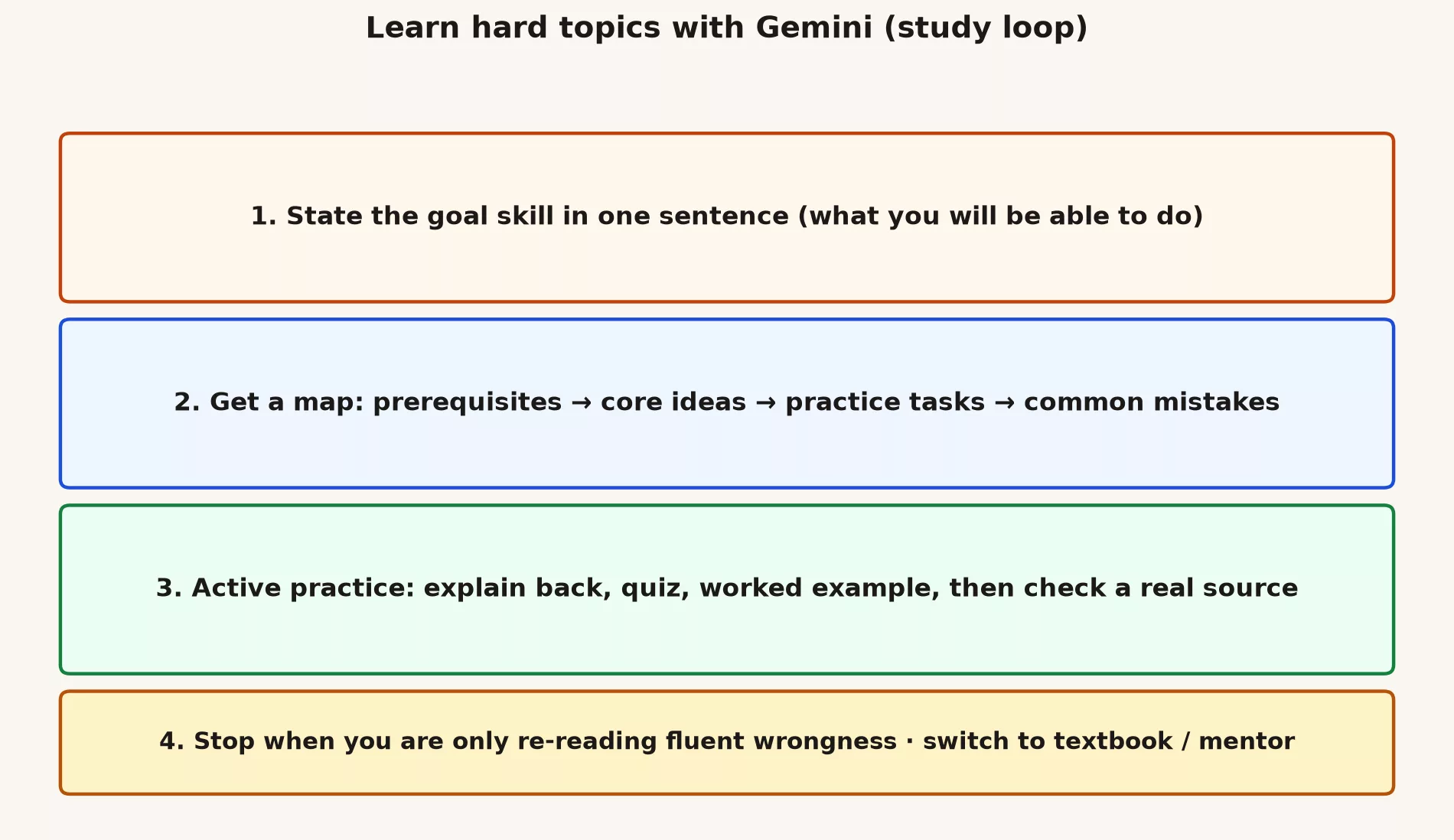
1. State the goal skill
Say you want to learn SQL, the standard language for asking a database for data. A bad goal is “learn SQL.” A better one is “write SELECT queries with WHERE and GROUP BY on a sales table, and explain what one row of the result stands for.” (WHERE filters rows, and GROUP BY sorts rows into buckets before totaling.) The better goal is something you could watch yourself do, so you will know when you have reached it. Paste a short template like this one into Gemini to keep it from trying to teach you everything:
I want to be able to: [observable skill]
I already know: [ ]
I have: [time budget, tools]
I will practice on: [dataset / problems]
Do not teach everything. Propose a minimal path for that skill only.
2. Get a map
Ask Gemini for the ideas you need to know first, the core ideas, some practice tasks, and the mistakes beginners make. Keep the map short enough to stick on a note, because a map you cannot hold in your head will not guide you while you work.
3. Practice actively
You have to produce something yourself: explanations in your own words, answers to quiz questions, and worked problems. Reading a perfect explanation is not practice, because recognizing an answer when you see it is a much easier task than producing it from memory.
4. Verify
Check what you learned against a source you trust, such as official documentation, a textbook chapter, a course you know is good, or a mentor. When Gemini and the source disagree, the source wins until you understand why they differ.
Good study prompts and traps
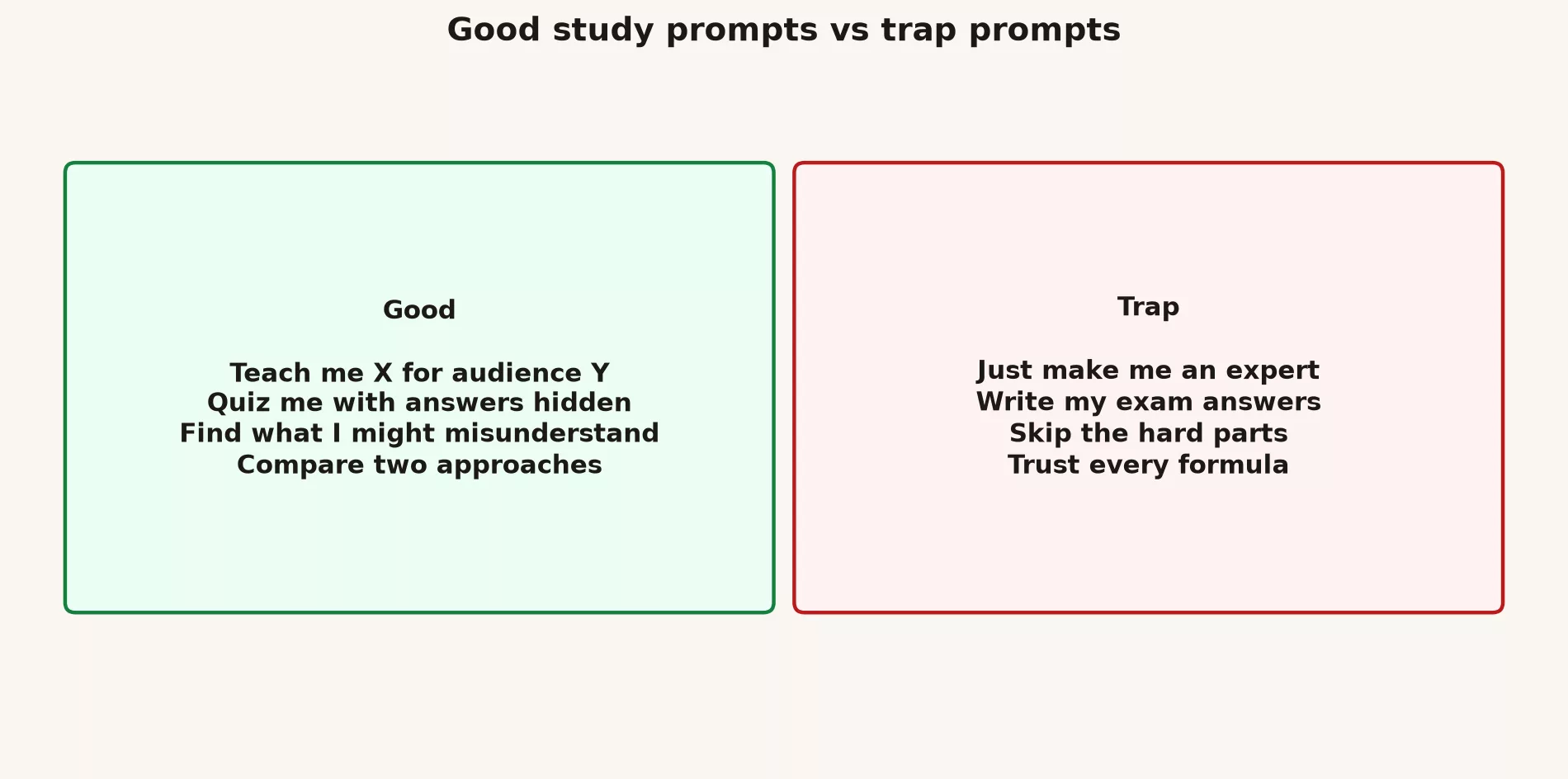
The good prompts share one trait: they make you do some of the work. The table below lists five that do, with a plain reason each one helps.
| Good prompt | Why |
|---|---|
| “Quiz me 8 questions; hide answers until I reply” | Forces retrieval |
| “What might I misunderstand about X if I only know Y?” | Surfaces misconceptions |
| “Give a tiny example, then a slightly harder one” | Scaffolding |
| “I will explain X in 5 bullets; correct me” | Generates evidence of understanding |
| “Compare approach A vs B for goal G” | Decision skill, not trivia |
Ask for two explanations
For a technical idea, ask for two layers at once. The first is plain and uses an analogy, and the second uses the exact terms you will need later. Asking for both lets you see what the simple version leaves out.
Explain [concept] twice:
A) for a smart non-specialist using one analogy
B) with precise terms I will need later
Then give one numeric or concrete toy example.
Flag any oversimplification in A that B must correct.
If the two layers contradict each other, ask Gemini which simplification would be dangerous in real work.
Worked mini-session: learning a metric
Here is the loop applied to a real question, using a small made-up set of app data. Notice that at the third step you still touch the rows yourself, and that is the point.
- Goal: define and compute weekly active users (the number of different people who used the app in a week) for the toy app data.
- Map: the difference between events and users, time zones, removing duplicates, and edge cases.
- Practice: you write the definition, Gemini critiques it, and you compute the number on ten rows by hand.
- Verify: check your answer against the official definition in your analytics tool’s documentation.
Spaced practice with Gemini
Spread your practice over days, because you remember more when you have to pull an idea back after a gap. On day 1, learn the material. On day 3, ask for a quiz and answer it without your notes. On day 7, ask for a transfer task, which means applying the idea to a new scenario. Keep a list of the questions you missed and re-teach only those. This works better than rereading the same chat transcript, since rereading feels productive but tests nothing.
Using files and notes
You can paste or upload your own notes, as long as the content is safe to share, and ask “Where am I vague? What definitions are missing?” Put your effort into improving the notes file rather than hoarding old chat threads, because your notes are the lasting record and a chat thread is not.
When Gemini is a bad tutor
- Topics where a wrong answer is costly and hard for you to spot, such as medicine, law, or structural engineering judgments
- Cases where you need accredited learning and formal assessments
- Days when you are too tired to verify anything and just want a comforting summary
- Subjects that need lab work, fieldwork, or a human giving feedback on how you perform
Weekly study plan template
Copy this into your notes at the start of a week and fill in the goal. It gives each day one job so you never have to decide what to study.
Week goal skill:
Mon: map + 2 practice problems
Tue: quiz (closed notes) + review misses
Wed: harder problem + dual explanation
Thu: teach-back to a friend or rubber duck
Fri: verify against primary source + update notes
Sun: 15-min spaced quiz on misses only
Tools: Gemini for tutor loops; [book/docs] for authority
Honesty checks
Recognizing an answer and having a skill are different things, so ask yourself these four questions at the end of the week.
- Can I do the skill cold, without the chat open?
- Can I explain a case where it fails?
- Can I spot a wrong answer that Gemini plants on purpose?
- Did I check at least one claim outside the chat this week?
The third question is a real exercise. Ask Gemini to plant a subtle error in an explanation, then try to find it. If you cannot, you are not ready to trust yourself with that topic in front of other people.
Practice this week
- Write one skill goal you could observe yourself doing.
- Ask for a minimal map and edit it down to half a page.
- Explain the topic in your own words with your notes closed.
- Run a five-question quiz and log the ones you miss.
- Open one primary source and, if you find a conflict with Gemini, work out which one is right.
Common mistakes
- Collecting summaries like trading cards instead of using them
- Skipping the problems because the explanation “made sense”
- Letting the model set an endless scope instead of the one skill you picked
- Studying only with AI and never with official documentation
Why a chat alone is not enough
Analysts learning statistics often feel productive after three chat sessions and then freeze on a real A/B test writeup, which is a report comparing two versions of something. The fix is cold practice on a tiny dataset, judged against a rubric a person wrote. Language learners who only chat with a model and never speak to humans hit the same wall. Gemini is a drill partner, and it is not the whole sport.
If you are learning alongside a course, use Gemini to rephrase ideas and to quiz you. Do not use it to skip the homework, because that homework builds the exact skill the exam measures, and shortcuts show up later as fragile confidence.
Pair your study with sleep and real breaks. Marathon chat sessions feel heroic but teach you less than you think, and short loops with a quiz in the middle beat a long night of smooth, confident nonsense.
It also helps to share your goal with a teammate who can spot-check you for ten minutes. Another person catches the gap between “I read it” and “I can do it,” which the chat cannot.
Learning in public without the stage fright
Teaching an idea back to a coworker is very valuable, and it can feel scary. Start with a rubber duck (any object you explain things to out loud) or a voice memo only you will hear. Then teach a peer who already likes you. Finally, volunteer for a short internal talk once you can pass a cold test on the skill. AI can help you structure the talk, but it cannot stand in for the nerves that prove you own the material.
Domain-specific cautions
- Statistics: insist that the model state its assumptions, and check the result with a dataset where you already know the answer
- Programming: run the code and read the errors, instead of only reading explanations
- Finance: definitions and policy documents beat chat analogies
- Languages: speak with humans, because AI is drills and not immersion on its own
- History: primary sources and the scholarship about them matter, since models squash real debates into false certainty
For each subject, keep one bookmark folder of sources you trust. When Gemini disagrees with that folder, investigate. Sometimes the folder is out of date, and sometimes the model is wrong, but either way you learn more than if you only chat.
Motivation without streak mythology
Missed days happen. Restart with a ten-minute quiz on only the questions you missed. Streak apps encourage guilt, but skill grows from pulling ideas out of memory, so log your sessions with a simple checkbox in your notes. If you miss a whole week, shrink the goal instead of giving up on the method.
Using Gemini to design practice, not to avoid it
Ask for a set of practice problems, then close the chat and solve them. Reopen it to check your work. If you leave the chat open the whole time, you are just reading with extra steps, so the gap while the chat is closed is the useful part.
One more practical habit is to keep a single note file for this topic, titled with the week you start. Paste in the prompts that worked, the near misses, and one sentence on what improved. That note becomes more valuable than any single chat transcript, and it is what you can show a teammate when they ask how you got faster without getting sloppy.
A second worked path: learning a new internal tool
New CRM (customer relationship management system, where sales keeps customer records) fields, a data warehouse (the central database that holds company data for reporting) screen, or an analytics product can feel like a second language. Start by setting a skill you can observe, such as “create a filtered report for last week’s orders and explain each filter to a teammate.” Map the menus and permissions, then practice in a sandbox (a safe practice copy) if you have one. Quiz yourself on the places where people get burned, like time zones, deleted records, and currency. Then verify against your internal wiki and not only the chat.
You can also ask Gemini to play a confused teammate and answer their questions using only what is in your notes file. Wherever your notes have gaps, you have found your next study list, which is more honest than asking for another tour of the whole product.
Avoiding tutor dependence
If you cannot start a problem without opening Gemini, shrink the problem until you can. Working on your own is part of the skill. Use the model to design the problem set and to check your answers, with a stretch of solo work in between. Athletes film their practice, but they still run the drills without watching the film mid-sprint.
Schedule a weekly “no AI” practice block for any skill you claim. Cold performance is the only grade that matters when the network is down, or when the tool is banned for a certain type of data.
- Design problems with AI, and solve them without it
- Check solutions with AI, then redo the misses cold the next day
- Keep a log of misses with dates
- Retire a skill from the log only after two clean cold runs
Keep going with small, dated practice notes. Steady effort adds up faster than an occasional heroic session, and dated notes make your progress visible when your motivation dips.
Quick recap
- Pick a goal skill, get a map, practice actively, and verify outside the chat.
- Prefer quizzes and teach-backs over passive summaries.
- Stop chatting when the stakes call for credentialed sources.
- The next post covers everyday help with photos and documents.
Series notes
This is Part 3 of the Gemini everyday tutorial (GM15). Previous: research and writing. Next: multimodal photos and documents.
Sources
Keep going
Same lessons in your feed
Short diagrams, hooks, and weekly tutorials on Substack, Instagram, X, and Facebook.