
Aisha downloaded a 3-page lab PDF from the clinic portal at 11:07 on a Sunday. The file name was Lab_Results_Final.pdf. She pasted all three pages into ChatGPT, header and date of birth included, and asked what it meant. The reply came back as a numbered treatment plan: an infusion package priced at $2,400, a stack of supplements she did not own, and a line telling her to pause a prescription she already takes. The citations looked like blog posts. No portal order existed for $2,400. She had the Forward box open to her sister before she closed the tab.
This is Part 28 of Phase P, and Part 3 of AI safety for everyday life. Part 1 was scams, deepfakes, and too-good offers. Part 2 was school, work honesty, and citations. Next is kids, family, and shared devices. Setup still starts at Free vs paid in AI setup from zero. The chooser is Which AI product should I use?. This part is the hard line: a chat product is not your doctor, lawyer, or broker.
What you’ll learn
- Where health, legal, and money work has to stop, even when the reply looks finished
- Prep you can keep: questions for a visit, a summary of notes you already own, a paperwork stack
- Actions you cannot take from a chat: a diagnosis, a signature, a buy or sell
- What OpenAI, Anthropic, Google, and xAI write in their policies (as of writing)
- A before-you-paste checklist, plus how Aisha should have used that 3-page PDF
Why a chat box cannot take the job
A licensed person can be wrong on the record. They have a name, a board, a file, and a duty. ChatGPT, Claude, Gemini, and Grok have a text box. They will write a plan with numbered steps and a dollar amount because that is what a finished-looking answer looks like. They did not examine Aisha. They did not open her chart. They guessed from patterns in text, including wellness blogs that sell infusions.
Use the tools the way you used them for writing and questions: draft, sort, rehearse. Do not let the draft become the act. Better prompts live in Prompting for everyone. Safer uploads live in uploading docs safely. Read that before you paste another portal PDF.
Rule of thumb: If the next step costs money, changes a dose, or binds you in writing, a licensed person does that step. The chat only helps you walk in prepared.
The three hard lines
Health
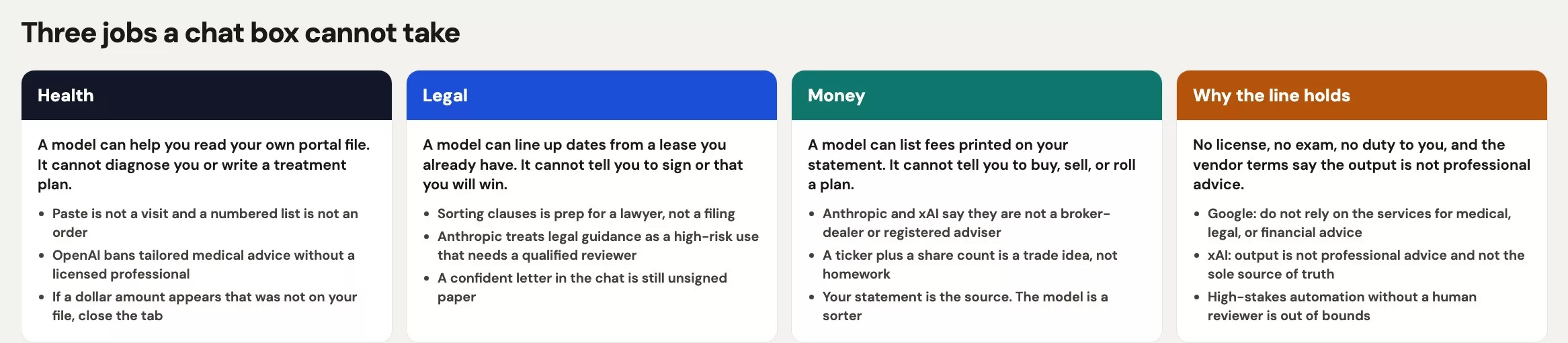
Aisha’s PDF was three pages of test names and numbers. Asking “what does this row mean in plain English, and what should I ask on Monday” is prep. Asking “what do I have, and what should I start” is a diagnosis request. The model cannot draw blood. It cannot see the rest of the chart. Stay on your side of the desk: a timeline of dates you already have, eight questions max, each one pointing at a line on the page. If it invents a protocol, a brand, or a price that was not on your file, stop. $2,400 was the stop. The infusion package was not in the PDF. It was a blog-shaped guess wearing a plan format. As of writing, health-flavored products still point you at a clinician. OpenAI’s usage policy still bars tailored medical advice that requires a license unless a licensed professional is involved. A Sunday-night paste is not that involvement. Do not paste someone else’s results.
Legal
Aisha’s roommate dropped a 14-page lease into Claude. Rent was $1,850. The prompt was “can I break this.” The model wrote that 30 days of written notice was enough. Page 7 said 60 days and a fee equal to two months of rent. The model had summarized a generic lease, not this one. A confident letter in the chat is still unsigned paper. Sending it would have been the act. Ask for a date table and a clause list with page numbers. Ask the model to quote the page so you can check. If it cannot quote the page, it is guessing. Do not send a termination the model drafted. Do not let it tell you that you will win. Chat products do not appear in court as your counsel. They also invent case names. Part 2 of this series already covered fake citations.
Money
Aisha also had $4,100 sitting in a cash sweep inside an old 401k PDF. She asked Grok what to do with it. The reply named a ticker and a share count. That is a trade idea. Anthropic’s consumer terms, as of writing, say you may not rely on the services to buy or sell securities, or to give or receive advice about those products, because Anthropic is not a broker-dealer or a registered investment adviser. xAI’s acceptable use policy says the same shape. Prep still exists: paste a fee table you already have (account numbers stripped) and ask for a list of questions to take to an advisor. You decide, or a licensed person decides with you. “Help me gather the tax forms I already downloaded” is prep. “Tell me what to claim” is advice. Every figure in the chat has to exist on your form. If it does not, delete it.
Allowed prep vs forbidden action
Hold the three domains in one grid. Left is work you can do in ChatGPT, Claude, Gemini, or Grok. Middle is the act that still belongs to a licensed person. Right is who signs off before anything leaves the house.
| Domain | Allowed prep | Forbidden action | Who signs off |
|---|---|---|---|
| Health | Glossary of words on YOUR portal file; 8 questions for Monday; a timeline of dates you already have | Diagnose, pick a dose, start an infusion, pause a prescription, skip the clinic | Your clinician |
| Legal | Date table from YOUR lease; clause list with page numbers; questions for a lawyer | Send a termination, fill a court form as if it is filed, “you will win,” sign | A lawyer licensed where you live |
| Money | Fee list from YOUR statement; questions for an advisor; a restatement you check against the PDF | Buy or sell a ticker, roll a plan on the model’s say-so, file a number that was not on your form | A licensed advisor, or you with your own judgment |
If a reply will not fit the left column, close the tab. The work is a phone call, a portal message, or an appointment. Same stop-and-do muscle as when to stop prompting, applied where a wrong answer has a body, a contract, or a balance attached.
Useful uses you can keep

The useful side is boring on purpose. Prep questions. Summarize notes you already wrote or already received. Organize the stack so the licensed person is not flipping through screenshots. Then close the chat.
Try this prompt shape: “Here is the text I already have. Give me eight questions I can read out loud. Each question must point at a line in this text. Do not answer the questions. Do not add facts that are not on the page.” For a summary: “Restate this in short sentences. Put every number next to the sentence it came from. If you cannot find a number on the page, write MISSING.” Then check. Part 2 of this series told you to open the citation. Here you open the PDF. A folder list and a date table are prep. A signed form is not. For health, legal, and money, an agent stays on watch, or you do not run it. That autonomy split is in AI agents for everyone.
What the vendors write
The companies already wrote the hard line. Policies move. Confirm the live page the week you rely on a sentence. As of writing (August 2026):
OpenAI’s usage policies (effective 29 October 2025) bar “provision of tailored advice that requires a license, such as legal or medical advice, without appropriate involvement by a licensed professional.” The same page bars automation of high-stakes decisions without human review in financial activities and credit, insurance, legal, and medical. A Sunday paste with no clinician in the loop is not “appropriate involvement.”
Anthropic’s usage policy lists legal, healthcare, and finance as high-risk use cases. A qualified professional in the field must review the content or decision before it goes to a person, and you must disclose that AI helped. Wellness tips (sleep, stress, nutrition, exercise) are carved out. A $2,400 infusion plan is not a sleep tip. The consumer terms add that you may not rely on the services to buy or sell securities, or to give or receive advice about those products. Confirm outputs yourself.
Google’s Terms of Service (effective 30 July 2026 in the US version I opened) say: do not rely on the services for medical, legal, financial, or other professional advice. Content on those topics is for information only, does not constitute medical diagnosis or treatment, and is not a substitute for a qualified professional. Older Generative AI additional terms used the same sentence; Google folded much of that into the main terms in 2024. Gemini still pops medical-information warnings. Read them.
xAI’s consumer terms say output is not professional advice and you should not rely on it as the truth. The all-caps disclaimer adds that you will not rely on output as the sole source of truth, or as professional advice. The acceptable use policy (effective 14 August 2026) repeats the broker-dealer / registered adviser line and bars high-stakes automated decisions in financial credit, insurance, legal, and medical. NIST’s AI Risk Management Framework is the public-sector version: high-stakes uses need human judgment. The FTC page in Sources is about scams (Part 1). Harm here also happens when nobody is scamming you and the model is just wrong with confidence.
Worked example: a 3-page PDF and a $2,400 plan
Aisha’s night, rewritten. The numbers are her story, not a medical statistic and not a recommendation.
| What she did | What the chat returned | What she should have done |
|---|---|---|
| Pasted all 3 pages, name and date of birth still in the header | A numbered treatment plan plus $2,400 infusion package | Strip the header. Paste only test names and numbers. Ask for a glossary and 8 questions |
| “What does this mean, what should I start” | Supplements, a pause on a current prescription, blog-shaped citations | “Do not diagnose. Do not add products. List questions. Write MISSING if a fact is not on the page” |
| Almost forwarded the plan to her sister | A document that looked like it came from the clinic | Forward the original PDF, or nothing. Bring the question list on Monday |
Monday, the clinic already knew the panel. There was no $2,400 order. The useful artifact would have been a half-page of questions: which rows are new, whether the prescription stays, what to watch before the next draw. That half-page is the work. The treatment plan was a costume. Same night, 30 days of notice was not in the lease PDF, and the ticker was not in the 401k statement. Check the source page. Then take the source page to a person.
Before you paste
Copy this into a note next to the chat. Fill it before the file goes in. If you fail a stop line, do not paste.
BEFORE YOU PASTE (health / legal / money)

1. Who is this for?
   [ ] me, as the patient / client / account holder
   [ ] someone else (stop unless they asked and they are in the room)

2. Strip identifiers
   [ ] name, date of birth, MRN, SSN, account numbers, case numbers out
   [ ] keep only questions plus facts already on MY page

3. What am I asking the model to do?
   [ ] glossary of words on MY file
   [ ] 8 questions I will ask a licensed person
   [ ] timeline / folder list / date table from MY paperwork
   [ ] diagnose / dose / sign / file / buy / sell   <- STOP, do not paste

4. After the reply
   [ ] every number exists on MY PDF (else strike it)
   [ ] every citation I can open (else strike it)
   [ ] no new dollar amount that was not on the file
   [ ] I will not forward this as a plan from the clinic, firm, or bank
   [ ] a licensed person sees it before any money, dose, or signature

Source file: [name of MY PDF]
Vendor: [ChatGPT / Claude / Gemini / Grok]
Date: [today]
Stop if: the reply looks like an order, a letter to send, or a trade
Aisha would have failed step 2 (date of birth still in the header) and step 3 (she asked what to start). Either fail is enough to keep the PDF in the portal and message the clinic instead.
Common mistakes
- Pasting a portal PDF with the header still on it, then asking “what should I start.”
- Treating a numbered list with a dollar amount as an order from the clinic or the firm.
- Sending a lease letter the model wrote without opening the clause it claimed to quote.
- Asking which ticker to buy, then placing the trade because the reply was specific.
- Forwarding the chat to family as if the licensed person already signed off.
- Assuming a health-flavored product name cancels the usage policy. It does not.
- Pasting someone else’s results, a child’s chart, or a partner’s statement without them present.
- Letting an agent click, file, or trade in these domains. Watch only, or do not run it.
How to practice this week
Pick one real file you already have: a portal result, a lease, or a statement. Strip the identifiers. Run the checklist. Ask only for a glossary, a date table, or eight questions. Print that page. Take it to the person who can act. Do not ask the model to act. Next: kids, family, and shared devices. If someone else uses the same laptop, read that before the next paste. Honesty from Part 2 still applies: if you used a model to sort the file, say so when you hand the questions over. More paths: Learn and Practical AI.
Quick recap
- Chat products help you prep questions, summarize your notes, and organize paperwork.
- They cannot diagnose, sign a contract, or tell you to buy a stock.
- If a dollar amount, a dose, or a signature appears and it was not on your file, stop.
- Vendor policies already say this. Open the live page before you argue with the model.
- Aisha’s $2,400 plan was a costume. The half-page of questions was the work.
Sources
- OpenAI: Usage policies (effective 29 October 2025; tailored licensed advice and high-stakes decisions)
- Anthropic: Usage policy (high-risk legal, healthcare, and finance uses; human review and disclosure)
- Anthropic: Consumer terms of service (no securities buy/sell or advice; confirm outputs yourself)
- Anthropic: Claude for Healthcare (as of writing, still points users to healthcare professionals for personalized guidance)
- Google: Terms of Service (do not rely on the services for medical, legal, or financial advice)
- Google: Generative AI additional terms (archived professional-advice warning; folded into the main terms in 2024)
- xAI: Terms of Service (consumer) (output is not professional advice; do not treat it as the sole source of truth)
- xAI: Acceptable use policy (not a broker-dealer or registered adviser; no high-stakes automated medical, legal, or credit decisions)
- NIST: AI Risk Management Framework (high-stakes uses need human judgment)
- FTC: How to avoid a scam (related to Part 1 of this series)
- AMS: AI safety for everyday life
Keep going
Same lessons in your feed
Short diagrams, hooks, and weekly tutorials on Substack, Instagram, X, and Facebook.
Merch on Etsy
Open store → Y Hat Mouse Pad, Data Science Mouse Pad, Analytics Mouse Pad, Y Pred Mouse Pad
View on Etsy →
Y Hat Mouse Pad, Data Science Mouse Pad, Analytics Mouse Pad, Y Pred Mouse Pad
View on Etsy →
 You're On Mute White Ceramic Coffee Mug, Data Science Mug, Data Mug, Analytics Mug, Statistics Mug, Programming Mug, Gift Mug, Coffee Mug
View on Etsy →
You're On Mute White Ceramic Coffee Mug, Data Science Mug, Data Mug, Analytics Mug, Statistics Mug, Programming Mug, Gift Mug, Coffee Mug
View on Etsy →
 Dashboard to Excel Ceramic Coffee Mug
View on Etsy →
Dashboard to Excel Ceramic Coffee Mug
View on Etsy →
 You're On Mute White Ceramic Coffee Mug, Data Science Mug, Data Mug, Analytics Mug, Statistics Mug, Programming Mug, Gift Mug, Coffee Mug
View on Etsy →
You're On Mute White Ceramic Coffee Mug, Data Science Mug, Data Mug, Analytics Mug, Statistics Mug, Programming Mug, Gift Mug, Coffee Mug
View on Etsy →