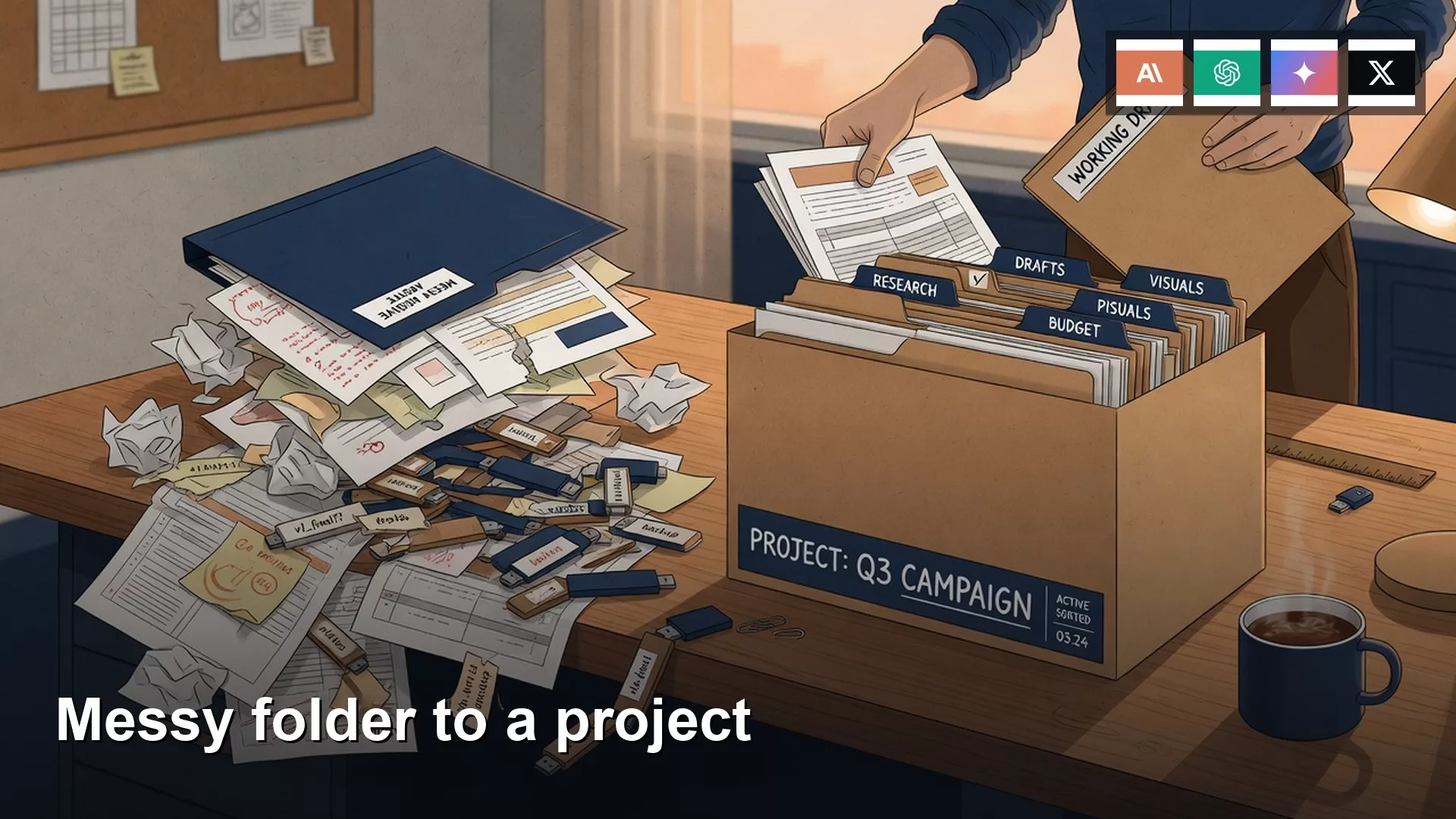
A messy folder full of files is not a project. Before you ask an AI tool for a one-page summary, copy only the files the job needs into one small folder, write eight lines of standing instructions, and decide what the finished page should look like. The whole cleanup takes about thirty minutes.
Say your boss messages you at 3:40 in the afternoon and asks for a one-page comparison of pallet-wrap film suppliers for 2026, due before the end of the day. You open the folder where you keep everything: 212 files, 1.4 GB, names cut off into a tiny grid of icons. The quickest move is to point the AI tool at that folder and type the question. That move is what this post is about, because it goes badly in a very predictable way.
A project is one job
Most AI tools now offer a saved workspace for a piece of work, and each vendor names it differently. ChatGPT calls it a Project. Claude also calls it a Project, under claude.ai/projects. Gemini’s closest match is a Gem, which is a set of saved instructions plus a list of knowledge files. Grok’s website does not offer the same kind of saved workspace, so there you keep one dedicated conversation and paste a short block of instructions at the top, or you skip the file dump. The product name is not the lesson. What you put inside is.
A working project has three parts you can point at. First, one named job, such as “pallet wrap 2026” rather than “Work”. Second, a small set of files that job can use. Third, standing instructions that apply to every chat inside the project, including what the answer should look like. OpenAI, Anthropic, and Google all offer those three under slightly different labels. Keep one client or one recurring task per project, because mixing a customer renewal with pallet wrap is how a lease clause ends up in a film quote.
In the scene above, you have a project and you skip all three parts. Your Mac then shows a permission sheet for the misc folder, and you click Allow, because it is in your way. The earlier post on file safety already warned that Allow on a whole folder lets in more files, not better answers, and 212 files is a lot of extra reading for a model that cannot tell which ones matter. ChatGPT also offers project-only memory, so chats inside one project do not pull in things you said elsewhere in your account. Use that when you have it, though it will not help if a personal lease is already sitting in the project files.
Rule of thumb: If you cannot finish the sentence “this project is for ___ by ___,” do not upload yet. Name the job first, and pick the files second.
What a messy folder holds

A folder like that is really four piles pretending to be one. You need to sort them with your own eyes before the model reads any of them, because the model will quote whatever is readable. It does not know your boss asked about film. It only knows that clause 4.2 is a paragraph with a dollar amount in it.
Job files
These are the few files that answer this week’s question. Here that is four: WrapCo_quote_v3.pdf, StretchRight_2026.xlsx, last year’s wrap invoice, and a six-line spec (20-inch film, 80 gauge, about 40 rolls a month). They belong in the project, after you black out anything private.
Dead personal files
This pile is life paperwork that never got filed: a 2019 apartment lease, a move-out checklist, a wedding photo your computer labeled IMG_4481. They are fine on your disk and wrong in a work project. The lease had a real number ($1,850) and legal-sounding headings, so it looked like a source, which is exactly why it won the first paragraph of the first answer.
Identity papers
Here you might find scanned employment forms (an I-9), tax PDFs, and a bank screenshot from the month you paid a deposit on a new apartment. The earlier post in this series on cleaning files covers the strip pass, which removes emails, phone numbers, addresses, and account numbers. An I-9 does not get a light touch-up and a second chance, and a recap about stretch film has no use for a Social Security card.
Noise
The other 180 files are Slack screenshots, an Untitled.pdf, a WrapCo_quote_v2.pdf sitting next to v3, and a boarding pass from 2022. Noise also uses up your plan’s file limits. As of October 2, 2026, OpenAI’s help page lists 5 files per project on ChatGPT Free, 25 on Go and Plus, 40 on Pro, and only 10 uploads at a time, while Anthropic’s help center caps Claude Free at five projects. Those numbers change, but the point stays: if you upload junk first, you spend the limit before the useful PDFs arrive.
Copy the files the job needs
Do not point the chat tool at the misc folder. Make a new folder on your computer named for the job, such as pallet-wrap-2026. Then copy, do not move, the three to eight files that belong. If you guessed wrong, the originals are still in misc, and you still have no I-9 in the project.
Next, run the strip pass on the copies. Last year’s invoice had four accounts-payable emails in the footer and a cell holding a bank routing number. Duplicate the sheet, blank those cells, and save it as wrap_invoice_2025_redacted.xlsx. The quote PDFs were clean enough to keep as they were. The I-9 and the lease never go into the new folder. If you are unsure about a file, leave it out, because you can paste one missing number by hand later but you cannot take back a passport scan you already uploaded.
Upload from that small folder only. If the Mac or the Claude desktop app still has Allow switched on for the misc folder, turn it off in your computer’s permission list, since a leftover folder permission is how all 212 files walk back in on Monday. Office files are the usual contents of a knowledge list (see AI for files and office work). If a file cannot leave your building at all, the better route is described in the privacy tutorial on running AI yourself. For today, the project sees the redacted copies and nothing else.
Eight lines of standing instructions
The instructions field is the briefing you would tape to a new hire’s monitor. It should be short, specific, and identical in every chat inside the project. OpenAI puts it under Project settings, Claude calls it “Set project instructions,” and Gemini’s Gem editor has an instructions pane next to the Knowledge list. Paste it once, so you never retype the briefing in the fourth chat.
Anthropic’s help page for creating a project has a catch worth knowing. You give the project a name and a description, but Claude does not read either one. The model only sees the instructions box and the knowledge files, so a title like “Pallet wrap 2026” tells it nothing about the job, while the eight lines do. I think eight lines is enough, and a two-page style guide in that box gets skimmed the same way a 212-file folder does.
Here is the block you would paste at 3:41, right after making the small folder:
Project: Pallet wrap 2026 (Cedar Lot Fulfillment)
Job: one-page vendor comparison for stretch film, due Friday 5pm
Audience: Rafi (GM). Four minutes. Hates walls of text.
Use only: WrapCo_quote_v3.pdf, StretchRight_2026.xlsx, wrap_spec.txt, wrap_invoice_2025_redacted.xlsx
Output: table with vendor, price per roll, monthly cost at 40 rolls, one risk note
Length: one page. After the table, 4 bullets of recommendation. No greeting.
Do not: cite files outside that list, invent SKUs, mention leases or personal docs
If a number is missing: write NEED: and the cell or page, then stop guessing
That block names the job, the reader, the allowed files, the table, the length, the things to avoid, and the rule for missing numbers. Line 4 puts the file list in writing, line 7 keeps a lease out of a film memo, and line 8 stops the model from stating a confident $47.80 that was never in the PDF.
Pin the output format
The shape of the answer belongs in the project, not in your mood that day. “Be concise” is not a format, but a four-column table is one, and so are four bullets after the table and “no greeting.” Put those lines in the standing instructions so the first chat and the sixth chat come back looking the same. You have already written the shape down, so you are not hoping the model guesses it.
With a blank instructions field, the first reply in this story runs 900 words, quotes the lease, and offers to “walk through occupancy terms.” Your boss does not occupy a studio, he buys film. A pinned table would have skipped the lease or hit the NEED line, because a lease has no price per roll. Similar dollar amounts are a trap of their own, since $1,850 in rent and a $1,912 monthly film line can sit side by side and look related. Separate columns keep them apart.
A 30-minute cleanup

You do not need a weekend for this, only a timer and one job. If you have 80 minutes until the deadline, spend thirty of them here. The other fifty are for reading the two quotes yourself.
- Name the job in one line, with the audience and due time. Create the project, Gem, or dedicated thread with that name, and leave “Work” and “Misc” for later (or never).
- Make
pallet-wrap-2026on disk. Copy three to eight files into it and redact the copies. Do not give the desktop app permission for the parent folder. - Paste the eight-line block into Project settings, Claude’s instructions, or the Gem editor. Include the output table, then save.
- Upload from the small folder only. If a project called Work already holds 40 random PDFs, remove them from the product. Turn off the misc folder permission if it is still allowed. Then ask a test question, and confirm the 2019 lease does not appear.
Minutes 1 through 5 go to the name. Minutes 6 through 18 go to copying and redacting, and the slow part is the invoice footer. Minutes 19 through 24 are for the eight lines. The last six minutes cover the upload, revoking the folder permission, and the test question: “What should we pay for wrap this year, using only the project files.” If the cat from the wedding photo shows up, a file is still in the project or the folder permission is still on. Find it, remove it, and ask again. Leave the rest of misc on your disk. A second job this month gets a second project and another 30 minutes, so do not merge them just because the sidebar looks tidy with one giant Work.
Worked example: 212 files, one lease
Here is the project before and after the half hour. The numbers are made up for teaching: WrapCo $47.80 per roll, StretchRight $52.10 per roll, 40 rolls a month, lease rent $1,850. The lease number is the decoy. It is larger and it sits under a clause heading, so a blank project will prefer it.
| Messy dump named Work | Working project | |
|---|---|---|
| Job | Everything on the Desktop | Pallet wrap 2026, one page for the GM by 5pm |
| Files in the product | 212 (1.4 GB), including a 2019 lease and an I-9 | 4: two quotes, spec, redacted 2025 invoice |
| Standing instructions | Blank | 8 lines, table pinned, lease banned |
| First citation | Lease clause 4.2, $1,850, cat named Biscuit | WrapCo $47.80 per roll, $1,912 per month at 40 rolls |
| Safe to forward to the GM | No. Identity papers and a personal lease | Yes, after the strip pass |
After the cleanup, the same question (“what should we pay for wrap this year”) returns a four-column table. WrapCo comes back at $47.80 a roll and $1,912 a month, StretchRight at $52.10 and $2,084. The risk note on WrapCo says 14-day lead time and no weekend delivery. Four bullets follow, with no greeting and no occupancy language, and the page reaches your boss at 4:51.
The same thing happens in Claude. Say your Claude project is named “Stuff,” it holds 19 PDFs from a shared folder called “ops,” and your recap of loading-dock hours cites a 2021 forklift inspection. The fix is the same: copy three files into a folder called dock-hours-april, write eight lines of instructions, and delete the extras from the project’s file list. Rename the project too, but the instructions are what tell Claude the job.
Common mistakes
- Naming the project Work, Misc, or AI. The model cannot infer the job from a junk-drawer label.
- Clicking Allow on Desktop or Downloads because the Mac permission sheet was in the way of a 3:40 panic.
- Uploading first and writing instructions later. The first answer has already been built from the whole dump.
- Putting the job only in the Claude project title and leaving the instructions box empty. Claude does not see that title.
- Spending the file limit on screenshots so the actual quote never fits. Check your plan’s limit before you upload batch 3 of 10.
- Redacting nothing, then forwarding the answer. The I-9 is still in the project even if the reply did not quote it.
- Deleting misc from your disk in a fit of tidiness. Remove files from the chat product, and keep your disk copy until you truly mean to shred it.
- Merging two jobs because “we already have a Work project.” Pallet wrap and a customer’s dock hours do not share a knowledge base.
How to practice this week
Pick one real deadline in the next five days and create a folder named for that job. Copy three to eight files into it and redact the copies. Open a new ChatGPT Project, Claude Project, or Gemini Gem, and paste an eight-line block modeled on the one above. Upload only from the small folder, then ask the real question. If a leftover from 2019 appears, you missed a file or a folder permission, so remove it and ask once more. After that, move on to AI agents for everyone, where a chat can take steps instead of only answering. If a file still goes missing after a clean project, back up to where did my file go. Broader practice sits on Learn and Practical AI. Upload travel is also covered in files, uploads, and where your data goes.
Quick recap
- A project is one job, a small set of files, and standing instructions. Name the job before you upload.
- Sort the folder into job files, dead personal, identity papers, and noise. Only the first pile goes in, after you black out private details.
- Write eight lines, pin the table (or whatever “done” looks like), and ban files that are not on the list.
- Spend 30 minutes, turn off the folder permission, and delete extras from the product but not from your disk. Then ask a test question and check the lease is gone.
Series notes
This is Part 4 of AI agents for everyone. Previous: Where did my file go. Next: Autonomy levels.
Sources
Vendor help pages checked in August 2026. Research and further reading used for this article:
- OpenAI Help: Projects in ChatGPT (chats, files, instructions, project-only memory, plan file limits)
- OpenAI Academy: Using projects in ChatGPT (dedicated spaces with shared context)
- OpenAI Help: Memory FAQ (memory is a different drawer from project files)
- Anthropic: What are projects? (knowledge base plus instructions; Free project limit)
- Anthropic: Create and manage projects (name and description are not visible to Claude; put the job in instructions)
- Google: Tips for creating custom Gems (instructions plus Knowledge files)
- Google Gemini and Grok (Gem editor vs grok.com, which has no matching Projects feature)
- AMS: Uploading docs safely (the redact pass before any file in this cleanup)
- AMS: Where did my file go (the earlier post, if the attachment still hides after a clean project)
Keep going
Same lessons in your feed
Short diagrams, hooks, and weekly tutorials on Substack, Instagram, X, and Facebook.