Before you pay for an AI tool, decide which email address the account belongs to, start on the Free plan, and buy any paid plan on the vendor’s website. Those three choices prevent most of the billing confusion people run into, such as paying twice for the same plan through two different stores.
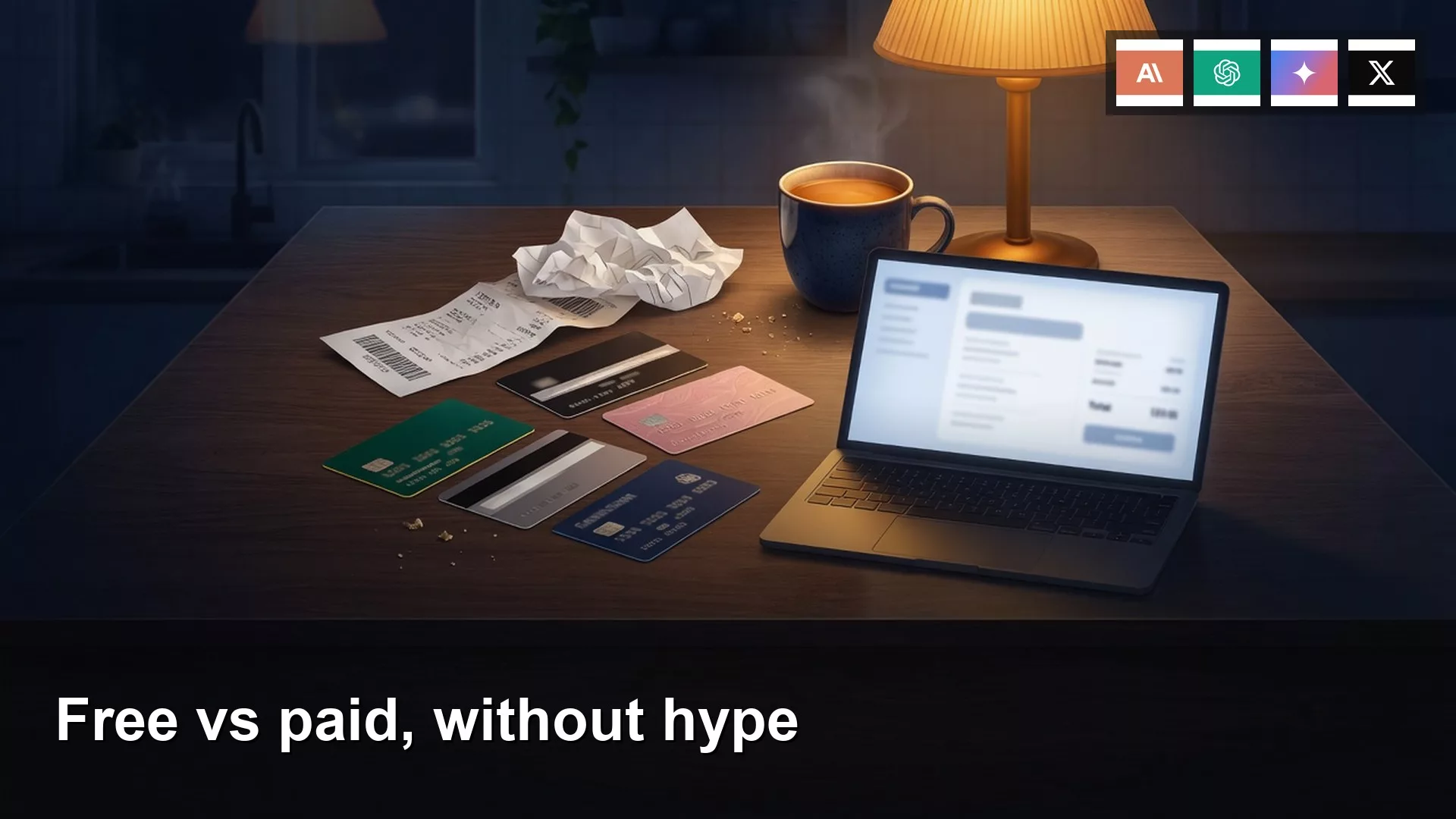
Picture your own credit card statement for one Thursday with three lines on it: $20.00 OPENAI *CHATGPT, $20.00 ANTHROPIC, and $19.99 APPLE.COM/BILL. You thought you had two AI tools. You did not. In fact you have ChatGPT Plus, Claude Pro bought on the web, and a second Claude Pro billed through your personal Apple ID after a late-night tap inside the iPhone app. That comes to $59.99 a month. Then your finance team asks which of these is the work one. You signed in with your Gmail on the website and with your Apple ID in the app, so they are not the same bill, they do not share a refund path, and neither is a work contract.
This is the first post in a short series on AI setup from zero, and it follows the chooser in Which AI product should I use?, which told you which product to open. This series covers the unglamorous part, which is accounts, cards, and Free versus paid, without a shopping spree. Plan names and prices move around, so the numbers below come from vendor help and pricing pages checked in August 2026. Confirm them on the vendor’s page the week you click Buy.
One account, one job family
Signing up is like getting a key cut, so use the email address you will still have in a year. If the writing is for customers, that means the work email, or your company’s single sign-on (one company login that opens many tools) when IT offers it. “Sign in with Google” is convenient, but it glues the chat to that Google account. If that Google account holds your personal photos, you have just mixed a work message into a personal identity. A later post in this series goes deeper on personal versus work accounts, and for now the rule is to pick the identity before you pick the plan.
You do not need four accounts to learn. The chooser’s default for writing is a single chat box, so open that one vendor and stay there for 30 days. Every extra product brings a second identity, a second card, and a second privacy policy. Suppose you opened three of them because a group chat said “they all hit limits.” You had not hit a limit, and what you had hit was indecision. That is common.
Rule of thumb: The email on the account is the legal person in the room, so do not sign in to a work draft with a shopping Gmail.
Free versus paid, without hype

Free is a real product, not a trap. ChatGPT has kept a Free plan with everyday text chat on a lighter model family whose name changes from time to time. Claude Free lets you chat on the web and in apps within caps, and Gemini and Grok both have Free plans as well. The catch is that you get message caps, slower image tools, and “come back later” notices. That cost is fine for a first job such as drafting a thank-you note, which the earlier post on AI for writing and questions walked through in plain steps.
Paid is not a personality transplant. It mostly gives you more, such as more messages in a rolling window, access to heavier models, and sometimes extra tools. Claude’s pricing page is unusually clear about this: at the August 2026 check, Pro was $20 a month, or $17 a month if you pay $200 for a year up front, and it included Claude Code, Cowork, Design, and Science. Max started around $100 for five or twenty times Pro usage. ChatGPT’s public ladder had Free, Go at about $8 in the US, Plus at $20, and a higher Pro or Max-style plan that vendors keep renaming, which has run from $100 to $200 depending on the multiplier. Gemini often hides inside Google One or Workspace, and Grok’s paid plans live under SuperGrok and X Premium. Please re-check all of it. Do not memorize this paragraph as a contract.
| Plan level (typical) | Ballpark, checked August 2026 | Buy it when | Skip it when |
|---|---|---|---|
| Free | $0 | You are learning your first 20-minute session | Never skip it for your first week |
| Cheap paid (Go-style) | ChatGPT Go, about $8 in the US | Free caps get in the way and you only write | You actually need Code, Cowork, or a team admin |
| Everyday paid | Plus or Claude Pro, about $20 monthly | You use it daily, want extra tools, and want fewer “come back later” notices | You have not used the Free plan for a week |
| Heavy or team | Max, higher Pro plans, or Team seats | You run agents all day, or need single sign-on and central billing | You just wanted a nicer thank-you note |
Claude Code and Cowork on Pro are the kind of paid feature that matters. Suppose you want a coding agent, which the earlier post on AI for coding and building software describes, and you only have Claude Free. The agent may simply be locked. That is a reason to pay one vendor, and not four. If you only write emails, then Free or a Go-style plan is the honest buy.
Three payment routes

The $19.99 Apple line in the opening story is the whole lesson. The iPhone Claude app offered an in-app Pro plan, and Apple billed it, even though the website already had Pro on a Visa. That is two merchants for one product. It happened because nobody opened Settings. Refunds on App Store purchases go through Apple, and Anthropic’s help form cannot reverse them. Work expense tools also dislike APPLE.COM/BILL, because that label could be anything.
Here is the rule for a first paid plan. Buy it on the website while logged in to the account you plan to keep, unless your company forces you to use device management software on phones. Then write the merchant name on the 10-line team note from the earlier post on trying an AI product first.
The third route is the API console, which is where developers buy usage for software they are building. Chat subscriptions and token wallets do not share a purse, and xAI says plainly that money spent on grok.com is not the same as credits on console.x.ai. OpenAI and Anthropic work the same way. If someone on the team pastes a key into a plugin, you get a surprise usage invoice. That is not “Plus failed,” because it is a different product. Keys belong in environment variables (private settings on a computer or server) and never in a chat.
A 15-minute first setup
- Pick one vendor from the chooser (for writing, that is ChatGPT or Claude), and close the other tabs.
- Create the account or log in with the work email if the work is for work. Skip “Sign in with Apple” if finance will need a normal receipt.
- Use Free for seven real tasks. If you never hit a cap, do not pay.
- If you do pay, pay on the website, then screenshot the plan name and the renewal date and put both in the team note.
- Turn off any second subscribe button in the iOS or Android app, because the extra $19.99 charge in our story lived there.
Here is a checklist you can paste into that note:
Setup (one vendor)
Account email: [work address]
Sign-in method: [email+SSO / Google work / not personal Apple]
Plan: Free until [date], then [Plus or Pro] on the WEBSITE
Merchant on the card: [OPENAI / ANTHROPIC / ...]
App Store subscribe: OFF
API keys: none, unless we are actually shipping an app
Owner: [your name]
Cancel path: Settings > Billing (web), not the App Store, unless we bought there on purpose
The checklist works because it names the payment route before the charge happens. If the merchant on the card turns out to be Apple, you already know that refunds and expense reports will be annoying, so fix it before the second month.
Worked example: $59.99, two products, three charges
| Line on the Visa | What you thought | What it was |
|---|---|---|
| $20.00 OPENAI *CHATGPT | A Plus plan for work | A Plus plan on your personal Gmail |
| $20.00 ANTHROPIC | The one Claude plan | Web Pro on a second email address |
| $19.99 APPLE.COM/BILL | A one-time app purchase | A duplicate Claude Pro billed through your Apple ID |
The fix goes in a specific order. First, cancel the Apple subscription in Apple’s own subscription list, because the vendor’s site cannot always see it. Second, decide on one email address. Third, move Plus or Pro onto that email on the website. Finally, expense the one remaining $20 if your policy allows it. Do not add a paid Gemini plan “to compare” this month, because Google may already be included in your Workspace, so check with IT before adding a fourth card.
If you only write, you could drop to Free or to ChatGPT Go (about $8 in the US at the August 2026 check) after your 30-day test. If you need Claude Code, keep Claude Pro and let ChatGPT go. Paying is a decision about which features you need, and it is not a loyalty program for a brand.
Bundles, trials, and taxes
Trials convert to paid plans automatically, and SuperGrok, ChatGPT, and Claude have all offered them, so put a calendar reminder on day five. Taxes sit on top of the sticker price. An annual plan looks cheaper, but it is a bigger miss if you picked the wrong product. Claude Pro annual was $200 up front at the August 2026 check, which is a lot of thank-you notes to prepay when you still do not know whether you wanted Code.
Workspace, Microsoft 365 Copilot, and X Premium are bundles. If IT already pays for one, your personal Plus plan may be duplicate capacity, so ask before you buy. A later post in this series covers two-factor sign-in (a second check, such as a code on your phone) and account recovery. Turn on two-factor sign-in today anyway. A $20 plan sitting behind an unlocked inbox is a cheap way in for someone else.
Common mistakes
- Paying four vendors before you hit a cap on one.
- Buying Pro in the iPhone app when the website already has Pro.
- Assuming that Plus also pays the API bill.
- Using a personal Apple ID for a work seat, then asking finance to expense APPLE.COM/BILL.
- Skipping the Free week because a tweet said paid is required.
- Buying Max or a $200 Pro plan because the $20 plan said “come back later” once.
How to practice this week
Open one account and screenshot the email address and the plan name. If you already have three charges like the ones above, cancel the App Store duplicate first. The next post in this series compares browser, mobile, and desktop apps, and the chooser stays at which product to pick. If what you really wanted was local versus hosted open models, that is the topic of a different post, and it is not a reason for a fourth $20 subscription.
Quick recap
- Use one email, one vendor, and start with Free.
- A paid plan at about $20 buys higher limits and sometimes Code and Cowork, so confirm the details live.
- Website billing, App Store billing, and the API wallet are three separate receipts.
- A $19.99 Apple charge next to a $20 Anthropic charge is how you pay twice for one Pro plan.
Series notes
This is Part 7 of Phase P and Part 1 of AI setup from zero. The chooser it builds on lives in Which AI product should I use?.
Sources
- OpenAI: ChatGPT plans (Free, Go, Plus, Pro; US prices checked August 2026)
- Anthropic: Claude pricing (Free, Pro $20 monthly / $17 annual, Max, Team)
- Google Gemini and Workspace / Google One plan pages (bundles move)
- Grok and xAI plan pages (SuperGrok / X; re-check)
- Analytics Made Simple: Which AI product should I use?
- Apple: subscriptions and billing (when the merchant is APPLE.COM/BILL)
Keep going
Same lessons in your feed
Short diagrams, hooks, and weekly tutorials on Substack, Instagram, X, and Facebook.