Gemini 4 Hydrogen is Google’s new fast AI model for everyday work, and since November 12, 2026 free Gemini users get it some of the time, whenever the app decides it suits the question, according to Google’s announcement. If you want to choose it yourself every time, the cheapest way is Google AI Plus at $4.99 a month in the US.
Imagine you use the free Gemini app every day to tidy up emails, summarise reports and plan your week. A friend tells you the new model is much better and that you should pay for it. You open the subscriptions page and find four plans, three model names that sound like a chemistry lesson, and usage limits described in multiples instead of numbers. What you want to know is simple: what changes for you if you stay on the free plan, and what $4.99 a month would actually buy.
This guide explains what Hydrogen is, how it fits with Google’s other Gemini 4 models, what each plan gets, and a one-week test that tells you whether to pay. If you are weighing the $19.99 Google AI Pro plan instead, our post on Gemini 4 Argon and Google AI Pro covers that step up.
What kind of model is Hydrogen?
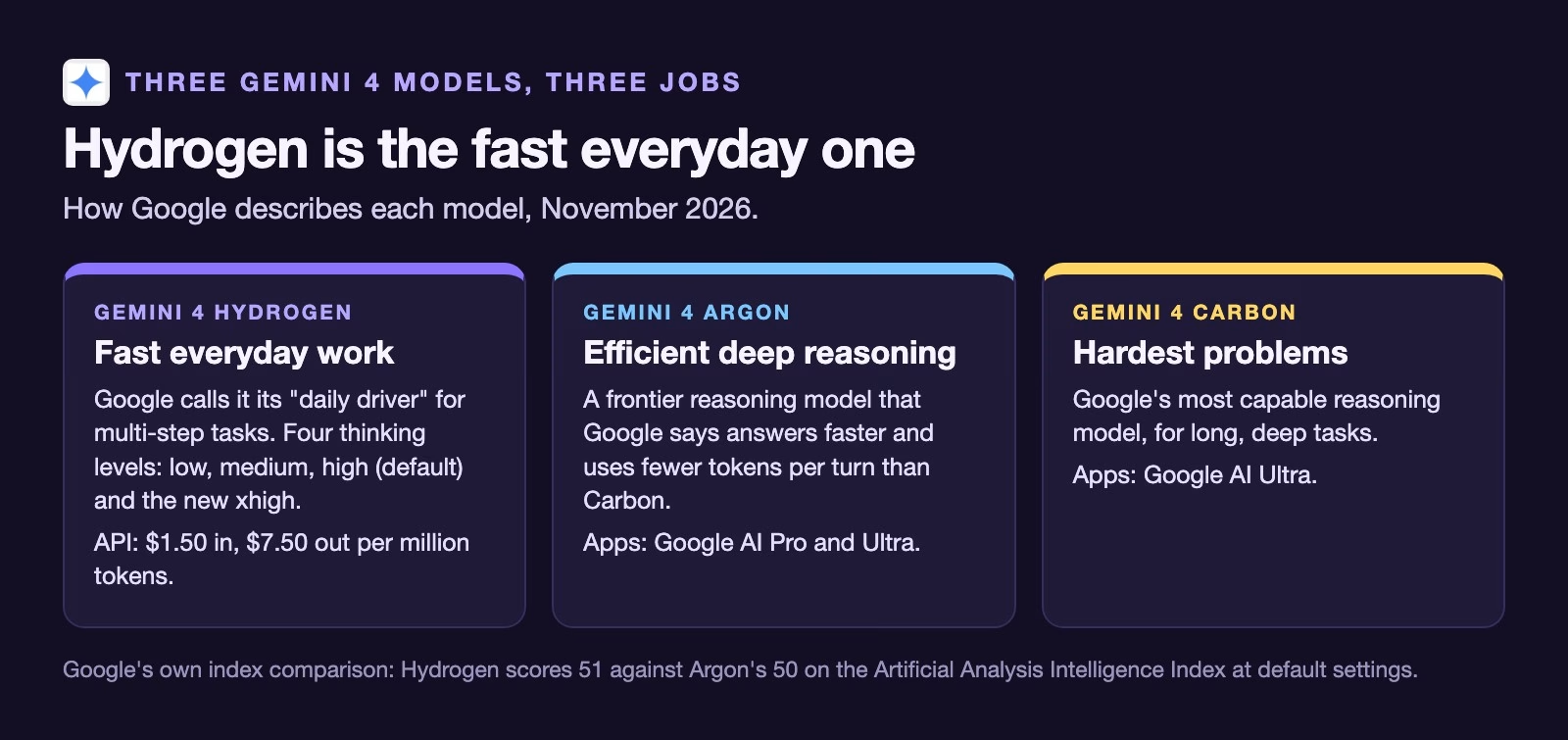
Hydrogen is the fast, low-cost member of Google’s Gemini 4 family, built for everyday tasks rather than the hardest problems. Google’s launch post, dated November 12, 2026 and updated the next day, calls it a “daily driver” for agentic work. Agentic work means tasks where the AI takes several steps on its own, such as searching, reading and then drafting, instead of giving one reply.
Google’s two other Gemini 4 models are built for deep reasoning. Gemini 4 Argon is the efficient reasoning model, and Gemini 4 Carbon is Google’s most capable one, according to the Gemini API pricing page (checked November 15, 2026). Reasoning models spend more time thinking before they answer, which helps on hard maths, long analysis and tricky code, and costs more.
How fast and how good, by Google’s numbers
Google’s launch post says Hydrogen finishes tasks 2.5 times faster than Gemini 3.8 Flash, the fast model it replaces, at its default setting. It also cites the Artificial Analysis Intelligence Index, an independent score that combines many tests, with Hydrogen at 51 against Argon’s 50 at default settings. Google chose and published these comparisons, so treat them as a reason to try it, not as proof for your own work.
Hydrogen has four thinking levels, low, medium, high and a new extra-high, according to the same post. A thinking level sets how long the model works through a problem before answering. Higher levels are slower and, through the API, cost more because the thinking counts as output.
What changes for free Gemini users?
Free users get Hydrogen only when the Gemini app picks it for them. Google’s launch post of November 12, 2026 says free users “will get access” through auto model selection “when it’s the appropriate model for the prompt”. Auto model selection means the app chooses which model answers each message, based on what you asked.
So on the free plan you cannot choose Hydrogen and count on getting it every time. Some answers will come from Hydrogen and others from a lighter model. The Gemini subscriptions page (checked November 15, 2026) lists the free plan’s own model as Flash-Lite, along with Deep Research, Canvas, Gemini Live and 15 GB of storage.
Google Search gets Hydrogen too. The launch post says it is upgrading Search “for all users globally” with the new model. That reaches you whether or not you open the Gemini app.
What each plan gets
The paid plans differ in which models you can pick, how much you can use them and how much storage you get. The Gemini subscriptions page showed these US prices and features when we checked on November 15, 2026.
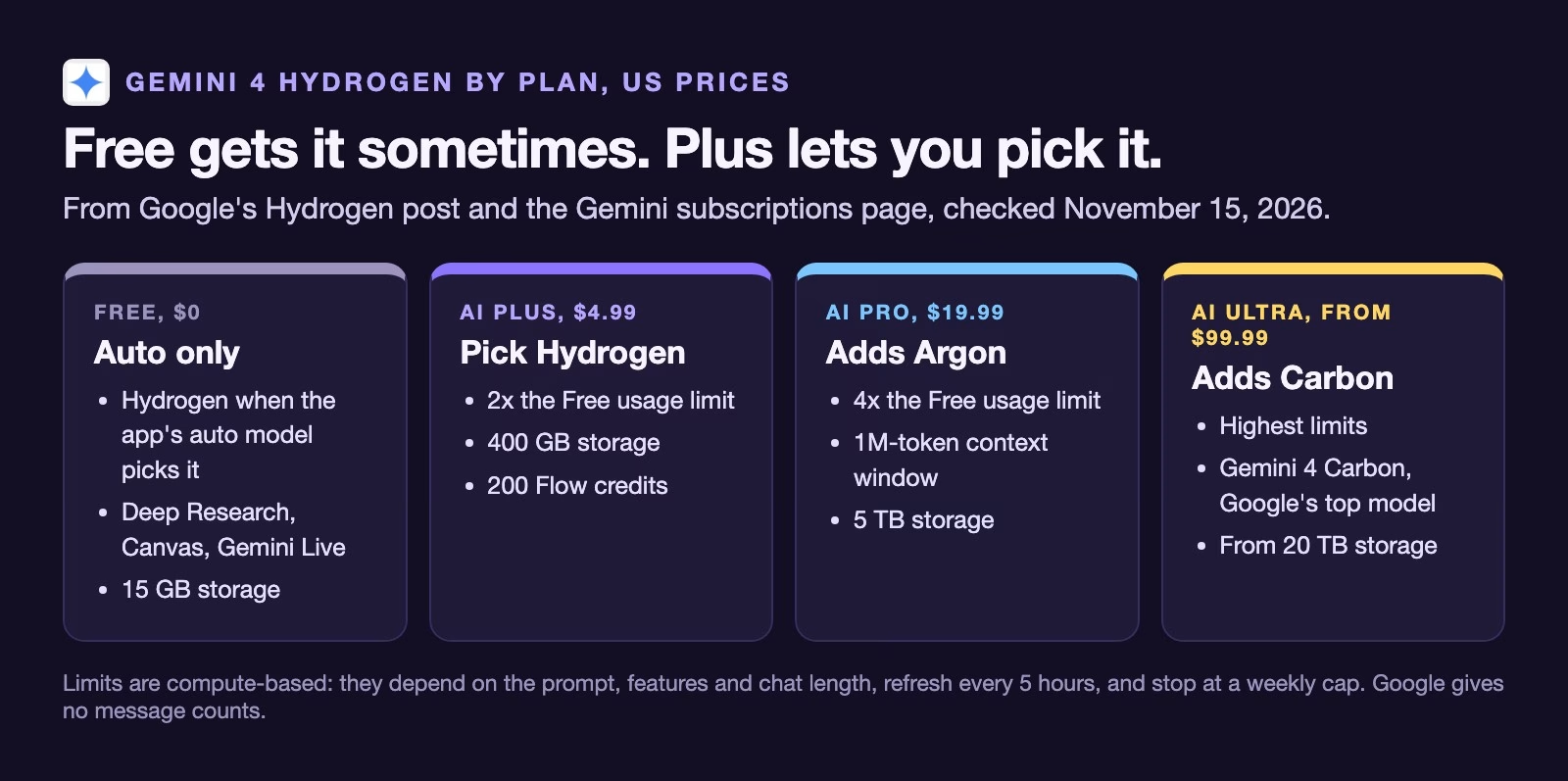
- Google AI Plus, $4.99 a month on the subscriptions page (November 15, 2026): lets you pick Hydrogen, gives about twice the free plan’s usage, 400 GB of storage and 200 credits for Google Flow, Google’s video tool.
- Google AI Pro, $19.99 a month on the same subscriptions page (November 15, 2026): adds Gemini 4 Argon and a 1-million-token context window, gives about four times the free usage and 5 TB of storage. A token is a chunk of text about three-quarters of a word long, so the context window is how much the model can read at once.
- Google AI Ultra, from $99.99 a month on the same subscriptions page (November 15, 2026): adds Gemini 4 Carbon and the highest limits, with at least 20 TB of storage.
How the usage limits work
Google does not publish message counts. The same subscriptions page (checked November 15, 2026) says limits are “compute-based”, which means they depend on how complex your prompt is, which features you use and how long the chat runs, and that they refresh every five hours until you reach a weekly cap. A long chat with big files uses up the allowance faster than a few short questions.
That makes “twice the free usage” hard to turn into a number. The test later in this guide gets you a real answer for your own habits.
When is the cheapest paid plan worth it?
Plus is worth it if you keep running into the free plan’s limits or you want Hydrogen for every answer, not just the ones the app picks. If neither happens to you, the free plan already gives you Hydrogen some of the time and Search gives it to you everywhere.
Three situations make the case for paying:
- You hit limits. If the free app tells you to come back later more than once a week, doubling the allowance is the cheapest fix.
- You need consistent answers. If you use Gemini for the same kind of work every day, such as drafting client emails, you may prefer the same model each time instead of whatever auto selection picks.
- You need the storage. Plus includes 400 GB of Google storage. If you were going to pay for extra Drive space anyway, Gemini comes along with it.
Pro at $19.99 makes sense when you need the deeper reasoning model or very long documents. If you are comparing Google AI Plus with Pro, they solve different problems: Plus buys more of the fast model, while Pro buys a smarter one.
A worked example: the daily email and report routine
Let’s go back to the daily routine from the start: tidying up emails, summarising reports and planning the week, all in the free app. Say you send about ten requests a day, most of them short, plus two long reports a week that you paste in whole.
On the free plan the short requests rarely cause trouble. The long reports are where the compute-based limit bites, because a big pasted document in a long chat uses far more of the allowance than ten short emails. If the app asks you to wait on report days, that is the signal that the limit, not the model, is your problem.
In that case Plus is a straightforward trade: $4.99 a month for roughly twice the allowance and the option to pick Hydrogen for the reports. If the report summaries also miss figures that matter, though, more of the fast model may not fix it. That is the point to try Pro’s deeper reasoning model on the same two reports before paying four times as much.
A one-week test before you pay
Use one week of your own work to decide, instead of the launch claims. You need the free app and, for a few days, a Plus account; check the subscriptions page for any trial offer in your country.
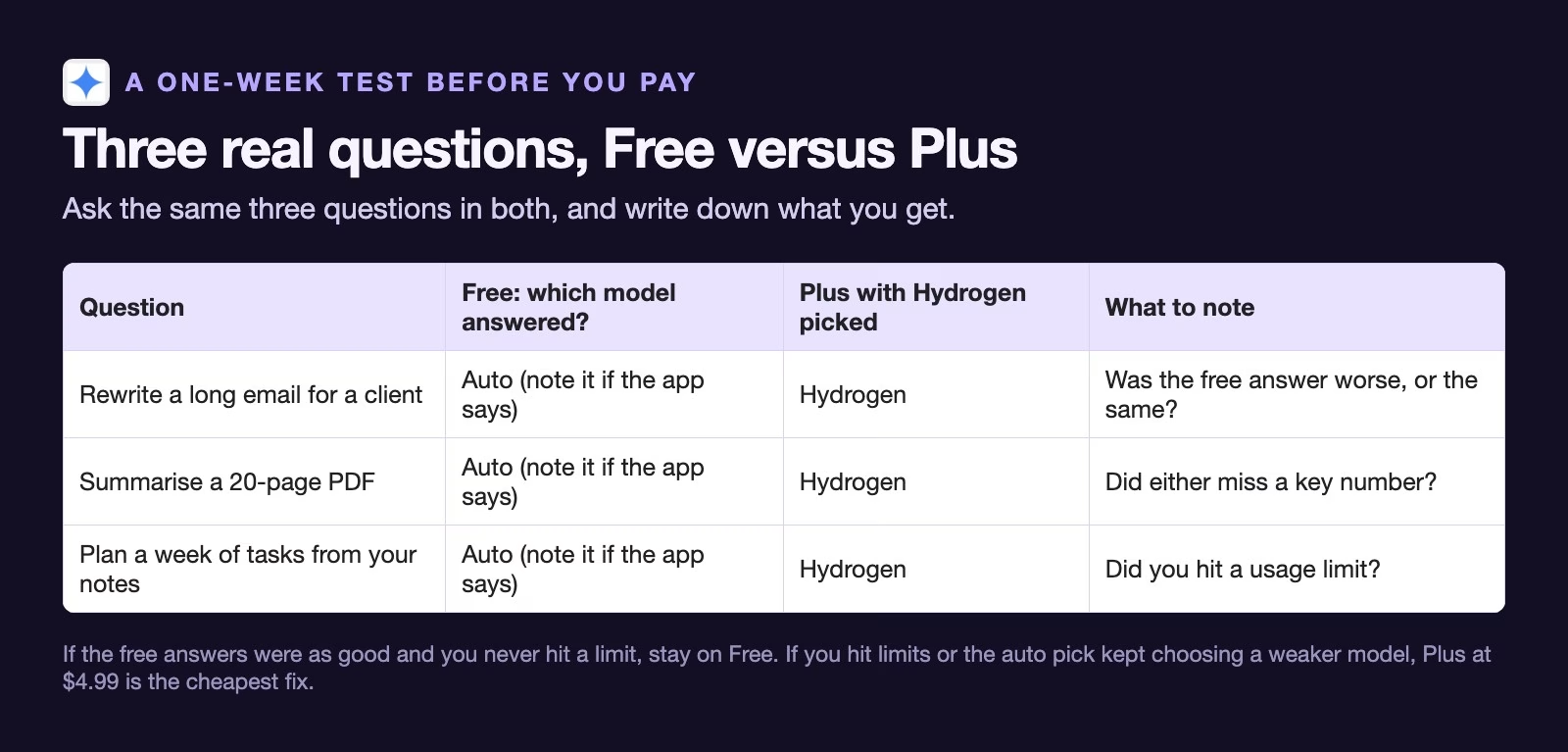
- Pick three questions you really ask, such as rewriting a long client email, summarising a 20-page PDF and planning your week from your notes.
- Ask each one on the free plan and save the answer. If the app shows which model replied, write it down.
- Ask the same three on Plus with Hydrogen picked, and save those answers too.
- Compare them side by side. Did the free answer miss a number from the PDF? Was the email noticeably better on Plus?
- Count the limit messages you got during the week on the free plan.
If the free answers were just as good and you never hit a limit, stay free. If the free plan stopped you, or its answers were clearly weaker on your real work, Plus at $4.99 is the smallest step that fixes it.
Using Hydrogen through the API
Developers can call it as gemini-4-hydrogen through the Gemini API, the service programs use to talk to Gemini directly. The Gemini API pricing page (checked November 15, 2026) lists it at $1.50 per million input tokens and $7.50 per million output tokens on the paid tier, with thinking tokens counted as output, and free of charge on the free tier.
| Gemini API, per million tokens | Input | Output (includes thinking) |
|---|---|---|
| Gemini 4 Hydrogen, paid tier | $1.50 | $7.50 |
| Gemini 4 Hydrogen, Batch | $0.75 | $3.75 |
| Gemini 4 Hydrogen, free tier | Free | Free |
Two notes for anyone building with it. The free tier’s data can be used to improve Google’s products, while the paid tier’s is not, according to the same pricing page. And Hydrogen reads up to 1 million tokens at once and can write up to 1 million, at the same price across that whole window, per Google’s launch post.
Common mistakes
- Paying to get Hydrogen when you only use Search, since Search already uses it for everyone.
- Expecting Hydrogen every time on the free plan, when auto selection decides which model answers.
- Reading “twice the usage” as twice the messages, when the limits depend on how heavy each chat is.
- Buying Pro for speed, when Pro’s extra is a deeper reasoning model, not a faster one.
- Judging from one question, when three real tasks over a week tell you far more.
Try it this week
- Ask the free Gemini app your three most common work questions and save the answers.
- Note every time the app tells you that you have reached a limit.
- If you hit limits, try Plus for a few days and ask the same three questions with Hydrogen picked.
- Compare the answers blind, without looking at which plan made which.
- Decide: stay free, take Plus for more of the fast model, or read the Pro guide if you need deeper reasoning.
Quick recap
- Gemini 4 Hydrogen launched on November 12, 2026, as Google’s fast everyday model.
- Free users get it only when auto model selection picks it.
- Google AI Plus at $4.99 a month lets you pick it and roughly doubles your usage.
- Pro at $19.99 adds the Argon reasoning model and a longer context window.
- Usage limits depend on how heavy your chats are and reset every five hours.
- Test three real tasks for a week before you pay.
Sources
- Google: Introducing Gemini 4 Hydrogen (November 12, 2026, updated November 13; free access through auto selection, Search, speed and index claims, thinking levels, 1M-token window)
- Google: Gemini subscriptions (Free, Plus, Pro and Ultra US prices, features and compute-based limits; checked November 15, 2026)
- Gemini API pricing (gemini-4-hydrogen prices, free tier, Batch, data use; Argon and Carbon descriptions; checked November 15, 2026)
- Gemini app on X (rollout announcement, November 12, 2026)
Keep going
Same lessons in your feed
Short diagrams, hooks, and weekly tutorials on Substack, Instagram, X, and Facebook.