Elena started the CUDA installer at 4:12pm because a tutorial promised she could “try Llama” on the office ThinkPad. Seventy minutes later the toolkit still wanted a newer driver, nvcc was missing, and the thank-you for aisle 4 sat at nine lines in Notes. She had not opened a chat box. The warehouse lead wanted the note before Thursday.
This is OS8, Part 1 of Run open models from scratch. The map series Open-source AI explained already split location in OS2: hosted GPUs versus a file on your disk. This series starts in a browser chat, because that is the finishable path if you wanted Llama, Qwen, or DeepSeek-class weights without an installer. Next is OS9, friendly desktop runners from zero. Privacy still lives in OS4 and the paste test in P4. Groq (the inference company, spelling with a q) is not Grok (xAI’s product).
Start hosted if you just needed a reply
- Why a hosted chat UI beats a CUDA install for a first conversation with open weights
- Which boxes to open as of writing (August 2026): Groq playground, Together Chat, Fireworks playground, HuggingChat
- A 15-minute first session: account, one named model, one public task, then retention
- That this still leaves the building, even when the badge says Llama
- When to stop and wait for OS9 instead of compiling llama.cpp tonight
Skip the installer if you only need a chat
She wanted the nine lines to sound less stiff than the Notes draft. Someone on the team had said “use Llama, it’s open.” She searched “run Llama locally CUDA” and landed in a stack that assumes you are building an engine: NVIDIA driver, CUDA toolkit, maybe cuDNN, then llama.cpp or a 70B GGUF. That path is real. It is also how a 4:12pm start becomes 5:22pm with no paragraph.
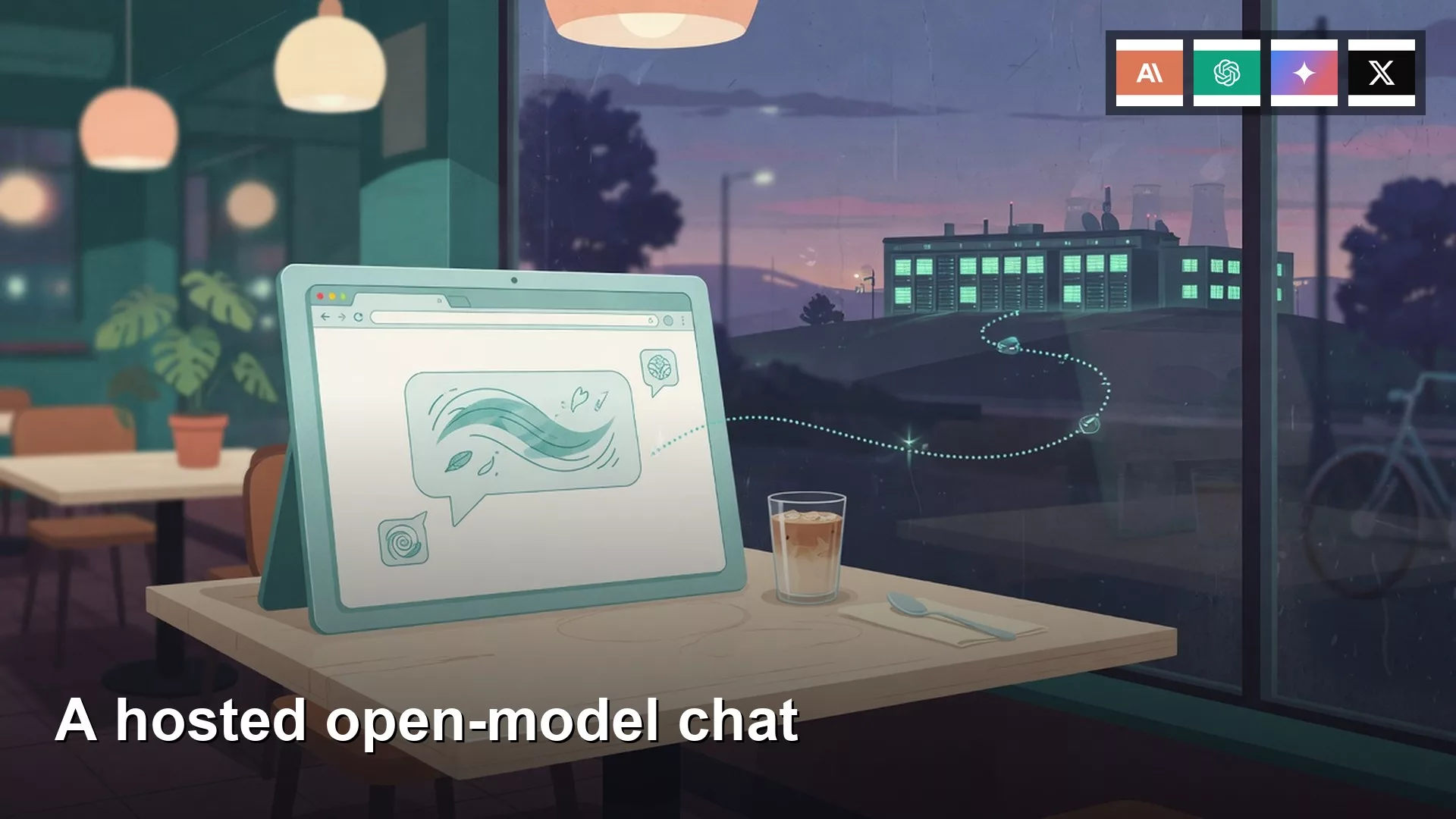
A hosted open-model chat UI is a website that already loaded those weights on someone else’s GPUs. You sign in, you pick a named model, you type. You pay with an account, a rate limit, and a prompt that left the building. If that trade is acceptable, do that first. Do not start with llama.cpp. llama.cpp is the engine under a lot of local apps. OS9 will put a window on it. Tonight you need a box with a send button.
If the job is a public thank-you, the chooser would also have sent her to a closed $20 chat. This series exists because she asked for open weights by name.
Rule of thumb: If you cannot point at a chat box in 15 minutes, you picked the wrong first tool. Installers come after you know you need a machine of your own.
Hosted chat vs a download

OS2 split location. This page picks the hosted door. Hosted chat is the same weights you could download, served in a browser. A download is Ollama, LM Studio, or llama.cpp plus a file that lands in RAM.
| Question | Hosted chat UI | Download to your machine |
|---|---|---|
| What you install | A browser account on Groq, Together, Fireworks, HuggingChat, or a vendor chat that lists open weights | Ollama, LM Studio, or llama.cpp, plus a GGUF or similar |
| First 15 minutes | Sign in, pick one named model, send one public prompt | Drivers, a multi-GB file, a RAM check, then maybe a reply |
| Where the prompt goes | Their GPUs. Read retention the same day. | Your RAM, if you stay offline and you do not flip a cloud toggle |
| Speed on a big model | Usually fast, because the host bought the hardware | Often slow on a laptop. Elena never got that far. |
| When it is the right door | You want Llama/Qwen/DeepSeek-class chat today, and the text may leave | The text must stay, or you already committed to one local stack |
Ken in OS2 watched a 4.7 GB download for 41 minutes, then used a cloud id in the same app. Elena never even reached the download. Llama is a weight family, not a place. Write the host on the sticky note, then the model id.
Who these chat boxes belong to
As of writing (August 2026), four doors cover a first session. Product names move. Re-open the host’s site the week you click.
Groq playground
Groq sells fast inference on its own chips. The try-it UI is the GroqCloud Playground at console.groq.com/playground. Sign in with Google, GitHub, or email. Pick a model from the list. Groq’s public console, as of late August 2026, still showed GPT OSS 20B and 120B, Qwen 3.6 27B, and Llama 3.3 70B on some surfaces. Docs also told free and developer users to migrate off llama-3.1-8b-instant and llama-3.3-70b-versatile after 16 August 2026. Copy the id in the picker that day. Groq’s legal pages also name GroqChat at chat.groq.com. That is still Groq the host.
Together Chat and playground
Together AI runs a large catalog of open models. For a ChatGPT-shaped window, Together Chat at chat.together.ai is the consumer app. Together’s own posts in 2026 still pointed people there to try new weights (Kimi K3 was one example in August) with no API setup. For knobs and “give me the curl,” use the developer Playground at api.together.xyz/playground. Either one is hosted.
Fireworks playground
Fireworks AI is the other big GPU rental desk with a model library you can click. Open a model page (DeepSeek V4 Pro 0813, GLM 5.2, Qwen 3.8 27B, and friends were on the public library in August 2026) and use the playground from there. Pick a serverless model, type, watch the reply. This post stops at the send button.
HuggingChat and other vendor chats
HuggingChat is Hugging Face’s chat for open models. The current default is Omni: it routes your prompt to some model in a large pool. For a first session, open the model list and pick one named id so you can write it down.
Labs sometimes wrap their own open weights in a branded chat (Qwen Chat, DeepSeek’s site). Those count if the picker names an open-weight model. Meta AI at meta.ai is the trap: as of 2026 the flagship assistant is not Llama in a browser. Llama weights still live on Groq, Together, Fireworks, HuggingChat, and downloads. If Elena wanted Llama, Meta AI was the wrong tab.
For 15 minutes, pick one host so you can name it in a sentence. OpenRouter can wait; it is a switchboard, not a first chat box.
Fifteen minutes, one named model

Set a 15-minute timer. One host. One model. One public task.
- Open one playground (Groq, Together, Fireworks, or HuggingChat). Close the other tabs.
- Create the account. Do not start a second account “to compare.” Comparison is tomorrow.
- Pick one named model. Write the exact id on the screen (
qwen/qwen3.6-27bor a Llama/DeepSeek id the picker still shows). If the UI is Omni or Auto, switch it off so you can say the name out loud. - Send one real task that is allowed to leave. Elena’s aisle 4 thank-you is the right grain: public, short, no vendor NDA. Time the first reply. If you like it, you are done installing things today.
- Open the host’s data or privacy page before you close the laptop. Retention, training, zero-data-retention toggles, playground logs versus API logs. Write two sentences on the sticky note under the model id.
The prompt still leaves
A Llama badge on a Groq tab does not make the ThinkPad the computer. The prompt went to Groq. Together Chat’s “hosted in North America” line is a geography claim, not a local claim. Fireworks playground is Fireworks. HuggingChat is Hugging Face plus whichever inference provider Omni picked. OS4 is the map-series version of that sentence. P4 is still the paste test: would you email this PDF to that vendor.
Do not copy a blog’s privacy paragraph into a legal memo. Open the page. Groq’s public “Your Data” docs (as of writing, August 2026) say default inference is not retained except reliability and abuse logs up to 30 days, with a Zero Data Retention control in the console. Playground and consumer chats can keep more because the product is a conversation history. Together and Fireworks publish their own notes, and those notes change. Assume logs exist until the page you opened this week says otherwise. If the thank-you includes a name you would not put in Gmail, do not put it in Groq either.
Worked example: 70 minutes for nine lines
Elena’s thank-you, as it sat in Notes:
# First hosted session. Public toy only.
# Do this in a playground, or (optional) hit the Groq chat API.
# Never paste a live key into Slack, a ticket, or this file.
# In the shell only:
#   export GROQ_API_KEY="paste-your-key-here-in-the-terminal"

curl https://api.groq.com/openai/v1/chat/completions \
  -H "Authorization: Bearer $GROQ_API_KEY" \
  -H "Content-Type: application/json" \
  -d '{
    "model": "qwen/qwen3.6-27b",
    "messages": [
      {
        "role": "user",
        "content": "Rewrite this public thank-you in nine short lines. Keep aisle 4 and Thursday. Text: Thanks for the warehouse walkthrough. The slotting map on aisle 4 was the piece we needed. Attached is the one-pager. See you Thursday."
      }
    ]
  }'
What that curl is for: proof you can talk to a named open-weight model without a compiler. The playground does the same job with a send button. If the model id 404s, the host moved the list (Groq did that to older Llama ids in August 2026). Open the picker, paste the new id, keep the toy prompt. Prefer the UI checklist if you do not want an API key yet.
# First 15 minutes, no CUDA
# [ ] One host tab only (Groq / Together / Fireworks / HuggingChat)
# [ ] Account created
# [ ] Exact model id written down
# [ ] Prompt is public (would you email it to that vendor)
# [ ] First reply timed
# [ ] Retention page opened the same afternoon
# [ ] Sticky note: host name, model id, "leaves the building"
# Stop. Do not install llama.cpp today.| Clock | Elena (CUDA path) | Same thank-you in a hosted UI |
|---|---|---|
| 4:12pm | CUDA installer starts on the ThinkPad | Opens console.groq.com/playground, signs in |
| 4:18pm | Progress bar, driver warning in small type | Picks qwen/qwen3.6-27b (or the Llama id on screen), sends the nine lines |
| 4:20pm | Still installing | Paste, edit two adjectives, send the note |
| 5:22pm | nvcc missing, no chat box, 70 minutes gone | Retention page skimmed, sticky note written |
| Thursday | Warehouse lead still waiting, or she used Gmail after all | Thank-you already sent |
Dario, two desks over, did the hosted path in the time Elena spent reading the CUDA license screen. He still has to tell legal the host name if the next paste is an NDA. He did not owe anyone a GPU driver for a thank-you.
A hosted UI is still a vendor
- Installing CUDA “to try Llama” when a playground would have finished the job.
- Saying Groq when you mean Grok, or opening meta.ai and calling it Llama.
- Calling a Groq or Together tab “local” because the model name is Qwen.
- Letting Omni or Auto pick the model, then being unable to write the id on the sticky note.
- Pasting an NDA, payroll, or a customer list into the first session “because it is open source.”
- Starting llama.cpp on day one. That engine belongs after OS9, when you want a desktop runner.
One hosted open-model chat, no download
Pick one host. Run the 15-minute list on a public paragraph you already wrote. Put host, model id, and “leaves the building” on one sticky note. If the reply is good enough, stop. If you need the prompt to stay on the ThinkPad, wait for OS9 and skip the CUDA detour. Location recap: OS2. What “open” meant: OS1. More paths: Learn.
The easy door is still a company
- Want Llama/Qwen/DeepSeek-class chat with no install: hosted UI first.
- Account, one named model, one public task, retention page. Fifteen minutes.
- Groq ≠ Grok. Llama in the badge ≠ on your disk.
- Do not start with llama.cpp. Desktop runners are OS9.
Sources
- Groq (inference cloud; not xAI Grok) and GroqCloud Playground
- Groq model list and Groq: Your Data (retention as of writing)
- Together AI, Together Chat, and Together Playground docs
- Fireworks AI and Fireworks inference intro (model playground)
- HuggingChat
- llama.cpp, Ollama, and LM Studio (later in this series, not today)
- AMS OS2: hosted vs download and AMS P4: privacy paste test
Keep going
Same lessons in your feed
Short diagrams, hooks, and weekly tutorials on Substack, Instagram, X, and Facebook.
Merch on Etsy
Open store → You're On Mute White Ceramic Coffee Mug, Data Science Mug, Data Mug, Analytics Mug, Statistics Mug, Programming Mug, Gift Mug, Coffee Mug
View on Etsy →
You're On Mute White Ceramic Coffee Mug, Data Science Mug, Data Mug, Analytics Mug, Statistics Mug, Programming Mug, Gift Mug, Coffee Mug
View on Etsy →
 Boxplot Mouse Pad, Data Science Mouse Pad, Analytics Mouse Pad, Box Plot, Whisker Plot
View on Etsy →
Boxplot Mouse Pad, Data Science Mouse Pad, Analytics Mouse Pad, Box Plot, Whisker Plot
View on Etsy →
 Imbalanced Classes Mouse Pad, Data Science Mouse Pad, Analytics Mouse Pad, Imbalanced Mouse Pad
View on Etsy →
Imbalanced Classes Mouse Pad, Data Science Mouse Pad, Analytics Mouse Pad, Imbalanced Mouse Pad
View on Etsy →
 Mute Mouse Pad, Data Science Mouse Pad, Analytics Mouse Pad, You're On Mute
View on Etsy →
Mute Mouse Pad, Data Science Mouse Pad, Analytics Mouse Pad, You're On Mute
View on Etsy →