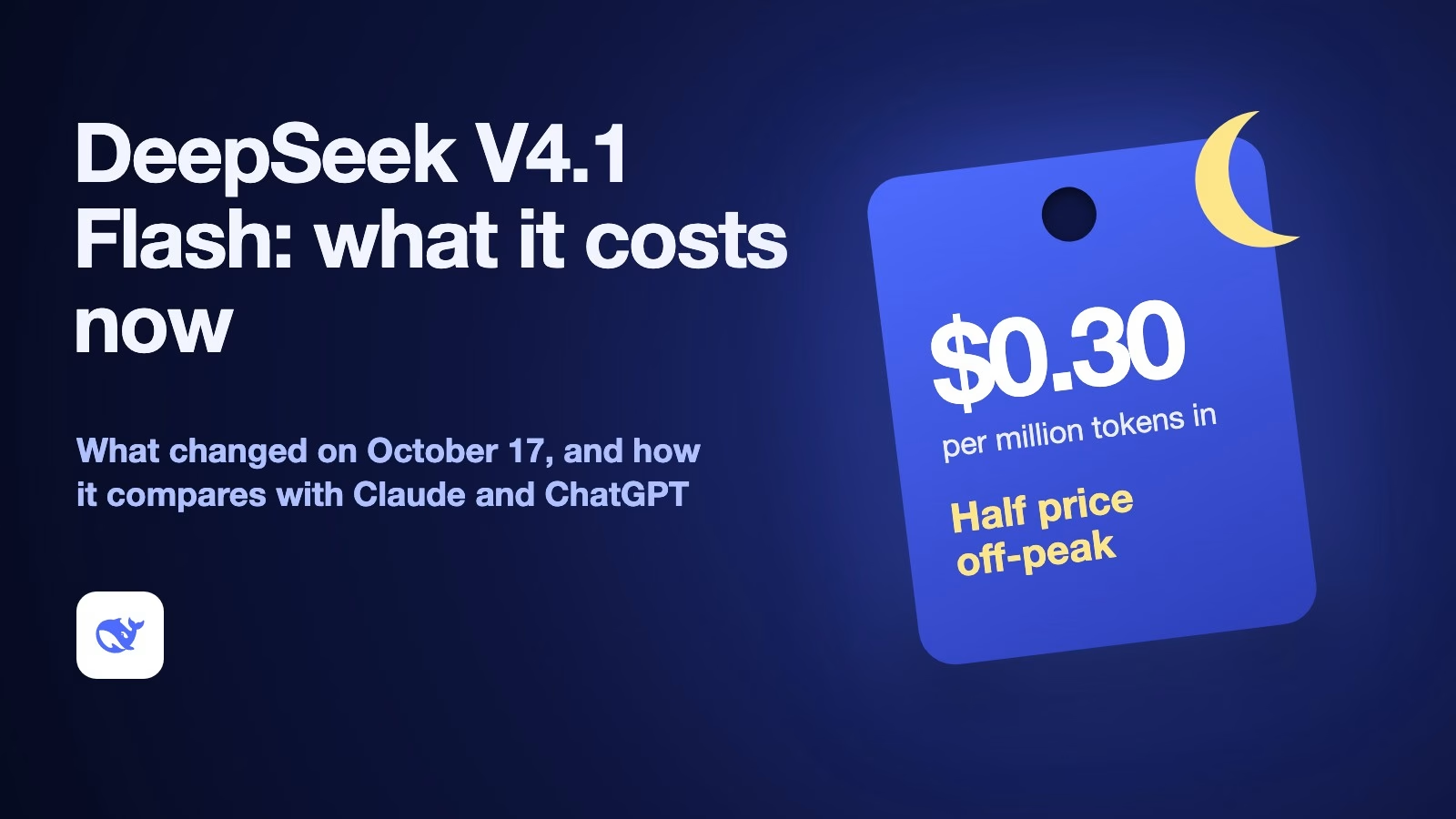
DeepSeek V4.1 Flash, the newest model from the Chinese AI company DeepSeek, is a capable and inexpensive choice for coding and multi-step work, but it is no longer the cheapest small model you can buy. Its real advantages, according to DeepSeek’s pricing page (checked October 19, 2026), are a half-price rate that covers the whole American working day, and its open weights: DeepSeek lets anyone download the model files themselves, so a company can run it on its own servers.
Imagine you set up a small tool last spring that sends contracts to DeepSeek and gets back a short summary. It worked, it was cheap, and you stopped thinking about it. Then you read that DeepSeek released a new model over the weekend, and you wonder whether your tool changed, whether it now costs more, and whether something newer from Claude or ChatGPT would be a better deal. You want the answer in numbers, not adjectives.
If DeepSeek is new to you, the guide to what DeepSeek is covers the company and its apps first.
This guide covers what DeepSeek changed on October 17, 2026, what one task costs on it next to the Claude and ChatGPT models people compare it with, when the discount applies, how to read its test scores, and a short test to run before you decide.
The October 17 update and the four changes that matter
DeepSeek released V4.1 Flash 1017, a minor update to the V4.1 Flash model it launched in September. The “1017” is simply the release date, October 17. According to DeepSeek’s release note, the update is live on its website, its phone app and its API, which is the service programmers use to connect their own software to the model.
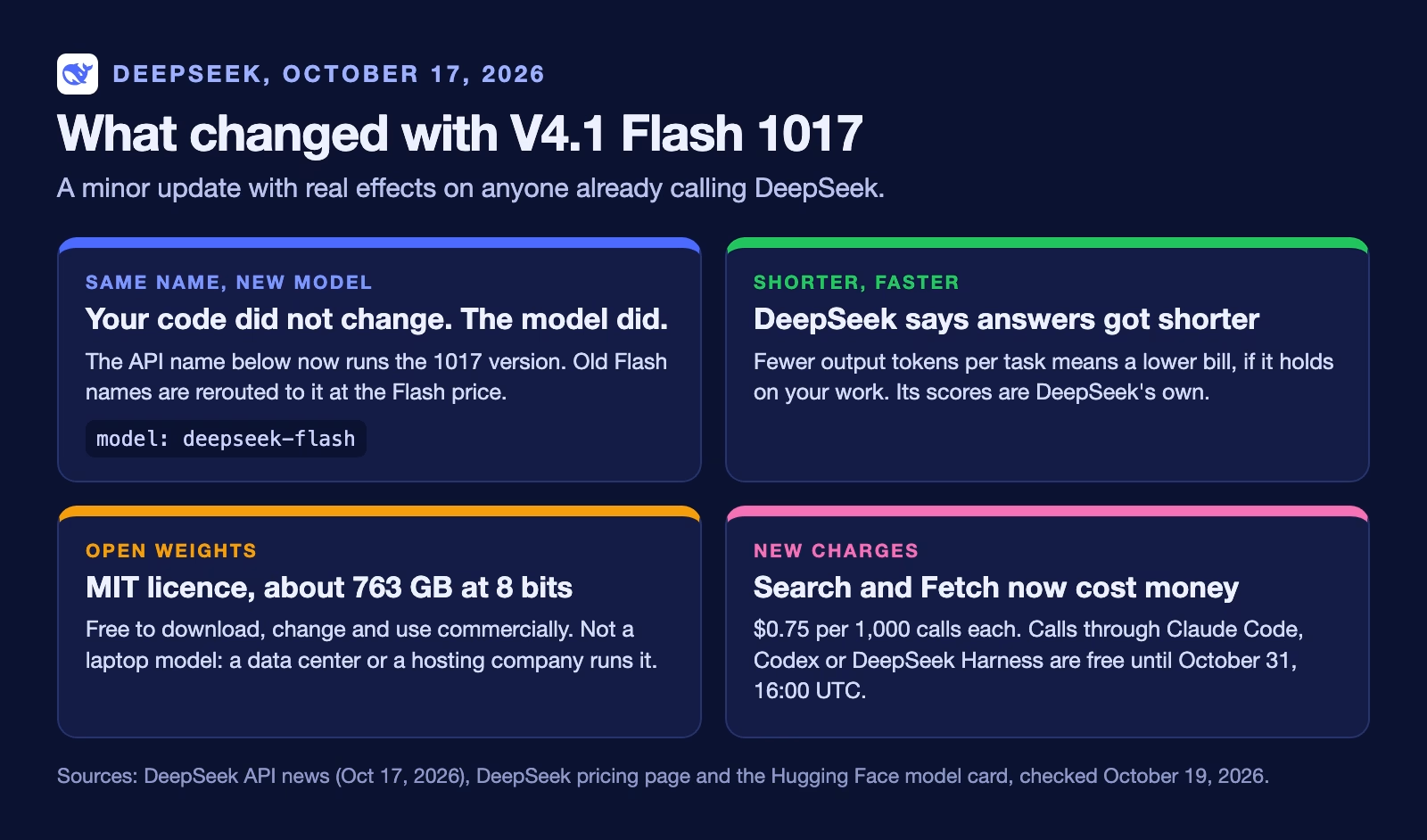
Four changes matter for most readers.
The model behind the name changed. Programs ask for a model by name. DeepSeek’s pricing page (checked October 19, 2026) says the name deepseek-flash now runs V4.1 Flash 1017, and that two older names, deepseek-v4-flash and deepseek-v4-flash-vision-exp, are retired and rerouted to it at the Flash price. If your tool uses any of those names, it switched to the new model on October 17 without a single change on your side. That is convenient, and it is also a reason to re-check results after any vendor release.
Answers should be shorter. DeepSeek says the update scores higher on its tests, finishes tasks faster and writes shorter answers. Shorter answers matter for cost, because you pay for every token the model writes. A token is a chunk of text about three quarters of a word long.
The weights are open. The model card on Hugging Face (checked October 19, 2026) says the code and the model weights, the files that hold everything the model learned, are released under the MIT licence, a short legal text first written at the Massachusetts Institute of Technology and one of the most permissive licences there is: you can download, change and use the model in a business without paying DeepSeek. The card lists about 763 billion parameters, the numbers inside the model.
Search and Fetch now cost money. These are tools the model can call to search the web or read a page. DeepSeek’s release note (October 17, 2026) says they now cost $0.75 per 1,000 calls each, and that calls made through Claude Code, Codex or DeepSeek Harness, DeepSeek’s own tool for long tasks, are free until billing starts on October 31 at 16:00 in Coordinated Universal Time (UTC), the world’s reference clock. That is noon in New York. DeepSeek’s pricing page (checked October 19, 2026) gives the same moment as midnight on November 1, Beijing time.
The cost per task next to Claude and ChatGPT
DeepSeek’s reputation is that it is cheap. That was true against most of the market a year ago. In October 2026 it is cheaper than the mid-size models but not the small ones.
Here are the list prices, in US dollars per million tokens, for the models people most often compare. Input is what you send, output is what the model writes back. DeepSeek charges different prices at peak and off-peak times, which the next section explains.
| Model | Input, per million tokens | Output, per million tokens |
|---|---|---|
| DeepSeek V4.1 Flash (deepseek-flash), peak | $0.30 | $1.20 |
| DeepSeek V4.1 Flash, off-peak | $0.15 | $0.60 |
| DeepSeek V4 Pro, peak | $1.32 | $3.96 |
| Claude Haiku 5.5 | $0.10 | $0.50 |
| GPT-6 Luna | $0.10 | $0.50 |
| Claude Sonnet 5.5 | $2 | $10 |
| GPT-6 Sol | $2 | $10 |
To see what that means in practice, take one job: summarizing a 30-page contract. Say that is about 25,000 tokens in and 1,500 tokens out. Multiply each by its price and add them up, and 1,000 contract summaries cost this much.
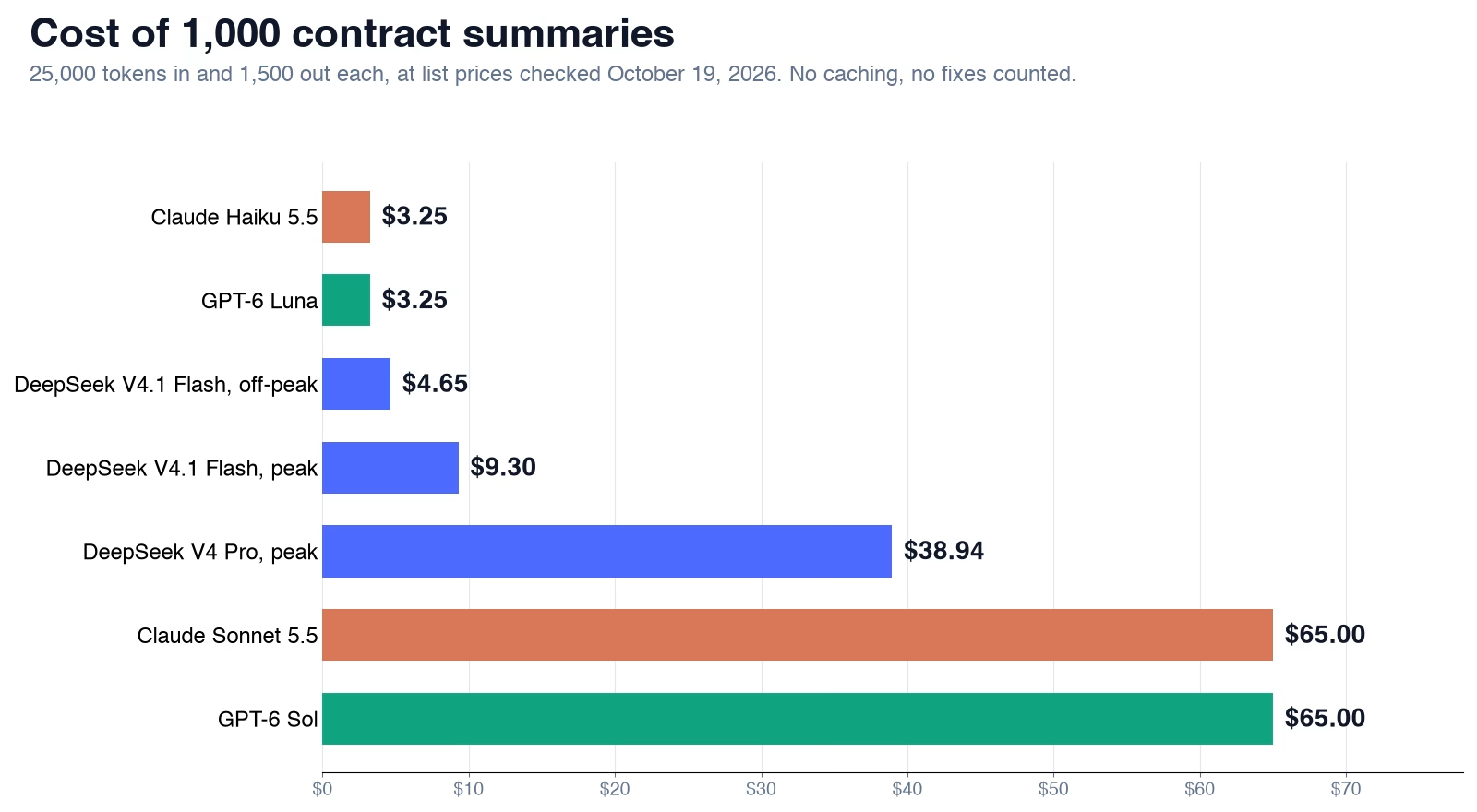
The math for one row, so you can check the rest: on DeepSeek Flash at peak, 25,000 tokens in at $0.30 per million is $0.0075, and 1,500 tokens out at $1.20 per million is $0.0018. Together that is $0.0093 a summary, or $9.30 for 1,000. At the off-peak price it is half, $4.65.
So DeepSeek V4.1 Flash costs less than a seventh of Claude Sonnet 5.5 or GPT-6 Sol for this job, which is a large saving if it does the work as well. But Claude Haiku 5.5 and GPT-6 Luna, the smallest current models from Anthropic and OpenAI, are cheaper still, at $3.25. If you thought of DeepSeek as the bargain option for simple jobs, the bargain moved.
Two details change these numbers in real use.
Repeated instructions are much cheaper. If you send the same long instructions with every request, DeepSeek keeps a copy of that recently sent text, called a cache, and charges a lower “cache hit” price for the repeated part: $0.006 per million input tokens at peak instead of $0.30, which is 50 times less. Tools that reuse a long prompt can cost far less than the chart shows.
Thinking counts. Both DeepSeek models run in thinking mode by default, where the model works through the problem in writing before it answers. With most AI services those reasoning tokens are billed as output, so a short answer can still carry a long bill. Check the token counts in your own responses rather than assuming the answer length is the whole story. If you want the full method for pricing a task, including the cost of fixing wrong answers, the post on what an AI task really costs walks through it.
The off-peak discount and who gets it
Of the three companies here, only DeepSeek charges by time of day. Its pricing page lists peak hours as Monday to Friday, 01:00 to 04:00 and 06:00 to 10:00 UTC. Every other hour is off-peak, and so are Chinese public holidays, at exactly half the peak price.
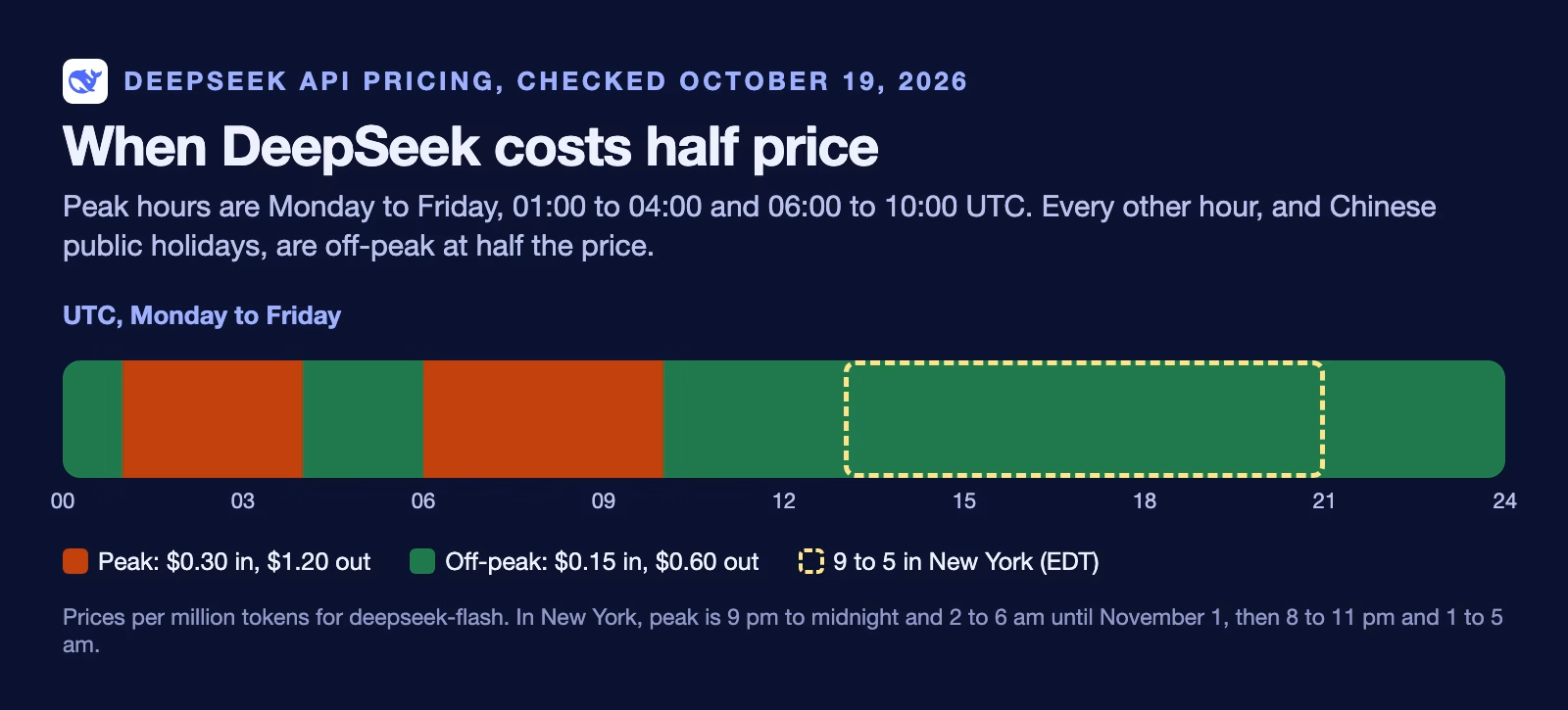
Those peak hours fall in the Chinese working day. In New York they land in the late evening and the early morning: 9 pm to midnight and 2 to 6 am until clocks change on November 1, then 8 to 11 pm and 1 to 5 am. The whole American business day is off-peak, and so is the European afternoon.
For a team in the United States, the price that matters is the off-peak one: $0.15 in and $0.60 out per million tokens. Overnight batch jobs are the exception. A job that runs at 3 am Eastern time lands in peak hours and pays double, so if you schedule large jobs, move them to the afternoon or the weekend.
How to read DeepSeek’s benchmark claims
A benchmark is a fixed test that companies run models on so the scores can be compared. DeepSeek’s model card shows a table of eleven benchmarks with V4.1 Flash 1017 scoring higher than the earlier V4.1 Flash on all of them. It is worth reading that table carefully before you quote it.
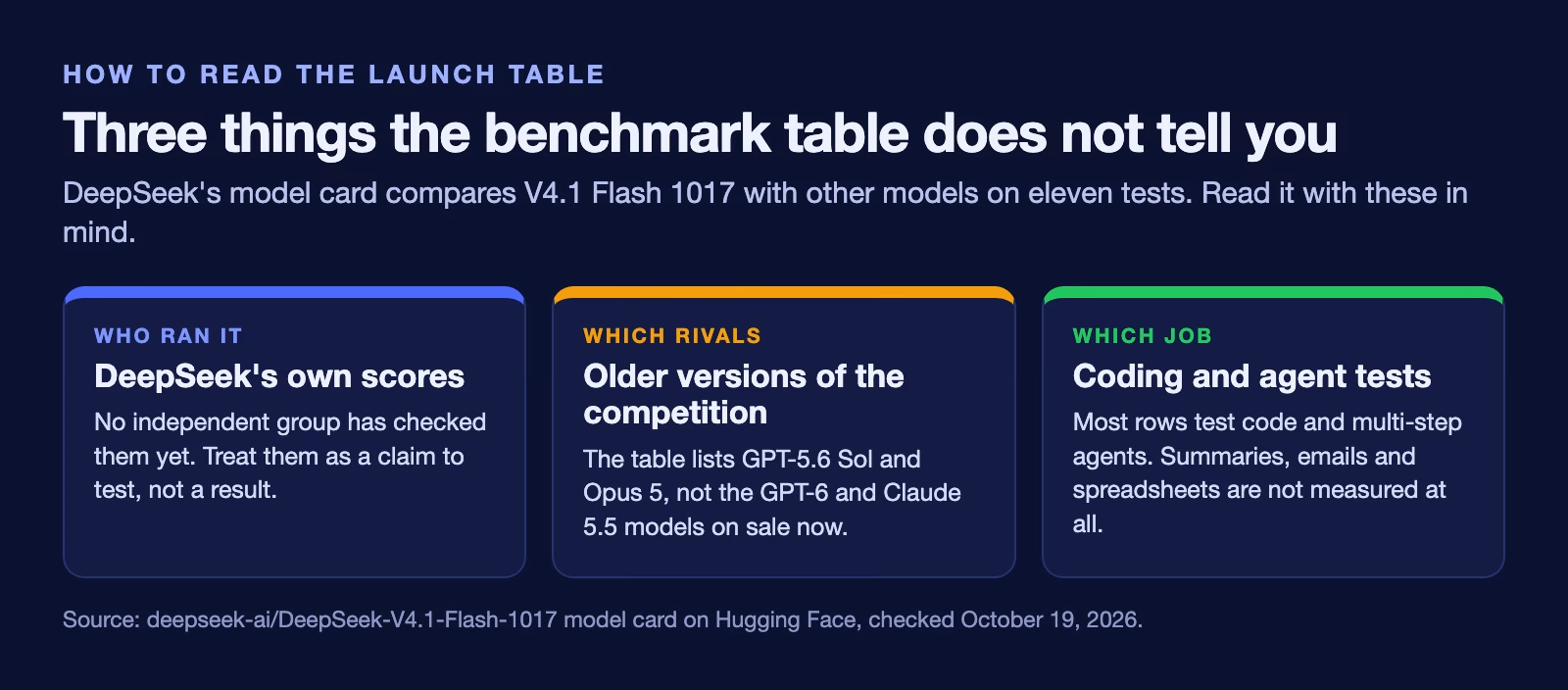
They are DeepSeek’s own scores. Nobody independent had checked them by October 19. Results from the company that made a model are a claim to test, not a verdict.
The rivals are not the current models. The table compares DeepSeek with GPT-5.6 Sol and Opus 5. The models on sale now are GPT-6 Sol and Claude Opus 5.5, so the comparison says little about today’s choices. On the same table, Opus 5 still beats DeepSeek on several rows.
The tests are mostly coding and agents. An agent is an AI that works through a task in many steps, such as editing files and running commands until something works. Rows like Terminal-Bench and DeepSWE measure that. Nothing in the table measures contract summaries, emails, or questions about a spreadsheet. DeepSeek also notes which harness, the software that drives the model through each test, it used for two rows, such as the Claude Code harness for Terminal-Bench.
None of this means the scores are wrong. It means they tell you DeepSeek is now much better at coding and agent work than its last model. Whether it is good enough at your job is something only your own test can show.
Where your data goes, and what the open weights change
There are two very different ways to use this model, and they have different privacy answers.
DeepSeek’s own website, app and API. DeepSeek’s privacy policy (checked October 19, 2026) says it collects, processes and stores personal data in the People’s Republic of China, and the service is run by a company registered in Hangzhou. For public text and personal experiments that may be fine. For customer records, contracts or anything your company’s AI policy covers, it usually is not. The guide on whether DeepSeek is safe for work covers that decision in detail.
The open weights. Because the weights are MIT-licensed, anyone can run the model on their own servers, and the data then stays wherever those servers are. Some hosting companies already offer it; the Hugging Face page lists providers you can call without running anything yourself. Running it in-house is a serious project, though. At 8 bits per number, 763 billion parameters take about 763 GB of memory for the weights alone, before any working memory. That takes several high-end graphics chips built for data centers, the kind of GPU (graphics processing unit) that AI runs on, not a laptop or a gaming PC.
So the open weights matter most to companies that already run their own AI hardware or have a contract with a hosting company in a region they trust. For an individual, the useful part is simpler: the same model is available from more than one company, so you are not tied to DeepSeek’s own service to use it. The post comparing DeepSeek’s website with running its open models yourself explains the trade-offs.
How to try it this week without changing your setup
You do not need to rebuild anything to find out whether V4.1 Flash is worth it. A one-hour test answers most of it.
| Step | What to do | What to write down |
|---|---|---|
| 1 | Pick three real tasks from last week, nothing private | What a good answer looks like |
| 2 | Run each in DeepSeek’s free chat and in your current tool | Right or wrong, and how much you fixed |
| 3 | If you use the API, read the usage numbers in each response | Input and output tokens |
| 4 | Multiply the tokens by the price table | Cost per task on each model |
| 5 | If you already call deepseek-flash, rerun last month’s requests | Changes in length, format or accuracy |
Pick three real tasks from last week that you would normally give to your current AI tool. Avoid anything private if you use DeepSeek’s own site. Write down what a good answer looks like before you run anything, so you are not swayed by a confident tone.
Run each task in DeepSeek’s free chat and in the tool you use now. For each one, note whether the answer was right, how much you had to fix, and, if you use the API, the input and output token counts from the response. Multiply those counts by the prices in the table above to get a real cost per task, not a guess.
If you already call DeepSeek through the API, also rerun a few of last month’s requests. Your tool moved to the new model on October 17, so compare the new answers with the old ones and look for changes in length, format or accuracy that could break whatever reads the output next.
Should you switch?
It depends on the job, the price you would pay, and where your data is allowed to go.
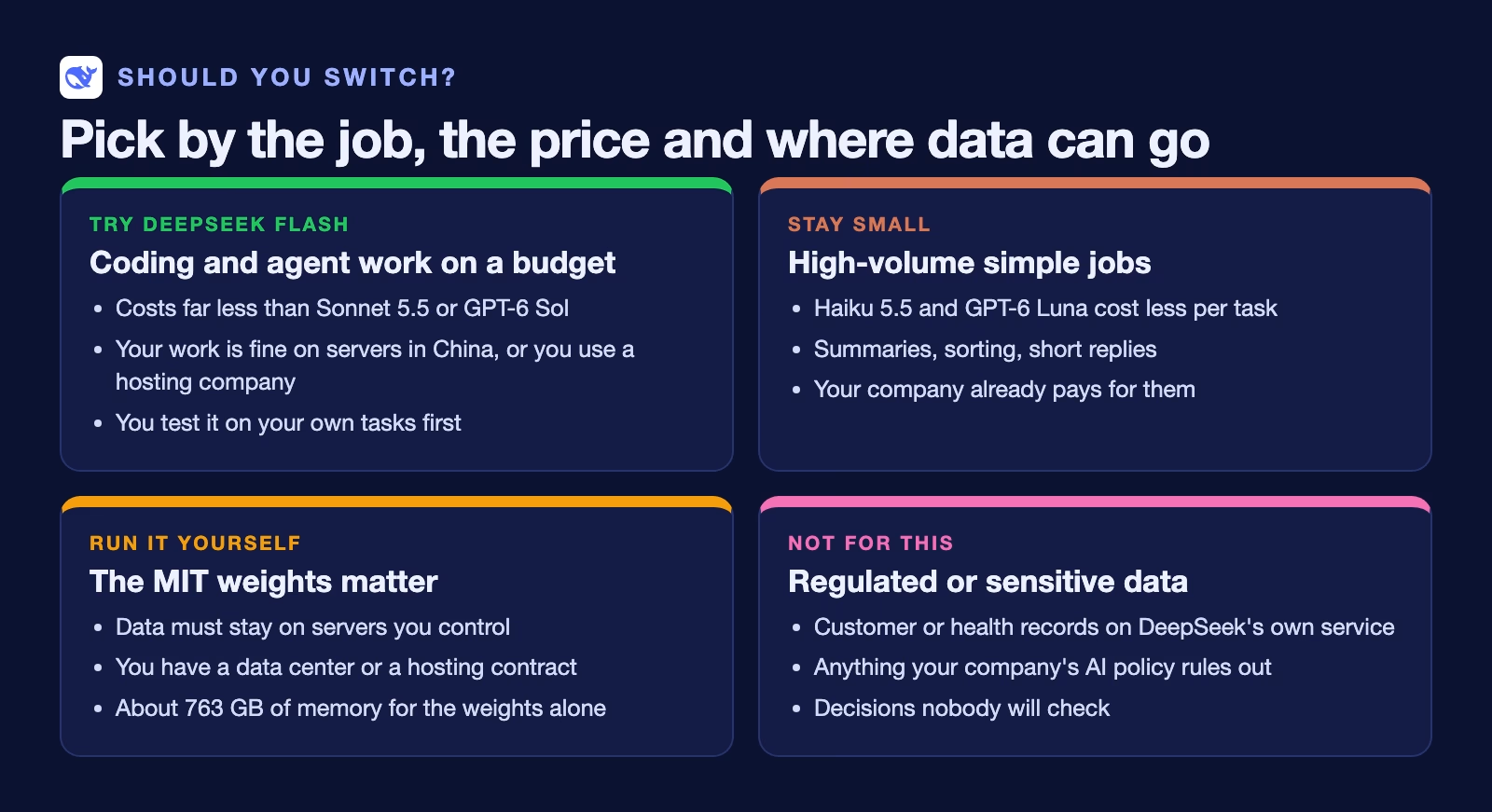
Try DeepSeek V4.1 Flash if you do coding or agent work and pay for Claude Sonnet 5.5 or GPT-6 Sol today. At about a seventh of the price for the same task, even a model that is slightly worse can come out ahead, as long as your data can go to DeepSeek or you use a hosting company you trust.
Stay with a small model if your work is high-volume and simple, such as summaries, sorting or short replies. Claude Haiku 5.5 and GPT-6 Luna cost less per task, and if your company already pays for one of them, switching saves nothing.
Run it yourself only if the open weights solve a real problem, such as data that must stay on your own servers, and you have the hardware or a hosting contract for a model this size.
Skip it for regulated or sensitive data on DeepSeek’s own service, and for any decision nobody will check. That rule applies to every model, but it is easier to forget when the price is low.
Whatever you decide, write down the three tasks, the answers and the cost per task. When the next model launches, and with DeepSeek that is often within weeks, you can rerun the same test in an hour instead of starting from headlines.
Sources
- DeepSeek API news: DeepSeek-V4.1-Flash-1017 (October 17, 2026 release, live on web, app and API, open weights, Search and Fetch pricing and free period)
- DeepSeek API: Models and pricing (deepseek-flash prices, peak and off-peak hours, cache hit price, retired model names, checked October 19, 2026)
- Hugging Face: DeepSeek-V4.1-Flash-1017 model card (MIT licence, parameter count, DeepSeek’s benchmark table, checked October 19, 2026)
- DeepSeek privacy policy (data collected, processed and stored in the People’s Republic of China, checked October 19, 2026)
- Anthropic: Claude API pricing (Claude Haiku 5.5 and Sonnet 5.5 prices, checked October 19, 2026)
- OpenAI: API pricing (GPT-6 Luna and GPT-6 Sol prices, checked October 19, 2026)
Keep going
Same lessons in your feed
Short diagrams, hooks, and weekly tutorials on Substack, Instagram, X, and Facebook.