DeepSeek is often the wrong place to spend your effort in two situations. When the text is already public, like a website FAQ anyone can read, arguing about privacy wastes time. When the data is sensitive, like health notes from a client form, it belongs in a proper form tool and not in any chat app at all.
Imagine a board member at your small nonprofit shares an article about government limits on foreign AI tools and asks whether using AI is risky. Your team spends nine days and 31 messages debating it, all about rewriting a six-question FAQ that has been public on your website for months. Meanwhile, someone on your team is pasting client forms with personal health notes into a free chat app, and nobody notices.
Nine days for a FAQ that was already public
Consider a small community shop helping members with benefits paperwork: three people on staff (operations, a program coordinator who sits with applicants, and a volunteer who manages the website). The board Slack is often larger than the staff, and unpaid board members read the same news headlines everyone else reads. On Monday morning, someone pastes a story about federal guidance and agency memos warning that DeepSeek is not authorized on government devices. Fair clip, but the wrong object, because the thing actually sitting in the thread was a public FAQ.
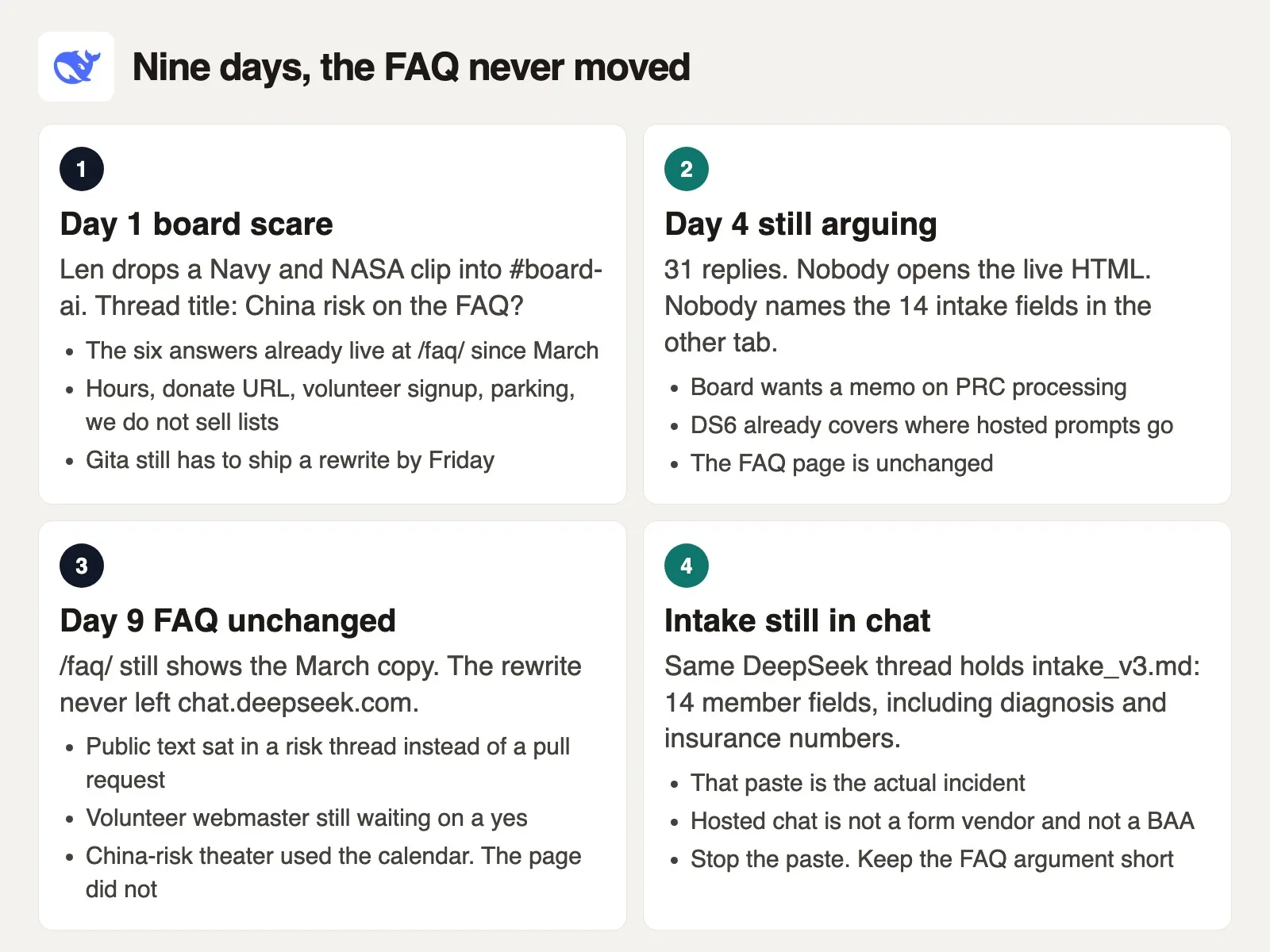
Open /faq/ and you can read the six answers without logging in: hours, donate, volunteer, parking behind the loading dock, how to request a membership letter, and “we do not sell member lists to partners.” That last line is the one the board likes to quote at funders, and it is also already on the internet. A rewrite that shortens the parking paragraph and adds a second volunteer shift is an edit to a public web page, not a classified packet. Hosted DeepSeek will still send the prompt to the lab’s service in China, which the earlier post in this series already covered. The question for Monday is whether that fact is a stop on this job, or a stop on a different job sitting in the next tab.
Day 1 was the scare. The first board reply asked whether “we are sending member data to China.” Staff answered that the public FAQ has no member rows, and the coordinator posted a screenshot of the live page, but the thread kept going anyway. Someone asked for a one-pager on processing rules in China. Someone else asked whether they needed “an American model.” Claude and ChatGPT are US vendors with their own paste rules, and they are the right door when you need that contract, but they were not going to change the six public sentences this week if nobody opened the file.
Day 4, still arguing. Thirty-one replies, and two emoji reactions on a PDF of DeepSeek’s privacy policy that nobody scrolled down to the storage section. Someone had already pasted the March FAQ into chat.deepseek.com on Sunday night and asked for a shorter parking line and a Saturday shift. The model returned a draft in forty seconds, and the coordinator dropped it in a Google Doc named faq_rewrite_sun.md. The volunteer webmaster was waiting on a yes in #website. The yes never came, because #board-ai was still performing risk.
Day 9, the FAQ was unchanged. Same six answers, same March timestamp in the footer the volunteer always forgets to bump. The DeepSeek draft sat in the Doc. The board thread had moved to “we should pause all AI until the retreat,” and the retreat is in November. Members still needed the Saturday hours on the page. That is the stall: nine calendar days for a public paragraph, while fourteen intake fields sat in the same chat product the board was scared of.
Two inboxes. Left: Slack, China-risk theater about copy the site already publishes. Right: DeepSeek, a working document of member intake. If you only read the Slack, you would think the nonprofit was careful. If you only read the chat, you would think nobody had read the earlier privacy post at all. The failure is the split: you can be loud about a vendor’s region and still paste the form that actually hurts people.
Rule of thumb: If the sentences are already on your website, a week of board Slack about China risk is optional. If the paste has member diagnosis or insurance numbers, stop the same day. Do both checks. Do not do only the loud one.
When the cheap API is the right stubborn choice
DeepSeek is not a consolation prize for teams that cannot afford Claude. The hosted API is often the cheap door for public text, and the permissively licensed weights (the numbers a model learned in training) are a real self-host door when you actually run the files yourself. A public FAQ rewrite is a cheap-door job, and the governance thread treated it like an international relations project instead. You can be stubborn in the other direction: keep DeepSeek when the job is public, the policy allows it, and you would rather pay cents than open a second vendor this afternoon.
Public FAQ, public copy
Start with what is already public: hours, the donate URL, volunteer copy, a parking note, a blog post you published last month, a press release on your own domain. If you would paste that text into a Google search and feel fine about it, hosted DeepSeek is in play, as long as your written policy has not already said no vendors based in China. The written policy had not banned foreign models; the team was drafting policy ad-hoc in Slack, on a page that did not need a new policy to ship a parking line.
Consumer chat at chat.deepseek.com is free, with fair-use throttling possible. There is no official DeepSeek Plus in the ChatGPT Plus shape. Instant Mode maps to V4-Flash, and Expert Mode maps to V4-Pro; confirm the live toggle labels the week you draft, since they change. For a six-answer FAQ, Instant is enough. You still read the draft against the live page, and you still press publish in WordPress yourself. The model does not own /faq/.
Cheap API for volume that stays public
If the job is fifty public blurbs, not one parking paragraph, the API (the paid service that lets a program send many requests at once) is the stubborn cheap choice. Official docs list deepseek-flash, which also reads images, and deepseek-v4-pro. The base URL is https://api.deepseek.com. The English pricing page (checked September 2026) bills per 1 million tokens (chunks of text, about three-quarters of a word each) with peak and off-peak rates, and off-peak runs about half of peak. Peak windows cited in the docs are 01:00 to 04:00 and 06:00 to 10:00 UTC (Coordinated Universal Time, the world’s reference clock), Monday through Friday. Copy the live numbers the week you buy; do not treat this post as a rate card.
On that page, checked October 7, 2026, Flash costs about $0.15 per million input tokens off-peak and $0.30 at peak when the text is not already cached. Its output costs about $0.60 per million tokens off-peak and $1.20 at peak. Cache hits (text the service already processed recently and can reuse) are listed much lower, fractions of a cent per 1M on the same table, and Pro is listed at several times Flash on those rows. New API accounts may have a free token grant, so confirm that too on the pricing page. For public FAQ rewrites and public help-center jobs, Flash off-peak is the default id to try. You still keep member rows out of the prompt, because cheap is not a waiver.
A US vendor service-level agreement (a contract that spells out uptime, support, and data handling) is a different product. Anthropic and OpenAI sell contracts, admin tools, and, on the right tier, a documented story about training defaults and support. DeepSeek’s official API is a billed handle on the same Hangzhou lab, and price is not the same thing as residency. If procurement needs a US signature on a data-processing addendum, this cheap-door path does not apply to you; skip ahead to the wrong-door list below. If procurement only needs a short public rewrite and the policy allows the vendor, paying Flash rates is the stubborn choice. Do not open Claude Projects to look serious about parking hours.
Open license files you actually run
Downloadable model files under huggingface.co/deepseek-ai are a third cheap door, and only when you run them. Check the license on the card the week you clone; permissive licenses are common on that org, but a file sitting on disk is not the same thing as the website. An earlier post on this site maps the general choice: hosted open models versus downloading files to your own machine. If the team had pulled a local model file onto an offline machine and rewritten the FAQ there, the board’s cloud-risk thread would have been aimed at the wrong surface. But using chat.deepseek.com sends data to a cloud host, and calling that “open source” does not move the prompt anywhere else.
Self-host is the right stubborn choice when the file cannot leave and you will actually operate a runner this week: a named process, the cloud toggle off, a machine you can point at. That is the same self-host case an earlier post in this series covers. It is not “we downloaded a folder so the Slack thread can say we self-host.” If you will not run the files, do not clone them as a privacy ritual. Use the chat or the API for public copy, or use Claude if policy already said no.
When DeepSeek is the wrong door this week
Three stops show up in real shops this year. Member protected health information and intake. A government-issued device, or a written ban that already names DeepSeek. A need for Claude Projects, ChatGPT Projects, or a US vendor contract you can show procurement. Staff hit the first risk in an unmonitored tab while the board performed the second as an abstract debate. The third was a slogan repeated in the thread, “we need an American contract,” without anyone ever opening one.
Health information, intake, anything the policy told you not to type
DeepSeek’s English privacy policy (last updated 10 February 2026 on that page) says the services are provided and controlled by Hangzhou DeepSeek Artificial Intelligence Co., Ltd., and that it directly collects, processes, and stores personal data in mainland China. The same policy says the services are not designed or intended to process sensitive personal data, including health information, and that you should not provide it, about yourself or other people. Terms of use repeat the caution on personal information. That is the lab’s own line, so you do not need an outside report to stop an intake paste.
Hosted DeepSeek is not a US healthcare vendor with a signed data agreement you can point at, at least not one published on the official site. If your shop handles health records, you already have a form vendor, a records system, or a lawyer who will say “not this chat.” Member intake belongs in that stack. It does not belong in Instant Mode just because the FAQ rewrite was open in the same window.
Banned government devices
If the laptop is issued by a government agency, read the memo before you open a tab. Reuters reported in March 2025 that US Commerce Department bureaus told staff DeepSeek is broadly prohibited on government-issued equipment, with a line that said do not download, view, or access related apps or websites. Internal guidance at the National Aeronautics and Space Administration (NASA), as reported, said DeepSeek products are not authorized for that agency’s data or on government-issued devices and networks. The US Navy told personnel not to use DeepSeek in any capacity, work or personal, on guidance that circulated in late January 2025. The Pentagon blocked access after staff reached the site from work computers, according to Bloomberg’s reporting. The US House restricted DeepSeek on House-issued devices, and several US states and other governments have published their own device bans. Confirm your agency’s current list, because a nonprofit laptop is not a federal badge. The board quoted federal memos as if they were internal policy, but it was a news clip; their internal policy still had a blank where “approved vendors” should be.
If you are on a banned device, the door is closed. Do not sideload an unofficial Android install file. Do not use a personal phone “just for the FAQ.” Follow the written ban. If you are not on a banned device, do not spend nine days reenacting someone else’s memo while intake sits in chat. Copy the clip into a policy draft if you need a policy, then name the jobs that are actually in flight.
Claude Projects, ChatGPT Projects, a US vendor contract
Some weeks the job is not a six-line FAQ. You need a Project with files that persist, an admin console, a data-processing addendum, and a vendor your counsel has already reviewed. That is Claude or ChatGPT, or another US vendor your shop already bought, not DeepSeek chat. Claude Projects, chats, files, and Research live in this Claude walkthrough. ChatGPT’s plan ladder lives in Free, Go, Plus, Pro, Business, Enterprise without hype. When the brief says “we need Claude Projects,” believe the brief, and do not force DeepSeek because the API is cheaper. Cheap is the wrong stubbornness when the requirement is the contract itself.
Repeating a slogan about an “American contract” for a public parking paragraph is theater. Nobody had a signed master agreement, and nobody had opened Anthropic’s or OpenAI’s customer terms. If you need the contract, buy the seat and put the files in a Project. If you do not, write the FAQ and stop quoting agreements you will not sign. The team needed a clear decision on day 1. Instead, they got nine days of circular debate, plus an unvetted intake form paste.
One more stop that is easy to miss: your own written policy already says no. If the board voted in April that vendors based in China are out, the FAQ rewrite goes to Claude or to a human, and the cheap API is then the wrong door even for public copy. That is a one-line answer. It does not require a nine-day thread. The board had not voted on an actual policy; they were using the thread to perform diligence, while real client intake sat exposed in the other tab.
The intake form that never belonged in the thread
Here is what sat in an unmonitored DeepSeek chat, pasted from intake_v3.md: fourteen intake fields someone wanted “plain language labels” for. Read them as a paste test. Would you email this list, filled in, to a vendor whose privacy policy stores prompts in China and tells you not to send sensitive personal data?
- Legal name
- Preferred name
- Date of birth
- Member ID
- Household size
- Monthly household income
- Insurance plan name
- Insurance member number
- Primary diagnosis (free text)
- Current medications
- Emergency contact name
- Emergency contact phone
- SNAP (food assistance) or other benefits status
- Housing type (shelter, doubled up, rent)
Fields 7 through 10 are the loud health-related ones. Fields 3, 4, 6, 13, and 14 are still people, just quieter about it. A blank template is milder than a filled row, and this prompt was not blank. The coordinator had pasted three anonymized-but-not-really examples: one with a real plan name from a local insurer, one with a diagnosis string copied from a paper form (“type 2, neuropathy”), and one with an emergency contact who was also on the volunteer roster. “Anonymized” that still names a clinic and a medication list is a hope, not a control. The model was asked to turn the fourteen labels into friendlier helper text, and helper text is a WordPress job. It does not need sample health data in the prompt.
What to do instead is boring, which is why it lost to the chat. Put the live form in the tool you already trust for members: a form product with a contract, a records system, or paper at the desk. Ask a human to write helper text, or paste only the fourteen labels with no examples. If you want a model on helper text, use a vendor your counsel has cleared, with no sample rows. If you want a model on filled rows, you are in the wrong meeting; that is an intake vendor conversation, not an Instant Mode conversation.
The uncomfortable reality: people often know the rules, but keep an unvetted tab open because starting a fresh compliant session feels like friction. Same login, same Expert toggle. The board was loud about China. The coordinator was quiet about the form. The quiet paste is the one that would have shown up in a breach review, while the loud Slack thread would have shown up in the minutes as diligence.
Delete the filled examples from the chat. Export if you need a record for counsel, then delete. Do not keep intake_v3.md open in a consumer window as a working file. If DeepSeek chat history is on, open Settings the week you read this and confirm the data-control toggles the earlier privacy post already walked through. Then move the form work out. The FAQ rewrite can stay in a clean chat, or go to the volunteer as a Doc, or go to Claude if the board votes no. The fourteen fields do not get a second chance in any of those windows.
A one-page chooser for Monday
Four doors. Public FAQ, when the copy is already live and policy allows it. Cheap API, when the volume is public text and you will pay Flash rates. Self-host, when open license files will run on a box you control. Stop, when the paste is intake, the device is banned, or the brief is Claude Projects plus a US vendor contract. The team needed door one, public chat, for the FAQ, and door four, stop, for the client intake form. Using door one for both while Slack debated news clips is the real failure mode.
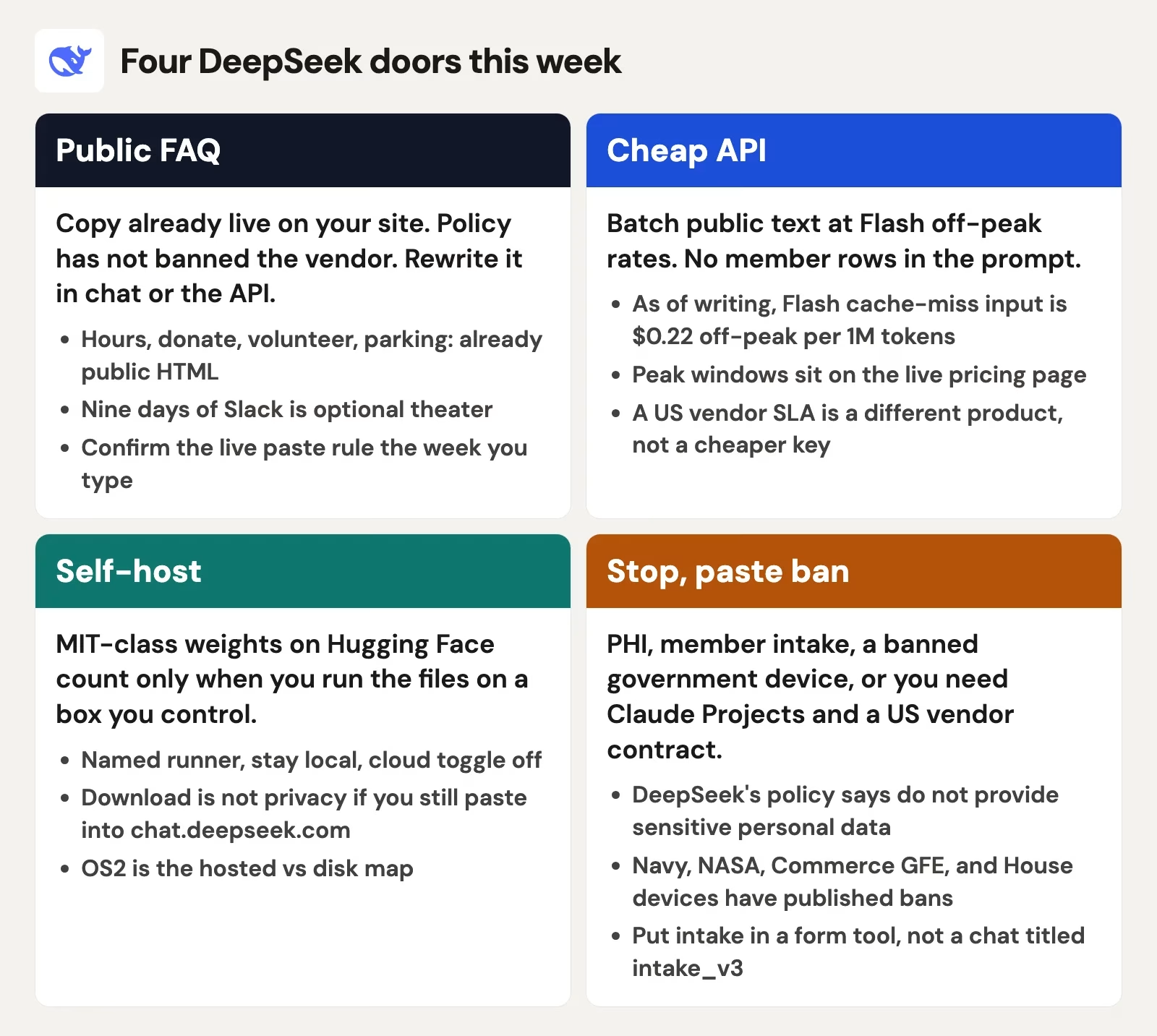
The lookup is a default door, not a personality test. Change it when policy is written, when the device is issued by an agency with a ban, or when the paste grows a diagnosis field. Do not change it because a board thread hit 31 replies.
| Job | Default door |
|---|---|
| Public FAQ already on the site, policy allows | chat.deepseek.com or Flash API |
| Batch public blurbs, help-center, no member rows | Official API, Flash off-peak, live prices |
| Need Claude Projects or a US vendor contract | Claude or ChatGPT this week |
| Member intake, health information, diagnosis, insurance numbers | Form tool or records system. Not any chat. |
| Government-issued device with a written DeepSeek ban | Do not open the site, app, or API on that device |
| Sensitive files you will run local this week | Hugging Face weights, named runner, stay local |
| China-risk thread about copy that is already public, while intake sits in chat | Ship the FAQ if policy allows. Stop the intake paste today. |
Paste this ten-line card into #board-ai before the thread becomes a retreat agenda. Fill it in the meeting. Post the filled card. Then close the DeepSeek tab that holds the form.
AMS DeepSeek door (fill in Slack)
1. Job in one line: ____
2. Already public on our site? Y/N: ____
3. Member / health / intake fields in the paste? Y/N: ____
4. Gov device or written ban? Y/N: ____
5. Need Claude Projects or a US vendor contract? Y/N: ____
6. Will we run open-license weights on our box this week? Y/N: ____
7. If 3 or 4 is Y -> STOP. Form tool, or get off the device.
8. If 5 is Y -> Claude or ChatGPT this week, not DeepSeek chat
9. If 2 is Y and policy allows -> chat or cheap API. Skip the 9-day thread.
10. If 6 is Y -> Hugging Face files, stay local. Else do not download.
A filled card for the FAQ: the job is a public parking and hours rewrite, already on the site, with no health data in the paste. No government device, no US contract needed, no weights running this week. Door: chat or cheap API, owned by the ops lead, reviewed at Thursday’s volunteer publish. The filled card for the form looks different: the job is member intake helper text, not already public, with health data in the paste. Door: stop. The second card is the one the board never filled out, because they were too busy with the first.
Monday, open the two tabs you actually have. If one is public copy and policy allows DeepSeek, ship the paragraph and stop quoting federal memos as if they were your own vendor list. If one is intake, close hosted DeepSeek and put the fields in a form tool. If you need Projects and a US contract, go to Learn Claude or Learn ChatGPT and buy the seat you will use. If you meant to self-host, read the earlier posts on hosted open models vs. your own machine and hosted DeepSeek vs. open weights (open weights are model files anyone can download) before you clone a folder you will not run. This series stops here. DeepSeek stays for cheap public text and for weights you operate. It does not stay for member forms, banned devices, or a contract you only wanted as a slogan.
Series notes
This is Part 7 of Learn DeepSeek, and it closes the planned DeepSeek track. Previous: privacy and region.
Sources
Plan names, model ids, prices, and device bans move. Confirm on the vendor page and your agency memo the week you act. Series recap for this DeepSeek path, checked September 2026, then the primary docs:
- Analytics Made Simple: DeepSeek from scratch (this series, all seven parts)
- What DeepSeek is: products plus open models
- DeepSeek chat app and plans without hype
- DeepSeek thinking mode without treating scratch as proof
- DeepSeek for coding: useful, still run the tests
- Hosted DeepSeek vs open weights
- DeepSeek privacy, region, and work caution
- DeepSeek chat (consumer web app)
- DeepSeek: Privacy Policy (Hangzhou controller, China storage, do not provide sensitive personal data)
- DeepSeek: Terms of Use (caution on sharing personal information)
- DeepSeek API docs: Models and pricing (Flash and Pro ids, peak vs off-peak, copy live numbers)
- Hugging Face: deepseek-ai (open-weight files, read the license on the repo you pull)
- Reuters: US Commerce department bureaus ban DeepSeek on government devices (guidance as reported, March 2025)
- Bloomberg: Pentagon workers used DeepSeek before DoD blocked access (Navy and NASA restrictions as reported in the same period)
- Analytics Made Simple: Learn Claude from scratch (Projects, US vendor path)
- Analytics Made Simple: Learn ChatGPT from scratch (plan ladder and Projects on that stack)
- Analytics Made Simple: AI products chooser
- Hosted open models vs download to your machine
- Analytics Made Simple: Learn
Keep going
Same lessons in your feed
Short diagrams, hooks, and weekly tutorials on Substack, Instagram, X, and Facebook.