Nia checked Yes on question 7 of the legal intake: “Is the software open source?” She had pulled llama3.1:8b at 16:12 on Thursday for a 9-person team that wanted 140 help-center macros drafted off customer tickets. Friday at 9:40, counsel dropped a 14-page pack in #legal-intake: the Llama community license, the Acceptable Use Policy it incorporates, and a developer use guide. Yellow highlight on a 700 million monthly user clause, a list of banned uses, and “Built with Llama” if they ship anything that includes the weights. Nia had also pasted three sample tickets into a free Llama playground on Tuesday. Same word on the Jira ticket. Three different facts, plus a chat box that was none of them.
This is OS7b, Part 8 of Open-source AI explained. OS1 named the nouns. This page is the work version: three sentences for a ticket, and a fourth trap (the free UI). Previous: OS7, when ChatGPT, Claude, Gemini, or Grok is simply easier. Next: OS7c, reading a model card without getting lost. Location still lives in OS2 and P4. Re-check every PDF the week you download. They move.
Three words that are not synonyms
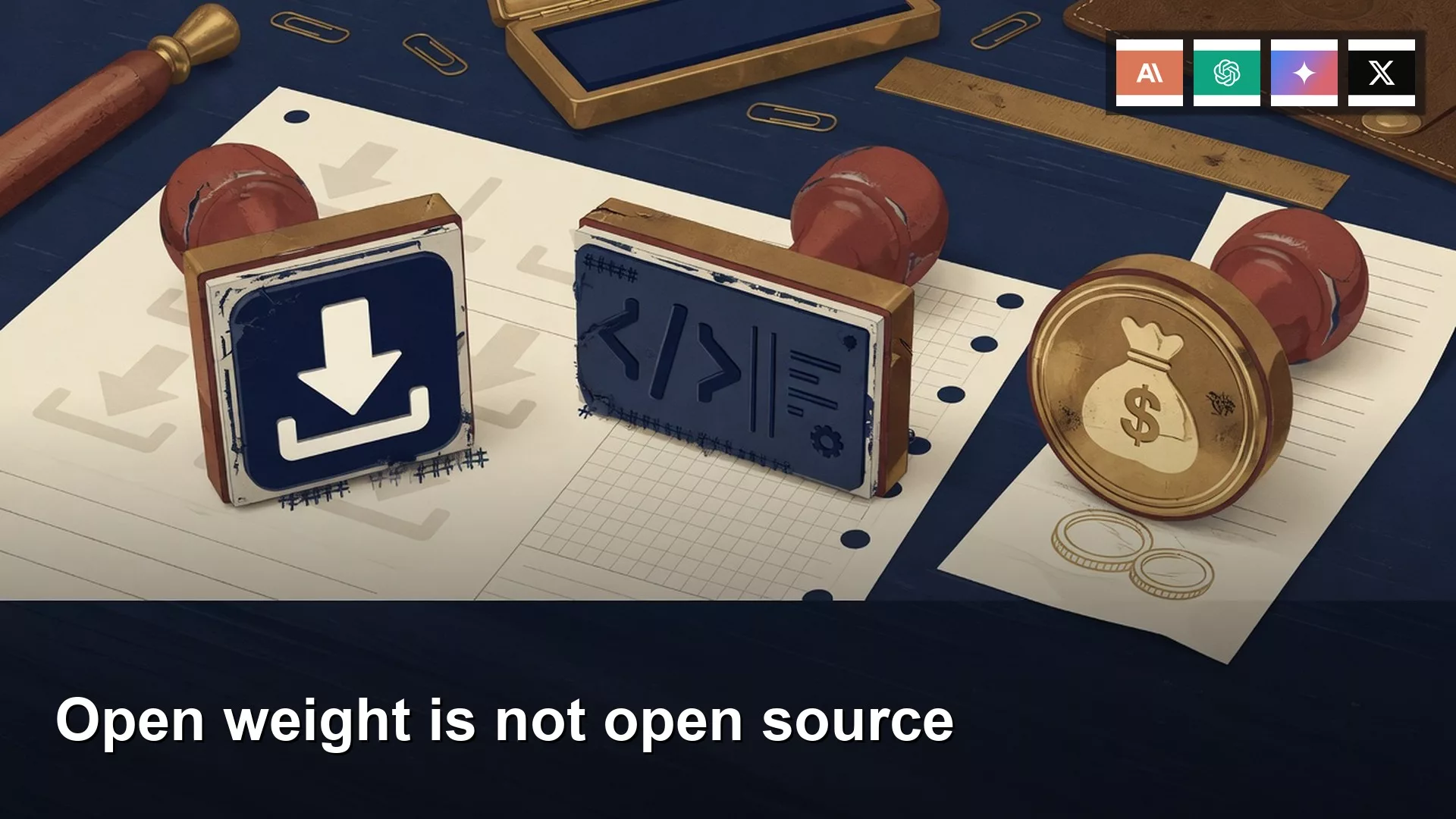
- Three sentences that are not synonyms: download the weights, the recipe is open, you may use it at work
- Why Llama-style licenses are usually (1) with extra rules, not OSI open source
- Why a true OSS repo (llama.cpp, some research stacks) is a different crate from the GGUF you load
- Why a free ChatGPT-like site is none of the three
- A license scan you fill in, then send to whoever signs contracts
Three sentences that are not synonyms

Hallway talk mashes these into “open.” Write them as separate lines, or you will fill in Nia’s form wrong.
- You can download the weights. Finished parameters, often a GGUF. You can run them on a machine you control, if the license lets you.
- The training code and data are open. Someone published the recipe under terms that match open-source software, and enough data information that a skilled person could rebuild something equivalent. The Open Source Initiative’s AI definition is this crate, not crate 1.
- You may use it at work, including commercially, under that license. This is a permission, not a price and not a download button.
A free chat UI is a fourth object: a quota in a browser. You do not get the weights or the recipe. You get that vendor’s terms, which can change on a Tuesday. Llama in the logo does not move the file onto your disk. ChatGPT, Claude, Gemini, Grok, and a Groq playground (Groq is the hosted inference company, spelling with a q, not xAI’s Grok) all sit here when you have not signed a model license at all.
| Claim | Llama-style release | True OSS repo (llama.cpp, some research stacks) | Free ChatGPT-like site |
|---|---|---|---|
| Download the weights | Usually yes, under the community license that week | llama.cpp is source, not Meta’s weights. OLMo-class stacks may publish weights too. | No. You type in a box. |
| Training code and data are open | Usually no. OSI: finished numbers are not open source AI. | Repo code is often Apache 2.0 or MIT. That does not cover a Llama file next to it. | No. |
| You may use it at work | Maybe. License plus AUP plus extra commercial terms. Counsel reads the PDF. | Apache or MIT on that repo is a real software license. Still read the model license if you load weights. | Vendor terms. Not a model license. |
| Who sits in the middle | Nobody if you stay local. A host if you used a playground or API. | Nobody for the code clone. A host if you then call Groq or Together. | Always a host. The prompt leaves. |
Rule of thumb: If you cannot paste the license URL in the ticket, you cannot write “open source” in the title. Send the PDF to whoever signs contracts. This page is homework, not legal advice.
Open-weight: the file you can download
Weights are the numbers the training run learned. When Nia typed an Ollama pull, she got that pile, quantized for a laptop. She did not get Meta’s training set, and she cannot reprint the original run from the file. OSI’s page on open weights is blunt: sharing the final parameters is more transparent than a closed API, and it is still not the preferred form for modifying an AI system.
Llama-style licenses live here. Start at llama.com/llama-downloads (as of writing, August 2026) and follow it to the current community license. The grant is limited: use, copy, modify, distribute the Llama materials, with strings attached. The Llama 3.1 community license (23 July 2024 on Meta’s developer site) is a useful specimen: a custom agreement, not Apache 2.0. OSI has said Meta’s Llama license is still not open source. Believe the PDF, not the keynote.
- Acceptable use is incorporated by reference. Nia’s 14 pages were the AUP plus the license plus a use guide, printed because counsel does not accept a Hugging Face badge.
- On the 3.1 text, if your products (or affiliates’) had more than 700 million monthly active users on the release date, you must request a separate license Meta may grant at its sole discretion. A 9-person team will not hit that. Legal still wants the clause on the record.
- If you distribute: “Built with Llama” on a related site, UI, or docs, plus a Notice file, plus naming rules if you train another model from the outputs.
- Breach, and you delete the materials. Field-of-use bans in the AUP are how “we downloaded it, so we’re fine” dies in a review.
Llama is a licensed download. Say “open weights under the current Llama community license” and attach the URL. That sentence survives Friday at 9:40.
Open-source software: the recipe under a real license
Open-source software, in the OSI sense, is source code under a license that lets you use, study, modify, and share for any purpose, without a field-of-use veto. Apache 2.0 and MIT are the names people mean in a staff meeting. A custom community agreement with an AUP is a different animal, even when the slide uses the same adjective.
Two crates get mixed on the same laptop. Crate A is the runner. llama.cpp is Apache 2.0 as of the LICENSE in that repo. Ollama and LM Studio have their own licenses; read those too. Apache on the engine does not relicense the weight file you pass into it. Nia’s folder had both. Question 7 has one checkbox. The folder has two licenses.
Crate B is the model, if anyone opened the recipe. The Open Source AI Definition 1.0 wants four freedoms (use, study, modify, share) for any purpose, plus the preferred form to modify: data information, training and inference code, and parameters, under OSI-approved terms. “We trained on a large crawl” is not enough. Some research stacks (Allen Institute OLMo is the usual example; re-check the card) publish more of the recipe than a Llama tarball. They are still rare.
Hugging Face license tags are a hint. apache-2.0 is a claim you verify by opening LICENSE. llama3.1, other, or a custom community name means: stop, get the PDF. nc in a Creative Commons tag means non-commercial, which is the opposite of sentence 3 for a company drafting 140 macros. Date the card in the ticket.
Free to use is a price
Free beer is not a license. A ChatGPT-like free tab, a Claude or Gemini quota, a Groq playground with a Llama badge: you paid $0 today and received a hosted box. Closed weights stay closed. Open weights on someone else’s GPU are still hosted; see OS2. Sentence 3 is whatever that site’s terms say, which is not the Llama community license unless you also accepted that separately.
Nia’s Tuesday playground felt identical to Thursday’s local replies, only faster. The Jira ticket called both “open source Llama.” Legal asked which host saw the three sample tickets. She had to reconstruct a URL from browser history. If the job is a public paragraph, a $20 closed plan from the chooser is allowed to be easier. If the job is 140 macros that might include customer wording, a free UI is a host with a smile. Price did not answer the intake form.
Work use: license, acceptable use, and the host

Sentence 3 is the one companies need, and it is three reads, not one adjective. Name the license (Apache 2.0, MIT, GPL, Llama community, Gemma-style terms, CC-BY-NC). Write the URL and the date. Look for user caps, attribution, share-alike, and “request a license from us.” If the file is 14 pages, that is data. If you cannot find a file, you do not have a yes.
Then read acceptable use. Llama’s AUP (specimen: the 3.1 policy on Meta’s developer site) lists prohibited uses: certain crimes, unlicensed practice of law or medicine, collecting sensitive personal data without rights, weapons, critical infrastructure, deception, undisclosed dangers, and more. Other families bury similar lists in use policies or model cards. Attach the file. A help-center macro project can still trip a line about professional advice or personal data if tickets include health or credit. That is why counsel exists.
Then name the host. If Groq, Together, Fireworks, OpenRouter, or a vendor chat sits in the middle, you have two contracts: the host’s terms and the model license. Local Ollama is one contract (the model, plus the app), and only if you did not toggle a cloud id. Fill a scan. Then stop talking. Whoever signs vendor paper gets the pack. A blog does not clear a hospital, a bank, or a 140-macro ship.
A checklist you can copy. It prints a hallway sentence. It does not sign anything.
# license_scan.py
# Fill from the PDF and the card this week. Not legal advice.

from datetime import date

scan = {
    "model_or_repo": "llama3.1:8b",
    "card_url": "",
    "license_url": "",
    "read_on": date.today().isoformat(),
    "weights_downloadable": True,            # sentence 1
    "license_name": "Llama 3.1 Community",   # Apache-2.0 / MIT / Community / NC
    "osi_approved_software_license": False,  # Apache/MIT/GPL on THIS artifact
    "training_code_public": False,           # sentence 2
    "training_data_or_disclosure": False,
    "field_of_use_or_aup": True,             # extra rules
    "user_cap": "700 million MAU clause, check current PDF",
    "host_in_the_middle": "playground Tuesday; local Thursday",
    "host_terms_url": "",
    "counsel_has_the_pack": False,           # sentence 3 is theirs
}

def hallway(s):
    if not s["weights_downloadable"]:
        return "Closed or hosted-only. Do not write open source."
    if s["field_of_use_or_aup"] or s["user_cap"]:
        return "Open weights with extra rules. Send the PDF."
    if not (s["training_code_public"] and s["training_data_or_disclosure"]):
        return "Open weights. Not the OSI AI bar."
    if s["osi_approved_software_license"]:
        return "Closer to open source. Still send the PDF."
    return "Recipe looks open; license name is still required on the slide."

print(hallway(scan))
print("Counsel pack:", scan["license_url"], scan["host_terms_url"] or "no host")
What that code draws: one sentence for the ticket, plus a reminder that a True in your editor is not a signature. Nia’s filled scan is the table below. OS7c will walk the model card fields so you can find those URLs without hunting.
Worked example: Nia’s 14-page pack
The job: draft 140 help-center macros from recent tickets, keep customer wording off ChatGPT, ship the macros in the product. The slide: “we’ll use open source Llama.” The machine: a laptop with a local pull and, earlier, a free playground. Counsel’s pack: 14 pages. Here is the scan she should have attached instead of a Yes on question 7.
| Line | What Nia told the form | What was true Friday 9:40 |
|---|---|---|
| Open source? | Yes | Open weights under a community license. OSI would not call that open source. |
| Sentence 1, weights | Implied by the download | True for Thursday’s file. False for Tuesday’s playground. |
| Sentence 2, recipe | Not asked | False. No training set, no full recipe. |
| Sentence 3, work use | Implied by “open source” | Unknown until counsel reads AUP, user cap, attribution, and whether macros in the product count as distribution. |
| Host | Not on the form | A playground saw three tickets. Local pull did not erase that paste. |
| Runner vs weights | One checkbox | llama.cpp or Ollama may be OSS. The GGUF is still Llama’s license. |
The fix is a boring ticket. Three sentences, two URLs (license, host terms if any), the card, the date. Macros that quote customers wait until counsel says go, or they get drafted by a human. A closed work chat can still be the right tool for public help copy; that was OS7.
Free, open, and open-weight are three claims
- Writing “open source” because you downloaded a file.
- Writing “open source” because llama.cpp is Apache, while the weights are Llama.
- Writing “free, so we can use it at work.” Price is not permission.
- Treating a Groq or Together playground as the license. Groq is not Grok, and a playground is a host.
- Skipping the AUP because the Hub badge was green.
- Giving legal a hallway verdict instead of a PDF.
- Pasting tickets into a free UI, then pointing at the local file as if the paste never happened.
Label one card with all three
Pick one model you already named in a slide. Open the current license from the vendor or Hub, not from memory. Fill the scan. PDF the license and any AUP. Put the host name on the same note, or write “local only.” Send that pack to whoever signs contracts if this is a work box. Next: OS7c, reading a model card without getting lost. Desktop runners live in Run open models from scratch. Learn paths: /learn/.
License, weights, price
- Write three sentences: weights, recipe, work use. A free chat UI is none of them.
- Llama-style licenses are usually open weights with extra rules. Attach the current PDF from the download page.
- Read the AUP. Name the host. Send the pack to whoever signs. Do not check Yes on question 7 because the file landed.
Sources
Research and further reading used for this article. Licenses change; open the copy that applies to the file in your hand.
- Meta Llama downloads (current community license and AUP links as of writing)
- Llama 3.1 Community License Agreement (specimen text, including the 700 million user clause and AUP incorporation)
- Llama 3.1 Acceptable Use Policy
- OSI: Open Weights
- OSI: Open Source AI Definition 1.0
- OSI: Meta’s Llama license is still not open source
- llama.cpp (Apache 2.0 runner; not a Llama weight license)
- Hugging Face: model cards
- AMS OS1: what open means
Keep going
Same lessons in your feed
Short diagrams, hooks, and weekly tutorials on Substack, Instagram, X, and Facebook.
Merch on Etsy
Open store → Y Hat Mouse Pad, Data Science Mouse Pad, Analytics Mouse Pad, Y Pred Mouse Pad
View on Etsy →
Y Hat Mouse Pad, Data Science Mouse Pad, Analytics Mouse Pad, Y Pred Mouse Pad
View on Etsy →
 SQL Order of Operations Coffee Mug – Data Science Gift
View on Etsy →
SQL Order of Operations Coffee Mug – Data Science Gift
View on Etsy →
 Dashboard to Excel Ceramic Coffee Mug
View on Etsy →
Dashboard to Excel Ceramic Coffee Mug
View on Etsy →
 Good Cheap Fast White Ceramic Coffee Mug, Data Science Mug, Data Mug, Analytics Mug, Statistics Mug, Programming Mug, Gift Mug, Coffee Mug
View on Etsy →
Good Cheap Fast White Ceramic Coffee Mug, Data Science Mug, Data Mug, Analytics Mug, Statistics Mug, Programming Mug, Gift Mug, Coffee Mug
View on Etsy →