
Tasha opened ChatGPT at 9:12 on Monday at the kitchen table, still in the teal Lightning hoodie from Saturday. The Tuesday ops review needed 14 slides. She typed “draft the board deck from the brief I pasted yesterday.” The reply opened with “Congrats on the Riverside U10 Lightning win. Ready to put that energy into the ops review?” She had not mentioned soccer. Memory had. She clicked Settings, then the Memory screen (as of writing it may sit under Personalization). Eleven saved items. Ten were work: she writes ops decks, she likes short sentences, the VP wants unit cost on slide 3. One said “Kid plays for the Riverside U10 Lightning, Saturday 8am, teal jerseys.” That line came from a Sunday carpool chat while the game sat delayed 22 minutes for rain. It had no business in a VP deck.
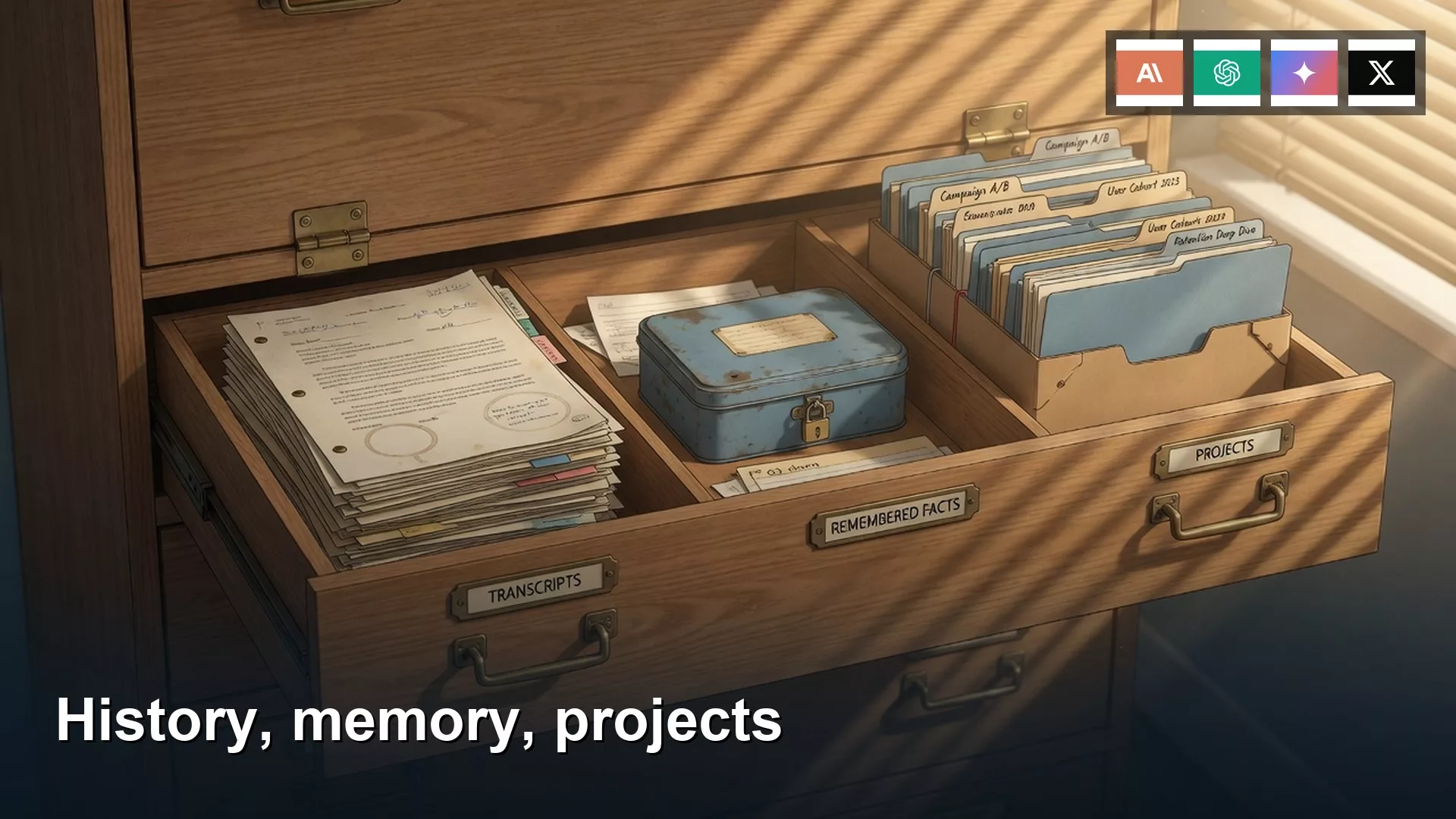
This is Part 17 of Phase P, and Part 1 of Memory, projects, and files across AI tools. The setup series got you an account. Part 7 is Free vs paid. AI for files and office work is the cousin for spreadsheets and PDFs. Today is the filing problem inside the chat product. History, memory, and projects are three drawers. Mixing them is why the model “remembers” a client name you never wanted saved, or forgets the brief you pasted yesterday. Next: Uploading docs safely.
What you’ll learn
- What chat history actually is (this thread, plus a sidebar list), and why it will not file yesterday’s brief for a new chat
- What Memory keeps across chats, how to view and delete it as of writing, and which facts should never live there
- What a Project (Claude Projects, ChatGPT Projects, Gemini Gems-style spaces) is: a job bucket with files and instructions
- When to use a Temporary or incognito-style chat, with the hedge that vendor names and hold times move
- A Monday audit: count the saved items, delete the soccer team, and put the board deck in a project
Three drawers, not one pile
People talk about “ChatGPT remembering me” as if the product had one brain. It does not. You are looking at three (sometimes four) places that keep different things for different lengths of time. Button labels will move. The jobs of the drawers stay stable enough to teach.

History is the conversation you are in, and the sidebar list of past conversations. Memory is a smaller set of facts the product may keep and reuse in later chats. A Project (or Gem, or similarly named space) is a bucket you build for a job: files plus standing instructions. Temporary is the “please do not file this” door. Some products also offer a “use my past chats” toggle that is not the Memory list. Treat it as Memory-adjacent until you read the vendor help page the week you care.
Rule of thumb: If you would not put the sentence on slide 1 of the deck, do not leave it in Memory. If you need the brief next Tuesday, put it in a Project, not in a thread you will lose in the sidebar.
Chat history is this thread
History is the scroll. You asked. The model answered. You pushed back. That stack is the thread. Most products also keep a sidebar list of threads, often searchable, sometimes archived. Closing the tab usually does not delete the thread if you are signed in. Open the same account on your laptop and the list is often there. Convenient. Still not a filing cabinet.
Tasha’s brief lived in Sunday night’s thread, 6 pages pasted at 11:04pm after the rain delay. Monday at 9:12 she started a new chat because the sidebar looked messy. The brief did not travel. The soccer team did, because that was Memory. She spent 8 minutes hunting the old thread by the auto-named title “Carpool and slides.” The brief was there. The new chat had never seen it. A new chat starts empty of that paste unless Memory, a Project, a Gem, or a “reference past chats” feature feeds it. Long threads also get fuzzy. Stay in the thread, or move the source into a Project. Name the thread yourself when the product lets you. “Q3 ops deck, 2026-09-08” beats “Carpool and slides.”
Memory is facts that travel
Memory is the sticky notes the product writes about you and then brings into later chats. OpenAI’s Memory FAQ (as of writing) is the clearest vendor page: when Memory is on, ChatGPT may keep useful context from chats, files, and connected apps so you repeat yourself less. You can turn it off. You can open a Memory summary and delete items. The same FAQ is honest that the summary is not a full dump of everything the system might use. Do not treat the list as a complete audit log.
Other products rhyme. Gemini has shipped personalization that can draw on past chats (look for Personal Context; names move). Gems are a different drawer. Claude’s obvious job bucket is Projects. Whether your Claude plan also shows a global Memory-style list is a Settings check this week. Grok keeps renaming similar controls. If you cannot find a list of saved facts, assume the product may still be personalizing.
What belongs in Memory: your role, your voice, your tools, constraints that are true in every chat. “I write ops decks for a VP who wants unit cost on slide 3.” “Short sentences. No sports talk.” What does not belong: kids’ names and teams, home addresses, health, a client’s nickname, passwords. Tasha’s 11 items were 10 useful notes and 1 leak. The leak took 40 seconds to delete. It had already reached the draft. Some ChatGPT accounts also get a “reference chat history” toggle (wording moves) that can pull from old threads even when a fact is not in the Memory summary. If Sunday should never flavor Monday, archive that thread, turn the toggle off, or use Temporary for the Sunday stuff.
Projects are a job bucket
A Project is a container you build for a job. You give it a name, standing instructions, and files. New chats inside that container should see the files and the instructions. Memory tries to follow you everywhere. A Project stays in its box, or it should.
Claude Projects (as of writing, Anthropic’s help: “What are projects?”) are workspaces with their own chats, uploaded files, and instructions. Free accounts can create a small number; Anthropic has published a cap of five for free users. ChatGPT Projects are the same shape. As of writing you can pick default memory (global notes can bleed in) or project-only. Default is how a soccer team walks into a client folder. Use project-only for client work when the product offers it. Temporary chats cannot be dropped into a project. Gemini Gems wrap instructions plus knowledge files. A new Gem chat often reloads those original files, not last Tuesday’s conversation. One job, one bucket. A Gem named “Work” is how Harbor and the soccer team sit together. Team plans that share a project are a leak surface: if the bucket has a client brief, check who can view it.
Tasha’s fix for the deck was not “turn Memory off forever.” She created a project named “Tuesday ops review.” She uploaded last year’s 12-slide PDF and this year’s 6-page brief (once she found the Sunday thread). She pasted instructions: audience is the VP of Ops, 12 minutes, unit cost on slide 3, no family details, if a number is missing say “not in the brief.” The soccer team had nowhere to stand.
Temporary chats exist, names move
Several products now offer a chat that tries not to join history or Memory. ChatGPT calls this Temporary Chat as of writing. OpenAI’s Temporary Chat FAQ says those chats do not appear in your history, do not use or create memories, and are not used to train models. For safety, OpenAI may still keep a copy for up to 30 days. Custom instructions at the account level may still apply. The button has lived as a pill in the top right of a new chat. Re-check. UI moves. Gemini has shipped a Temporary Chat with a similar pitch; hold times in public writeups have been shorter than 30 days, so open Google’s help the week you need it. Claude and Grok have offered incognito-style modes at various times. If you cannot find the control, do not invent it.
Temporary is the right drawer for Sunday carpool, a medical “what does this word mean,” or a messy paste. It is the wrong drawer for the board deck you need at 7:40am. Tasha’s Sunday chat should have been Temporary. The deck should have been a Project. She used one ordinary chat for both because it was late and raining. That is how 1 of 11 memories went wrong. Temporary is not a legal eraser. A 30-day vendor hold is still a hold. If the file cannot go to a US vendor at all, running a local model is the other series.
Which drawer for which job
Use this table as a map, then confirm in the product. Answers assume you are signed into the same account. A work laptop with a different login is a different person as far as the vendor is concerned. That identity split is setup series territory.
| Drawer | Survives closing the tab? | Shared across devices? | Good for | Danger |
|---|---|---|---|---|
| History | Usually yes, as that thread in the sidebar | If you are signed in, often yes | Continuing this conversation | You think the brief is filed. A new chat is empty. |
| Memory | Yes, until you delete the item or turn Memory off | Yes. That is the point. | Stable job, voice, tools | Sunday soccer in a Monday deck. Client names that travel. |
| Project / Gem | Yes. The bucket, files, and instructions stay. | Signed in, on that product, yes | A recurring job with source files | Default Memory bleed. One bucket for every client. |
| Temporary | Usually no lasting sidebar item. Vendor may hold a short copy. | Often no thread to reopen later | One-off, sensitive, or messy paste | You needed the transcript at 7:40am and it is gone. |

Worked beat, same Monday. Tasha’s Memory list after the audit (toy labels, her 11 items, one miss called out):
| Saved item (as she read it) | Keep? | Move instead |
|---|---|---|
| Writes ops decks for the Tuesday review | Keep in Memory | |
| Short sentences, no filler, no sports talk | Keep in Memory | |
| VP wants unit cost on slide 3 | Keep, or put in project instructions | Project instructions if it is only this deck |
| Kid plays for Riverside U10 Lightning, Saturday 8am, teal | Delete | Temporary, if she chats soccer at all |
| Client “Harbor” nickname from a Slack paste | Delete | The Harbor project only, never global Memory |
The other 6 of her 11 were tool names, a preferred table layout, and “do not invent numbers.” Fine. The Harbor nickname was item 11, spotted on the second pass. Soccer was the loud miss. Harbor would have been the expensive one in a shared slide. Paste this into a note, then into a project’s instruction box. Change the brackets.
What lives where (one vendor)
Vendor: [ChatGPT / Claude / Gemini / Grok]
Account email: [work address]
Date checked: [YYYY-MM-DD]

HISTORY
- This thread only. Yesterday's brief is in the old thread, not a new chat.
- Sidebar title I will use: [Q3 ops deck, 2026-09-08]

MEMORY
- Toggle: [on / off]
- Screen I opened: [Settings, Memory or Personalization]
- Count of saved items: [11]
- Deleted this week: [Riverside U10 Lightning] [Harbor nickname]
- Never put here: kids, health, home, client names, passwords

PROJECT / GEM / SPACE
- Name: [Tuesday ops review]
- Memory setting if offered: [project-only, not default]
- Files in the bucket: [brief.pdf] [last-year-12-slides.pdf]
- Who can view this (team plans): [only me]

TEMPORARY
- Use for: Sunday carpool, medical words, messy one-off paste
- Do not use for: the deck I need at 7:40am

PROJECT INSTRUCTIONS
Job: Board deck for the Tuesday ops review.
Audience: VP of Ops, 12 minutes.
Voice: short sentences. No sports talk. No family details.
Must include: unit cost on slide 3, if the brief has it.
Never mention: kids, teams, home, personal calendar, client nicknames from other work.
Cite only files in this project.
If a fact is missing, write "not in the brief" instead of guessing.
What that block does: it forces a count. Eleven is a number you can finish in one sitting. “I think Memory is off” is how the Lightning jersey gets into slide 1. If your vendor has no Project yet, keep the instruction block in a doc and paste it at the top of each work chat. Ugly. Clear. Better than hoping history filed it.
Common mistakes
- Starting a new chat every morning and wondering why the brief “forgot you.” That was history. Open the old thread or put the brief in a project.
- Leaving Memory on and never opening the list. Tasha had 11 items and had not looked once. The 1 miss was public in a draft.
- Putting client work in the default Memory pool, then opening a Project that inherits it. Prefer project-only when the product offers it.
- One Gem or Project named “Work” that holds every PDF you own. Names will mix. One job, one bucket.
- Drafting the real deck in Temporary, then losing the transcript. Temporary is for the rain delay, not for the VP review.
- Treating Temporary as “the vendor never saw this.” Read the FAQ. A 30-day safety copy is still storage. Attachments in a regular thread are also not a Project knowledge base. Where the file went is later in this series.
How to practice this week
- Open your main chat product. Find Memory (or Personalization, or the closest list of saved facts). Count the items. Write the number down. Delete anything a VP should not see.
- Find Temporary (or the incognito-style control). Send one throwaway question. Confirm it does not land in the sidebar the way a normal thread does.
- Create one Project or Gem for a real job you will do twice. Put two files in it. Paste the instruction block above. If the product offers project-only memory, turn that on.
- Rename one old sidebar thread so you can find last week’s brief without scrolling for “Carpool and slides.”
Next: Uploading docs safely, what to strip before a file goes in the bucket. Learn lists the paths. The chooser is still which door.
Quick recap
- History is this thread (and the sidebar list). It is not a cabinet.
- Memory is facts that travel. View, count, delete. Tasha: 11 items, 1 that should never have been there.
- A Project or Gem is a job bucket with files and instructions. Not Memory.
- Temporary is the “do not file this” door. Names move. Vendors may still hold a short copy.
- Sunday soccer in Temporary. The brief in a project. Memory only for job and voice.
Sources
- OpenAI: Memory FAQ (how Memory works, view and delete, Temporary as the opt-out)
- OpenAI: Projects in ChatGPT (project files, chats, memory settings as of writing)
- OpenAI: Temporary Chat FAQ (no history item, no Memory, possible 30-day safety copy)
- Anthropic: What are projects? (workspace, knowledge files, instructions, free-user cap as of writing)
- Google: Tips for creating custom Gems (instructions plus knowledge files)
- Google Gemini app (confirm Temporary Chat and personalization labels in the live UI)
- Grok (confirm any Memory or space labels the week you use it)
- AMS: AI for files and office work
- AMS: AI setup from zero
Keep going
Same lessons in your feed
Short diagrams and hooks on Instagram, X, and Facebook.
Merch on Etsy
Open store → Y Hat Mouse Pad, Data Science Mouse Pad, Analytics Mouse Pad, Y Pred Mouse Pad
View on Etsy →
Y Hat Mouse Pad, Data Science Mouse Pad, Analytics Mouse Pad, Y Pred Mouse Pad
View on Etsy →
 You're On Mute White Ceramic Coffee Mug, Data Science Mug, Data Mug, Analytics Mug, Statistics Mug, Programming Mug, Gift Mug, Coffee Mug
View on Etsy →
You're On Mute White Ceramic Coffee Mug, Data Science Mug, Data Mug, Analytics Mug, Statistics Mug, Programming Mug, Gift Mug, Coffee Mug
View on Etsy →
 Naive Bayes Mouse Pad, Data Science Mouse Pad, Analytics Mouse Pad, Bayesian Mouse Pad
View on Etsy →
Naive Bayes Mouse Pad, Data Science Mouse Pad, Analytics Mouse Pad, Bayesian Mouse Pad
View on Etsy →
 You're On Mute White Ceramic Coffee Mug, Data Science Mug, Data Mug, Analytics Mug, Statistics Mug, Programming Mug, Gift Mug, Coffee Mug
View on Etsy →
You're On Mute White Ceramic Coffee Mug, Data Science Mug, Data Mug, Analytics Mug, Statistics Mug, Programming Mug, Gift Mug, Coffee Mug
View on Etsy →