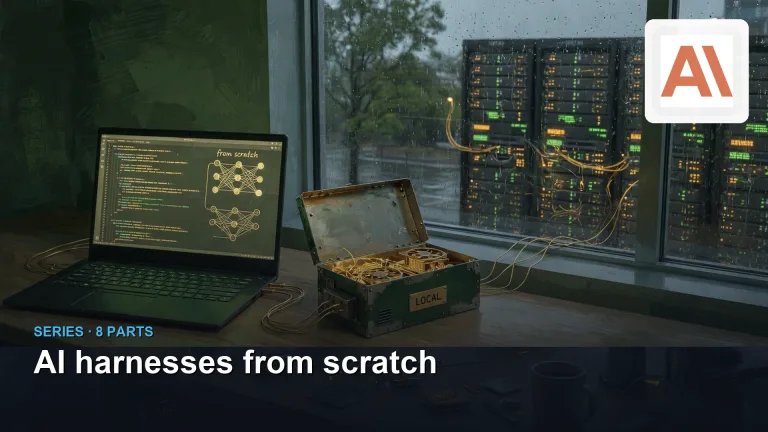
This path is for you if a coding agent is a black box and you want the loop: tools, packed context, and how a run is judged. No part is live on this page yet. Start with AI agents for everyone for the plain version of watch, approve, and check.
- 1 What is an AI harness, and how does it let an AI model do real work? An AI harness wraps a stateless model with tools, state, and a ReAct loop. Build a small one yourself before you assume you need a proprietary agent product.
- 2 Chat box or AI agent? Which kind of AI coding tool to use Choose chat for brainstorming, IDE agents for visual local edits, terminal harnesses for multi-file verify loops, and background agents for well-tested batch chores.
- 3 How to make an AI agent ask before it runs commands on your computer Define tool schemas, intercept calls for human approval, and isolate execution. Host subprocesses need allowlists; containers need clear mounts. Defense in depth beats hope.
- 4 How to give an AI coding assistant the right files and context Pack agent context on purpose: search, AST skeletons, tiered budgets, and pruned tool output. More tokens are not more understanding.
- 5 How to test whether an AI coding agent’s changes actually work Evaluate coding agents with real issues, unit tests, and Pass@k metrics. Build a small internal golden set. Do not trust demos or pure LLM judges.
- 6 Open-source AI coding agents vs paid products: which to use Compare open and product harnesses on control, cost, and compliance. Prefer portable tool protocols so you are not stuck rewriting every connector.
- 7 How to keep an AI agent from running away, leaking secrets, or deleting files Safety for agents means turn budgets, secret redaction, destructive-command gates, and hash-based loop detection. Assume the model will retry forever unless you stop it. Scheduled · October 22, 2026
- 8 When to use a plain AI chat instead of an AI agent Use plain chat when the work is thinking and writing. Use agents when files, tests, and shells must close the loop. Match surface to stakes. Scheduled · October 24, 2026