
You install an AI extension in your editor because a conference talk promised “10x.” Two weeks later the extension refuses requests, your personal Google AI Pro plan no longer covers that path, and a coworker on an enterprise seat still has completions. Nobody lied on purpose. Coding surfaces for Gemini-class tools split by edition, and mid-2026 was a transition year for consumer versus enterprise paths.
This is Part 2 of the Gemini product map (GM9). We map Gemini help inside IDEs, including Android Studio and Code Assist style products, without pretending every screenshot still applies to your license. For deep daily loops, the later coding tutorial series goes further. Here you learn which product family you are even installing.
What “AI in the IDE” means versus chat
- What “AI in the IDE” means versus chat apps and terminal agents
- How Gemini Code Assist style products show up across editors
- Why Android Studio has its own Gemini overview for mobile work
- What changed for many consumer / individual tiers around June 2026
- What often stays available for enterprise Standard/Enterprise seats
- A before-you-install checklist so you do not fight the wrong error message
IDE assist is not the Gemini chat app
Chat apps optimize for conversation. IDE assistants optimize for code next to your project files: completions, chat with local context, explain/refactor actions, and sometimes pull request help. You stay in VS Code, JetBrains IDEs, Android Studio, or cloud editors. The model family may still be Gemini. The product packaging, quotas, and login are different.
Gemini Code Assist in plain English
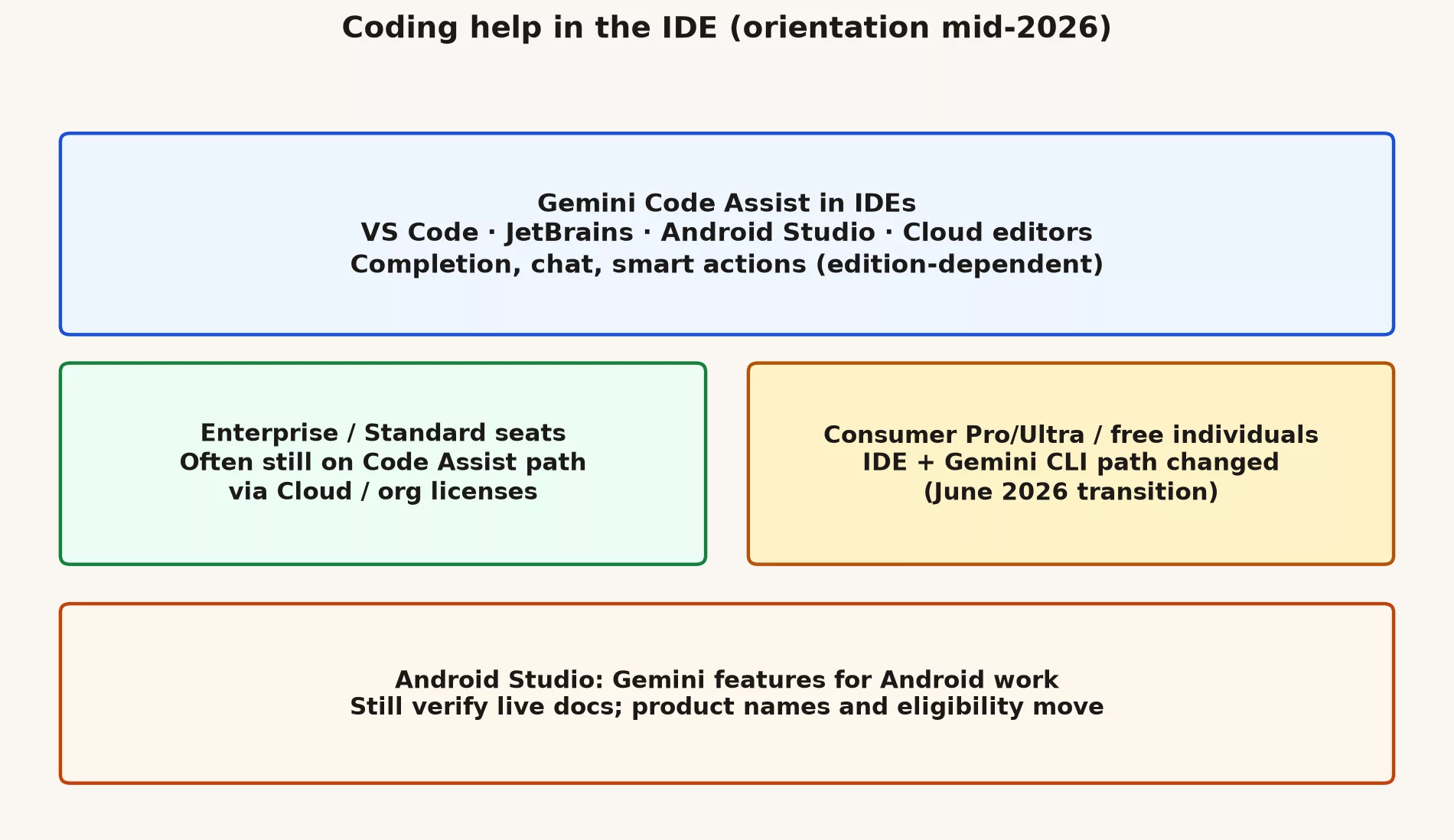
Google’s documentation describes Gemini Code Assist as AI coding assistance in supported IDEs (examples historically include VS Code, JetBrains IDEs such as IntelliJ and PyCharm, Android Studio, Cloud Shell Editor, and Cloud Workstations). Features commonly include:
- Inline code completion and generation in a project
- Chat oriented to the codebase
- Smart actions on selected code
- Slash-style commands in some editors
- Org-managed editions with different quotas and admin controls
Exact feature matrices depend on Standard vs Enterprise vs individual-era offerings. Always open the current overview for your edition before you promise a team “we all get the same thing.”
Android Studio specific angle
Android developers often meet Gemini through Android Studio documentation under Studio’s Gemini overview pages. The jobs are familiar (explain, generate, refactor) with Android project context. Treat Studio as a first-class IDE surface, not a random plugin afterthought. If your org standardizes on Android Studio, train on that UI, not only on a VS Code demo.
The 2026 consumer transition (orientation)
Google announced a unification of agent-first developer tooling under Google Antigravity, including a terminal experience called Antigravity CLI. Public developer blog material described a timeline where, on June 18, 2026, Gemini CLI and Gemini Code Assist IDE extensions would stop serving requests for Google AI Pro and Ultra and for free individual Code Assist style access. Related notes also covered Gemini Code Assist for GitHub installation changes for many non-enterprise paths.
Deprecation help pages after that date describe individual / Pro / Ultra IDE and Gemini CLI access as stopped for those tiers, and point people at migration guidance toward Antigravity CLI. Enterprise and Standard Code Assist style licenses via Cloud / org agreements were described as remaining supported on the older surfaces in those announcements. API-key based paths also appear in the “still works” notes for some paid platform use. This is orientation language for mid-2026. Your tenant may differ. Read the live deprecation and migration pages before you rewrite onboarding docs.
| Who you are (roughly) | What to verify first | Likely direction |
|---|---|---|
| Enterprise / Standard org seat | Admin docs + Code Assist edition | Often continue IDE Code Assist under org license |
| Personal AI Pro / Ultra power user | Deprecation + Antigravity download/migration | Terminal/agent path may have moved off Gemini CLI |
| Free individual experimenter | Whether IDE extension still accepts your login | Expect breaks; check Antigravity / Studio / API options |
| Android-focused employee | Studio Gemini + company policy | Use approved Studio features, not random personal plugins |
Before you install anything
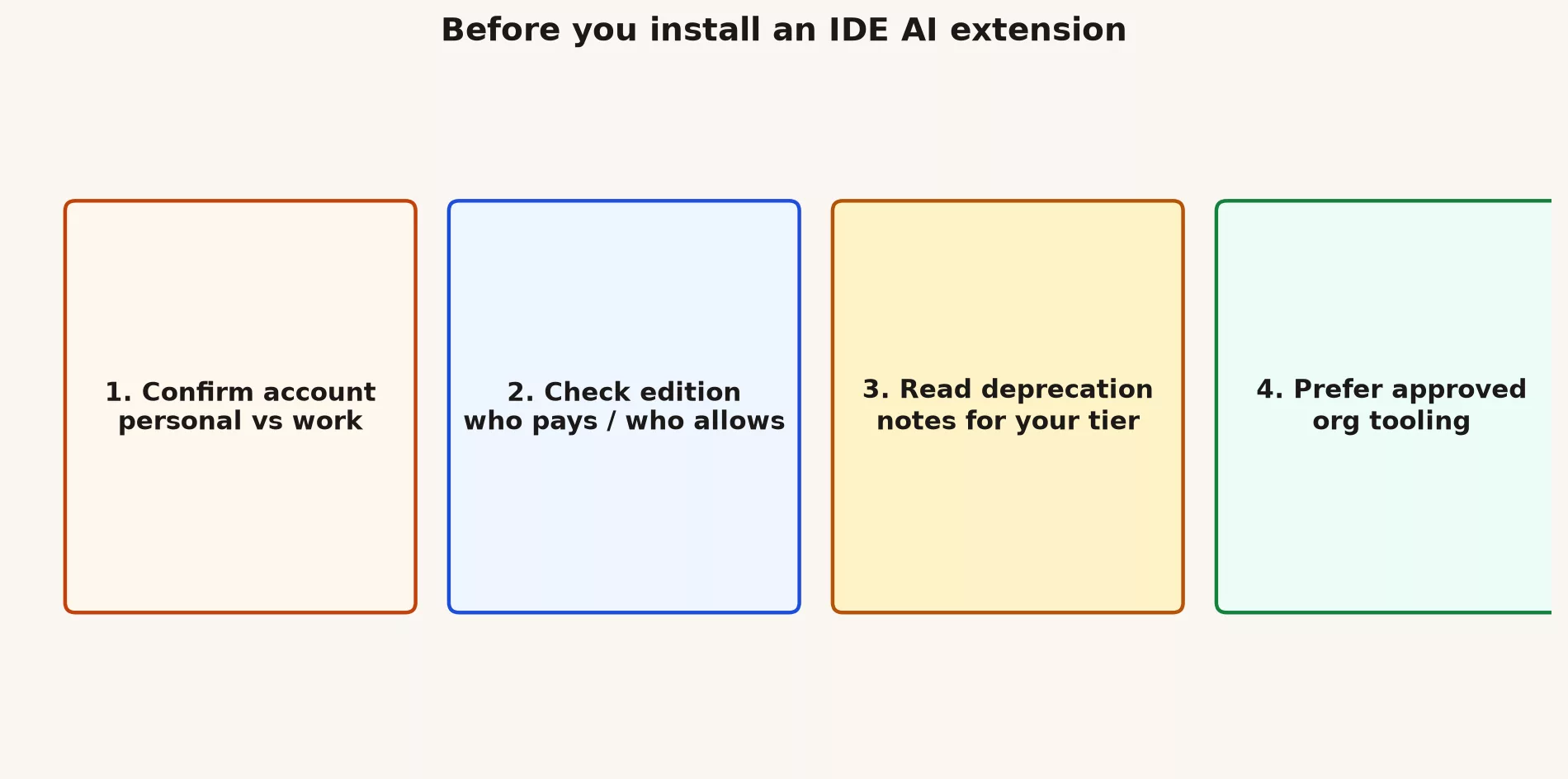
- Confirm personal vs work Google account (and which the company allows on the laptop).
- Ask which edition pays for coding AI: personal subscription, org Code Assist, Cloud project, or none.
- Read current deprecation notes if you are not on an enterprise seat.
- Prefer tools on the company approved list over conference swag installs.
- Plan a human review loop: AI completions are not merges.
What good IDE AI use looks like
- Small, reviewable diffs instead of multi-file mystery rewrites
- Tests run after generation, not vibes-based “it looks fine”
- Secrets never pasted into chat panels
- Licenses and third-party code checked when the model suggests dependencies
- Team style guides still win over model taste
# Example human checklist after an AI edit (any vendor)
# 1) Read the diff
# 2) Run unit tests you trust
# 3) Search for new network calls or file writes
# 4) Confirm no secrets in logs
# 5) Request review if the change touches auth or payments
When the IDE assistant is the wrong surface
- You only need a paragraph rewrite (use Docs / Gemini app)
- You need a long research chat with PDFs (chat or NotebookLM)
- Your org banned AI on source code
- You cannot explain the generated code well enough to own it
How GM9 connects to GM10 and the coding tutorial
GM10 explains the terminal story: Gemini CLI versus Antigravity CLI. The later Gemini coding surfaces tutorial (GM22 to GM26) is where you practice ask/edit/test/review loops and quota debugging. This part only answers “what product did I install?”
List the editors you actually use weekly
- List the editors you actually use weekly.
- For each, note whether AI is installed and which account it uses.
- Open one official overview page for Code Assist or Android Studio Gemini and write the edition name you think you have.
- If anything is unclear, send IT three bullets: editor, account type, business justification.
Assuming Pro chat plan equals IDE access forever
- Assuming Pro chat plan equals IDE access forever
- Debugging “model is dumb” when the real issue is a stopped consumer path
- Installing three overlapping AI extensions that fight keybindings
- Skipping code review because the suggestion looked authoritative
Name the approved editors and the approved AI
A operations team standardized on personal consumer accounts because Workspace AI was “not rolled out yet.” Six months later they had no audit trail and three conflicting prompt templates. The rebuild cost more than the original seat conversation with IT.
A mobile squad installed every AI IDE plugin available. Completions overlapped, secrets scanners screamed, and juniors accepted multi-file edits they could not explain. They cut back to one approved surface and a written review rule. Velocity went up because review time went down.
A prototype used Studio keys in a public demo without rate limits. A scraper found it over a weekend. Budget alerts did their job only after the bill was already ugly. Caps in code and on the cloud project are cheaper than postmortems.
If you only remember one sentence from this part: product packaging and account type decide what you can click long before model taste debates matter. Get the door right, then get the habit right, then worry about which label is on the dropdown this month.
Enterprise onboarding sketch for IDE AI
- Name the approved editors and the approved AI extension or built-in feature.
- Document login: work account only, SSO if required.
- Share a 20-minute recording of explain → patch → test on a toy repo.
- Publish a “never do” list: force push, secrets in chat, accepting huge diffs unread.
- Create an escalation channel for quota errors and deprecation banners.
- Review plugin allowlists quarterly after Google renames products.
Android-heavy teams
If your product is mobile-first, do not train exclusively on web VS Code demos. Run the first workshop inside Android Studio with a real module, a failing test, and a code style your team already uses. Show how to refuse a bad suggestion. Show how to ask for an explanation of generated Kotlin or Compose code before merge. Studio-specific context (Gradle, manifests, emulators) is where juniors get lost when tutorials are generic.
Personal projects on personal hardware
On your own machine, for open source or hobby code, you may choose consumer paths that your company would reject. Keep that world separate: different git configs, different keys, different browsers if needed. The failure mode is a hobby Antigravity session that still has a work repo open and a work secret in the environment.
Reading deprecation pages like an adult
Deprecation pages are written for many audiences at once. Skim for: effective date, which SKUs lose service, what remains supported, and the migration URL. Ignore comment-section panic. If your company has a Google Cloud TAM or reseller, ask them to confirm how your contract maps to the public language. Screenshots from social media are not contract interpretation.
IDE assistants are a different product surface
- IDE assistants are a different product surface from the Gemini chat app.
- Code Assist style tools span multiple editors; Android Studio has its own entry points.
- Mid-2026 consumer transitions pushed many people toward Antigravity; enterprise often stayed on licensed Code Assist paths.
- Next: Gemini CLI and Antigravity CLI, what replaced what.
Sources
- Gemini Code Assist overview
- Gemini in Android Studio overview
- Transitioning Gemini CLI to Antigravity CLI
- Code Assist individuals deprecation notes
- Google Antigravity
Keep going
Same lessons in your feed
Short diagrams and hooks on Instagram, X, and Facebook.
Merch on Etsy
Open store → Mute Mouse Pad, Data Science Mouse Pad, Analytics Mouse Pad, You're On Mute
View on Etsy →
Mute Mouse Pad, Data Science Mouse Pad, Analytics Mouse Pad, You're On Mute
View on Etsy →
 Dashboard to Excel Ceramic Coffee Mug
View on Etsy →
Dashboard to Excel Ceramic Coffee Mug
View on Etsy →
 Y Hat Mouse Pad, Data Science Mouse Pad, Analytics Mouse Pad, Y Pred Mouse Pad
View on Etsy →
Y Hat Mouse Pad, Data Science Mouse Pad, Analytics Mouse Pad, Y Pred Mouse Pad
View on Etsy →
 Good Cheap Fast White Ceramic Coffee Mug, Data Science Mug, Data Mug, Analytics Mug, Statistics Mug, Programming Mug, Gift Mug, Coffee Mug
View on Etsy →
Good Cheap Fast White Ceramic Coffee Mug, Data Science Mug, Data Mug, Analytics Mug, Statistics Mug, Programming Mug, Gift Mug, Coffee Mug
View on Etsy →