
The deck looked finished. Twelve slides, consistent fonts, a calm executive summary, and a chart that rose to the right like every chart that wants a raise. Finance circulated it before anyone opened the spreadsheet behind slide 4. Two days later someone noticed the “retention” series was actually new logo counts, the competitor prices were a year old, and the customer named on slide 7 had churned in March. Nobody had lied on purpose. The document was fluent, structured, and wrong. That pile of polished junk has a workplace nickname worth keeping: workslop.
This is Part 6 of the Claude Cowork tutorial. Part 5 covered autonomy modes and when to watch versus walk away. Here we cover what you do with the output: a quality loop that catches workslop before it becomes someone else’s decision. Cowork is good at multi-step office work. That skill is exactly why review has to get stricter, not looser, as autonomy rises.
What you’ll learn
- What workslop is (and why “it sounds professional” is not a quality bar)
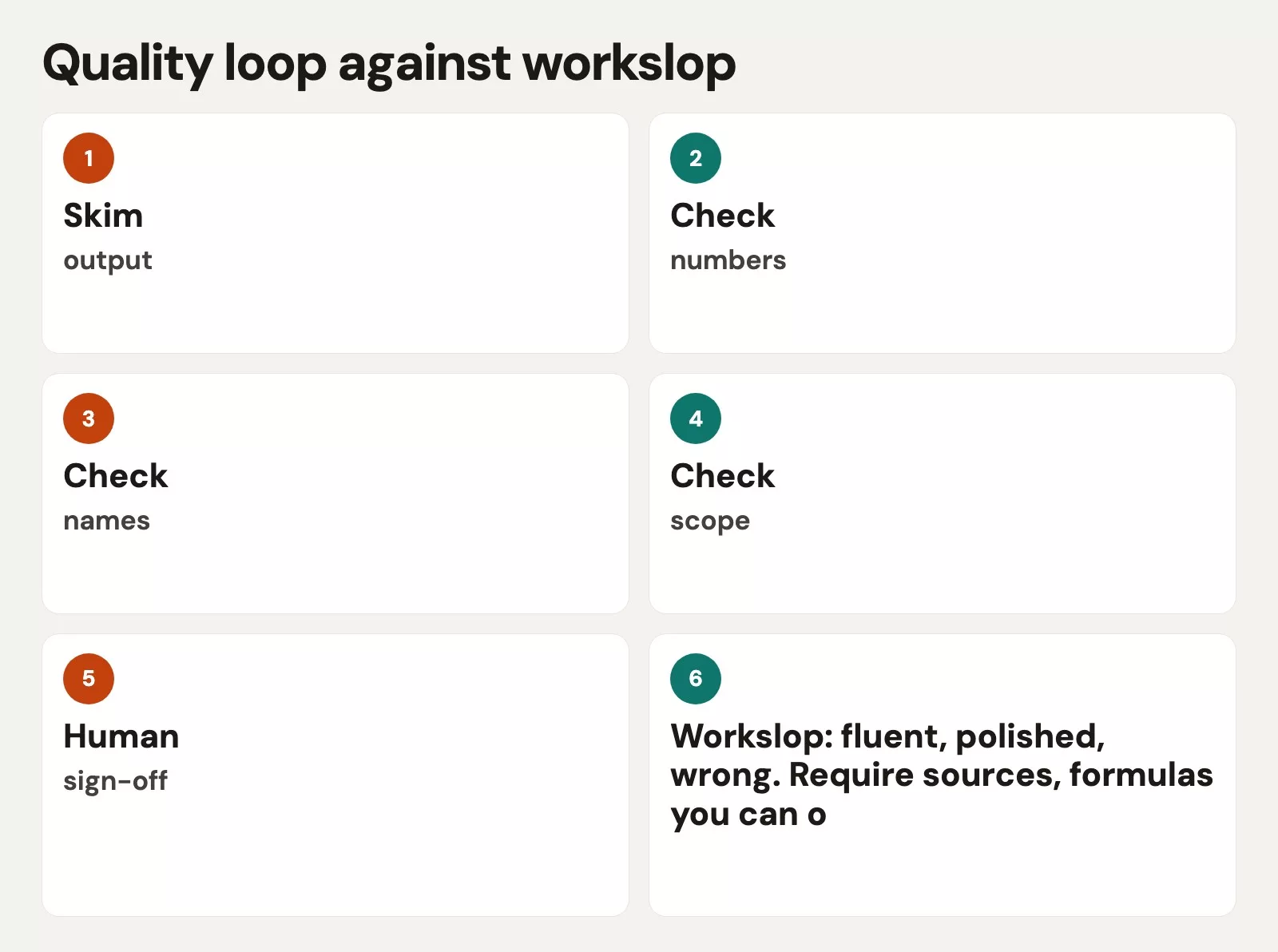
- A five-step quality loop: skim, numbers, names, scope, human sign-off
- How to check tables, decks, and email drafts without redoing the whole task by hand
- Failure modes that show up often in agent office work
- A short practice drill you can run on one real deliverable this week
- Why you still own the send, the share, and the number on the slide
UI labels and export formats change. The loop does not. Pair this chapter with Part 5’s mode choices: high autonomy without a quality loop is how workslop scales. For the coding cousin of this habit, the Claude Code tutorial’s diff-review parts rhyme with the same skepticism.
What workslop is
Workslop is fluent, wrong, polished junk. It looks ready for a meeting. It may even follow your brand colors. Under the finish, definitions drift, numbers do not reconcile, names are off by one letter, or the agent answered a slightly different question than the one you asked. The danger is social: busy people forward work that reads finished. Chat answers can be wrong too, but they often still look like drafts. Cowork deliverables look like products.
1. Skim structure
Before you deep-read, map the artifact. For a doc: headings, claim order, what is missing. For a sheet: tabs, column headers, filters, frozen panes, whether formulas still live or values are pasted. For a deck: slide titles only, first. Ask: does this outline match the goal you wrote? If you asked for a comparison of three vendors and you got a generic “market landscape,” stop. Fix the goal and re-run or re-scope. Do not polish the wrong essay.
Skim also catches empty sections that look full: a slide titled Risks with three vague bullets, a “methodology” paragraph that names no data source, an appendix that is only a logo. Structure fails are cheap to catch if you refuse to be hypnotized by layout.
2. Check numbers
Pick the numbers that would change a decision. Totals, rates, deltas, rankings, dates of “as of.” Recompute at least three of them from the source files Claude used, or from the system of record you trust. Do not only re-read the agent’s summary of the numbers. Open the cells. Open the PDF page. Open the export.
A tiny reconciling habit that saves careers:
NUMBER_CHECK (use on any agent table)
1. Row count of source filter vs row count in summary
2. Sum of amount column vs dashboard / warehouse total for same filter
3. One rate = numerator / denominator with the definition written in plain English
4. As-of date and timezone if the metric moves daily
5. Currency and units (thousands? millions? local currency?)

If any fail: quarantine the file. Do not “fix the narrative” first.
If Claude built formulas, spot-check that formulas reference the right ranges after sorts and filters. If Claude pasted values, ask whether refresh is possible later. Static paste is fine for a one-off pack if labeled; silent paste that looks live is workslop fuel.
3. Check names
Names are high-embarrassment, low-effort checks. People, companies, product names, legal entities, region labels, metric names. Compare against CRM, contracts, or the source folder. Watch for near-misses: one-letter swaps, old brand names, internal codenames that should never leave the building, and “Acme” placeholders that somehow survived into the external draft.
Also check that metric names match metric math. If the column says “gross margin” and the formula is revenue minus a partial cost set, rename or recompute. Wrong labels are how workslop travels: the number might be a real calculation of something else.
4. Check scope
Scope failures are agent classics. You asked for a one-page table. You received a twelve-slide strategy, three new folders, and a draft policy no one requested. Or the opposite: you asked for full vendor coverage and two PDFs were ignored without a note. Scope review asks:
- Did we only touch the working folder and tools I intended? (Part 5 habits)
- Did every required input appear in the output or in an explicit “not found” note?
- Did extra recommendations or actions appear that I did not ask to execute?
- Is outbound communication still a draft, or did a connector do something live?
If scope expanded, decide deliberately: accept the extra (rare), delete it, or re-run with sharper non-goals. Do not ship the bonus novel because the fonts match.
5. Human sign-off
Sign-off is a person accepting responsibility, not a rubber stamp emoji in chat. For low stakes, that person can be you after the four checks. For customer-facing, board-facing, or regulated content, add a second pair of eyes the way you would for a human junior’s work. Write one sentence: what you verified, against which source, on which date. That sentence is your audit crumb when someone asks later “who blessed this?”
Official Cowork safety guidance is clear that safeguards reduce risk and that users remain responsible for how they use the product. Sign-off is how responsibility becomes operational instead of theoretical.
Quality loop by artifact type
| Artifact | Skim | Numbers | Names | Scope | Sign-off cue |
|---|---|---|---|---|---|
| Comparison table | Columns match the ask | Recompute 3 cells from PDFs | Vendor legal names | All files included or noted missing | “Checked against folder X on date Y” |
| Spreadsheet model | Tabs and headers | Totals, rates, formula ranges | Metric labels vs math | No hidden sheets full of secrets | Owner initials on a README tab |
| Slide deck | Titles-only story | Every chart’s source cell | Customer and product names | No extra strategy chapter | Presenter agrees to defend each claim |
| Email / message draft | To, CC, subject, ask | Any figure in the body | Recipient names and titles | Still unsent; no surprise attaches | Human hits send after checks |
| Research brief | Claims vs sections | Cited figures openable | Source titles and orgs | Untrusted web limited; no live actions | Reader can re-find sources |
Worked example: the “finished” vendor pack
Suppose Cowork returns vendor_compare.xlsx and finance_note.docx from the sandbox folder in Part 5’s scenario. You run the loop.
Skim: Sheet has columns Price, Term, Support hours, Notes. Doc has three short paragraphs and a “recommended next step.” Structure matches the ask. Good start.
Numbers: You open vendor B’s PDF. Support is “business hours ET,” not “24/7” as the sheet claims. Price band for vendor C is list price, not the discounted band in the appendix. Two cells fail. You quarantine both files from email.
Names: Vendor A’s legal name is wrong by one word (old brand). Easy fix, high embarrassment if finance already knew them.
Scope: The note recommends “I can send this to the vendor reps this afternoon.” You did not ask for outreach. You delete that paragraph and confirm no connector sent anything.
Sign-off: You correct the two cells and the legal name, add a one-line source note (“cells B2:B4 checked against PDFs in vendors-q3, 2026-07-24”), and only then forward to finance. That is not distrust of Claude. That is how adults ship numbers.
A review card you can paste into instructions
You can put part of the bar into Cowork’s global or folder instructions so drafts arrive closer to usable. Instructions do not replace the loop. They reduce the distance.
OUTPUT_QUALITY (folder instructions sketch)
- Prefer tables with explicit units and as-of dates
- If a source is missing or unreadable, say so in a Gaps section
- Do not invent competitor prices or customer names
- Keep recommendations separate from facts
- Do not send messages or create calendar events unless I explicitly ask
- End with: Sources used (file names) and Checks I could not complete
That last line is gold. Forcing the agent to list what it could not verify gives you a head start on step 2 of the loop.
Workslop smells (checklist)
- No sources. Confident claims with no file names, URLs, or system references.
- Rounded theater. Every number ends in 0 or 5 without reconciliation to raw data.
- Definition drift. Same word, new math, no footnote.
- Time soup. Mix of years, quarters, and “recently” without as-of stamps.
- Scope souvenirs. Extra folders, policies, or outreach plans you did not order.
- Placeholder survivors. TODO, Acme, Jane Doe, lorem, “insert metric.”
- Chart without table. Pretty picture, no underlying cells you can audit.
- Apology-free certainty. Zero gaps section on a messy source folder.
- Action already taken. “I went ahead and emailed…” when you asked for a draft.
If two or more smells fire, slow down. Switch to Manual for the fix pass (Part 5). Do not stack more autonomy on a broken artifact.
Autonomy and quality are one system
| Situation | Mode (Part 5) | Quality loop intensity |
|---|---|---|
| Sandbox, reversible, no send | Auto after a few Manual wins | Full loop once; sample checks next time |
| Customer or exec facing | Manual or Auto with watch | Full loop + second human when stakes are high |
| Untrusted web or inbox inputs | Manual; limit write tools | Full loop; treat content as hostile until proven |
| Scheduled task | Simple jobs only | Review every run at first; then sample with alerts for drift |
| Skip all approvals | Rare, fully trusted only | Full loop before anything leaves your machine |
Notice the pattern: as permission friction drops, review friction should rise or at least stay honest. Skip plus skim-only is how workslop becomes culture.
Team habits that keep workslop out of Slack
Individuals can run the loop alone. Teams need social rules so the fastest person does not set the quality floor.
- Label agent drafts. Filename or first line:
DRAFT-agentuntil sign-off. - No raw agent drops in decision channels. Decision channels get signed-off artifacts only.
- Share sources with claims. A deck without a data tab is incomplete, not minimalist.
- Praise catches, not just speed. If the only hero story is “Claude did it in four minutes,” you will get four-minute fiction.
- Respect org rails. Team and Enterprise plans may force connector approvals and admin policy. That is quality infrastructure, not red tape for its own sake.
Part 7 of this series covers team and enterprise notes in more depth. The cultural rule starts here: speed is allowed; unverified speed is not a virtue.
Common mistakes
- Reviewing only the chat summary. Summaries are stories. Open the files.
- Checking tone instead of numbers. Friendly prose can hide bad math.
- Fixing workslop by asking for “a more professional version.” Polish without verification is more workslop.
- Assuming Auto mode validated the business logic. Safety screening is not metric certification.
- Skipping sign-off because the schedule ran overnight. Unattended production still needs attended acceptance.
- Letting connectors send drafts. Draft means human send unless you explicitly automated send with open eyes.
- Comparing agents only on speed. Measure rework hours and error catches too.
How to practice this week
- Pick one real Cowork (or chat-with-files) deliverable you almost trusted.
- Run the five-step loop with a timer. Note which step found the first real issue.
- Add the
OUTPUT_QUALITYsketch to folder or global instructions and re-run a similar task. - Create a personal “smells” note and add one new smell the first time it bites you.
- If you use schedules, review the last three runs on the Scheduled page with the same number checks.
You own the action
Cowork can draft the email. You own the send. Cowork can build the model. You own the number in the staff meeting. Cowork can assemble research. You own what the company believes afterward. Anthropic’s safety materials stress layered defenses and still put responsibility on the user for cautious configuration and use. Quality control is how that responsibility shows up on a Tuesday afternoon when the artifact looks fine and you are late for another call.
If that feels slower than the demo videos, good. Demos optimize for wonder. Work optimizes for not lying to your future self.
Quick recap
- Workslop: fluent, wrong, polished junk that travels because it looks done.
- Loop: skim structure → check numbers → check names → check scope → human sign-off.
- Numbers: recompute decision-critical cells from sources; quarantine on mismatch.
- Names: people, vendors, metric labels; high embarrassment, fast checks.
- Scope: no surprise actions, no missing inputs, no bonus novels.
- Sign-off: a person accepts responsibility; write what you verified.
- Autonomy: lower permission friction should not mean lower review standards.
- Ownership: safeguards help; you still own sends, shares, and decisions based on the work.
Next, Part 7: Team and enterprise notes covers how org settings, connector policies, and shared norms change the same habits at company scale. For the broader map of Claude products, see the Claude product map series. Everyday chat skills still live in Learn Claude from scratch. More paths: Learn hub.
Sources
Research and further reading used for this article:
- Claude Help Center: Use Claude Cowork safely (risk model, prompt injection, Auto vs Skip, monitoring patterns not every command, scheduled-task review, user responsibility)
- Claude Help Center: Get started with Claude Cowork (agentic multi-step work, permission modes, transparency and steering mid-task, scheduled tasks, professional outputs still under your control)
- Claude Help Center: Use Claude in Chrome safely (browser action risks when research or form-filling is part of the job)
- Claude Help Center: Claude in Chrome permissions guide (Manual / Auto / Skip modes for browser actions)
- Claude Help Center: Use Claude Cowork on Team and Enterprise plans (org-level connector approval controls that affect how drafts become actions)
- Analytics Made Simple: How to check AI-written SQL (parallel review habit for fluent wrong technical output)
- Analytics Made Simple: Learn (related series map on this site)
Merch on Etsy
Open store → Y Hat Mouse Pad, Data Science Mouse Pad, Analytics Mouse Pad, Y Pred Mouse Pad
View on Etsy →
Y Hat Mouse Pad, Data Science Mouse Pad, Analytics Mouse Pad, Y Pred Mouse Pad
View on Etsy →
 Mute Mouse Pad, Data Science Mouse Pad, Analytics Mouse Pad, You're On Mute
View on Etsy →
Mute Mouse Pad, Data Science Mouse Pad, Analytics Mouse Pad, You're On Mute
View on Etsy →
 Naive Bayes Mouse Pad, Data Science Mouse Pad, Analytics Mouse Pad, Bayesian Mouse Pad
View on Etsy →
Naive Bayes Mouse Pad, Data Science Mouse Pad, Analytics Mouse Pad, Bayesian Mouse Pad
View on Etsy →
 You're On Mute White Ceramic Coffee Mug, Data Science Mug, Data Mug, Analytics Mug, Statistics Mug, Programming Mug, Gift Mug, Coffee Mug
View on Etsy →
You're On Mute White Ceramic Coffee Mug, Data Science Mug, Data Mug, Analytics Mug, Statistics Mug, Programming Mug, Gift Mug, Coffee Mug
View on Etsy →