Gemini 4 Argon, Google’s newest top AI model, is worth paying for through Google AI Pro at $19.99 a month only if you give Gemini long, many-step jobs most weeks. If you mostly ask quick questions, the free plan still covers you. Argon is not on the free plan or AI Plus, according to Google’s plans page (checked October 15, 2026). Google announced it on October 13, 2026.
Imagine you use the free Gemini app to tidy emails and explain the odd formula. Then a coworker forwards a launch headline that says Google has a new top model, and asks whether the team should start paying for it. You want an answer you can give in one sentence, with the price and the catch, without reading a page of test scores first. Fair enough.
What the new model is for
Gemini 4 Argon is the first model in Google’s Gemini 4 family. Google’s announcement calls it a frontier model, which means one of the most capable models a company sells at the time, and aims it at long, many-step work in coding, finance, law, cybersecurity and science.
Many-step work is a job you would normally split into a dozen smaller asks. Think big, not quick. An example is reading three contracts, comparing their payment terms, and drafting a summary table. A smaller model can do each piece. A model like Argon is meant to keep the whole job in its head and finish it in one go.
Through the Gemini API, which is how a program rather than a person sends work to Gemini, Argon accepts up to 1 million tokens per request, and Google says that limit is shared by what you send and what it writes back. A token is a chunk of text of about three quarters of a word, so 1 million tokens is roughly 750,000 words. In the app, the Gemini Apps help page lists the same 1 million token context window, the amount of text the model can consider at once, for AI Pro and Ultra (checked October 15, 2026).
What Google says it does better
Google’s announcement leans on test scores, so read them for what they are: Google’s own results, not an independent review. A benchmark is a fixed test that companies run models on so scores can be compared.
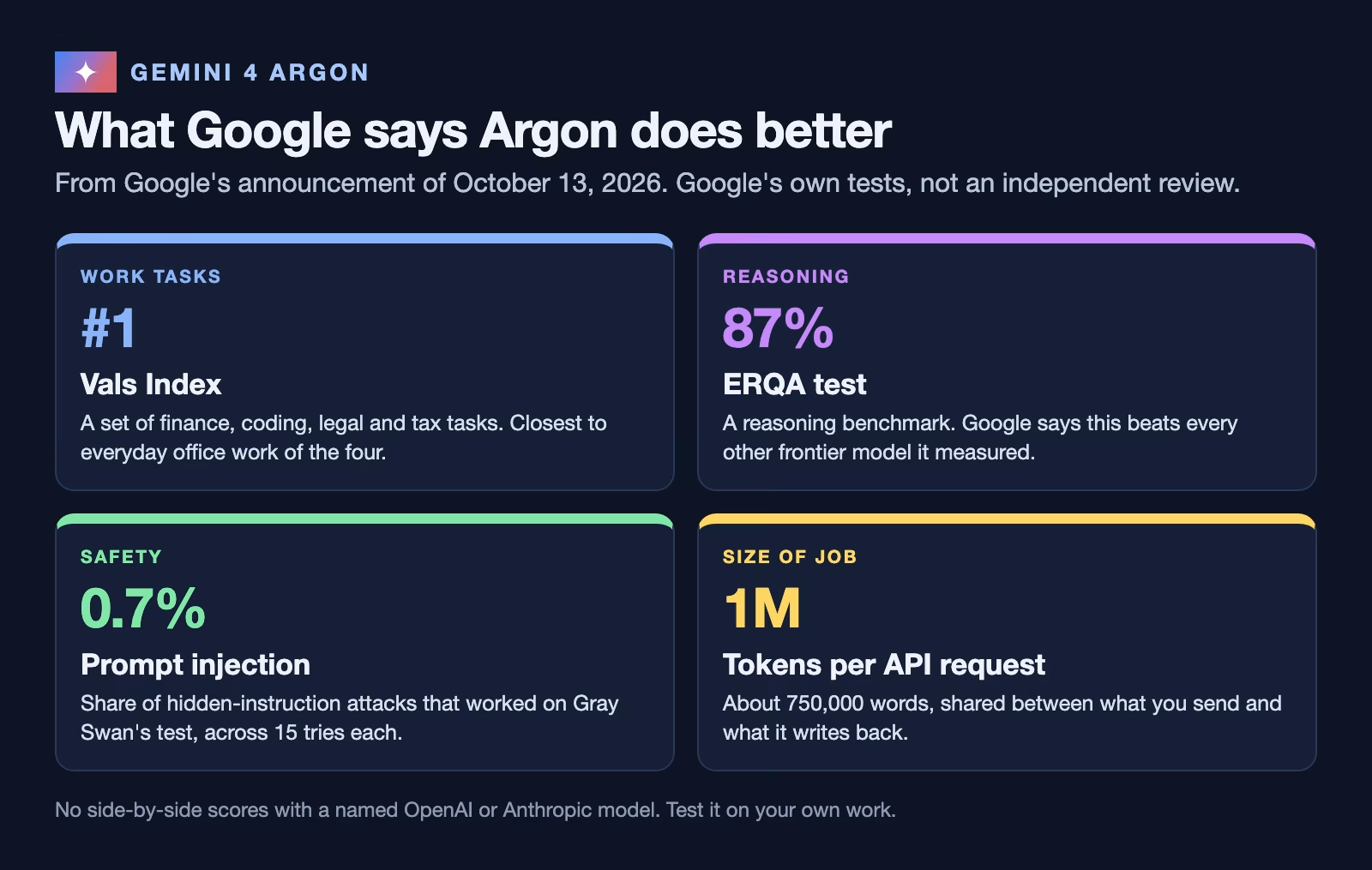
In its announcement, Google says Argon ranks first on the Vals Index, a set of finance, coding, legal and tax tasks, and scores 87% on ERQA, short for Embodied Reasoning Question Answering, a test of questions about pictures of real-world scenes, the kind of reasoning a robot needs. The same announcement reports that on Gray Swan’s prompt injection test, attacks succeeded 0.7% of the time across 15 tries. Prompt injection is when text hidden in a web page or file tricks the AI into following someone else’s instructions, so a low number there matters if you let Gemini read documents from outside your company.
The announcement compares Argon with “previous Gemini models” and unnamed “frontier models.” It does not put Argon side by side with a named model from OpenAI or Anthropic. If you are choosing between apps, run your own test, which the last section of this post walks through.
Who can use it, plan by plan
This is the part you probably came for. Here is where Argon shows up on Google’s consumer plans, from the plans page and the Gemini Apps help page, both checked October 15, 2026.
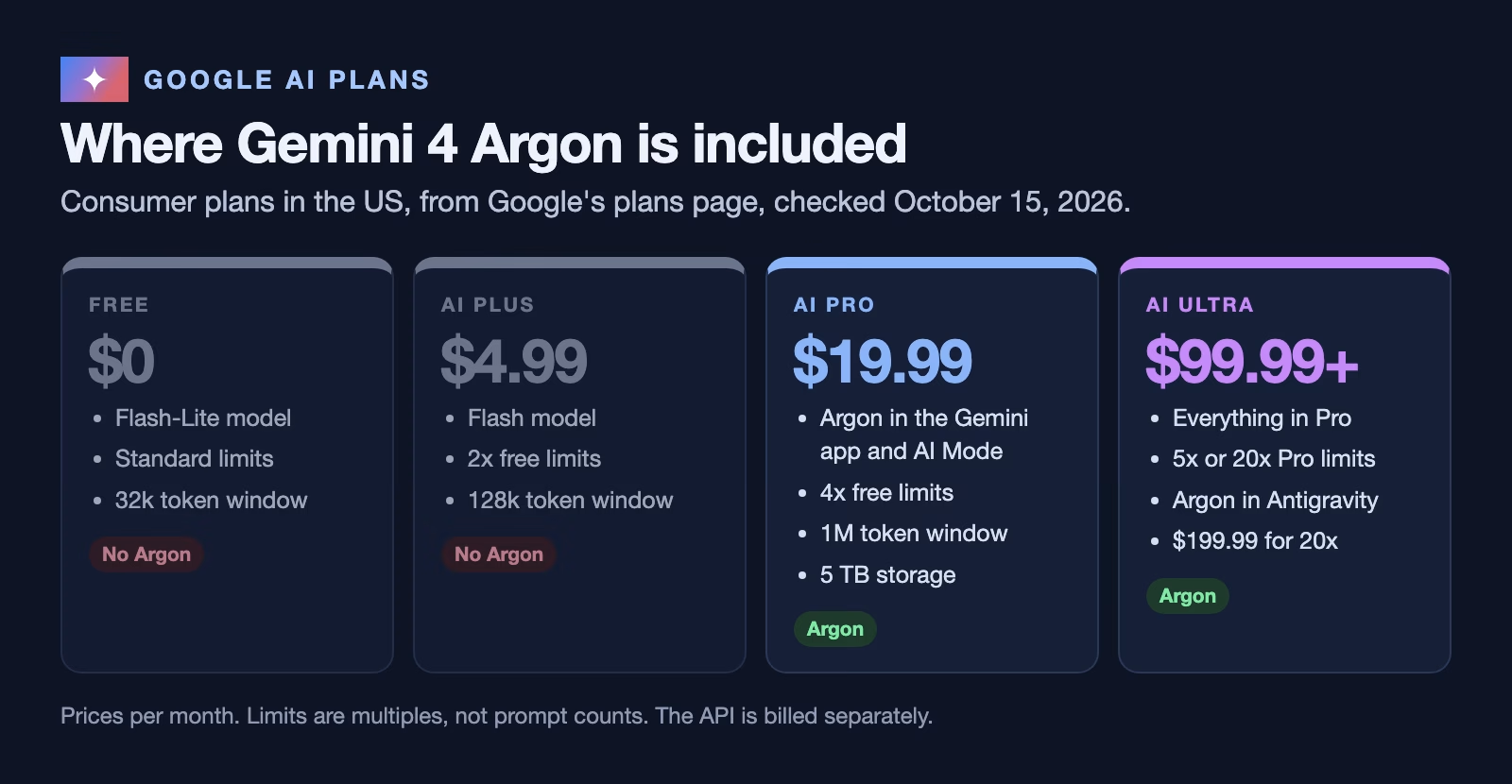
On October 15, 2026, Google’s plans page listed the free plan with the Flash-Lite model and no Argon. The same plans page listed AI Plus at $4.99 a month with the Flash model and no Argon that day, so Plus is not the cheap way in. AI Pro at $19.99 a month showed “Access to Gemini 4 Argon” on the plans page on October 15, 2026, in the Gemini app and in AI Mode, the AI answers inside Google Search. Ultra, at $99.99 or $199.99 a month on the plans page that day, added much higher limits and Argon inside Antigravity. Antigravity is Google’s coding app, where an agent, an AI that works through a task step by step on its own, writes and tests code.
Google does not publish a fixed number of Argon prompts per day. The help page describes limits as multiples: AI Plus gets 2 times the standard limits, AI Pro 4 times, and Ultra 5 or 20 times the AI Pro limits. The same help page lists how much text each plan can consider at once: 32k tokens on the free plan, 128k on AI Plus, and 1 million on AI Pro and Ultra (checked October 15, 2026). Long, file-heavy chats use up your allowance faster than short ones, so a few big jobs can hit the ceiling before a day of small questions would.
For work accounts, the announcement says Argon is in Gemini for business, but your company’s admin decides what you can use. Ask them before you put a personal card on file for work. The guide to consumer Gemini vs Workspace Gemini explains why those two accounts behave differently.
How much it costs to use through the API
A subscription pays for you, the person typing. It does not pay for software that calls Gemini on your behalf. That goes through the API, billed per token, and the Gemini API pricing page says Argon is not available on the API’s free tier (checked October 15, 2026).
On October 15, 2026, the pricing page listed an introductory price of $2 per million input tokens and $10 per million output tokens through November 30, 2026. From December 1, 2026, the same pricing page lists $4 and $20, double the launch price. Output includes the model’s thinking, the working-out it does before it answers, so a hard question can cost more than the length of the reply suggests. Cached input, text the API has seen recently and can reuse, costs a small fraction of the normal input price.
To make that concrete, picture one ordinary job: summarizing a 30,000-word report, about 40,000 tokens in, into a 2,000-word brief, about 3,000 tokens out. The chart prices 1,000 of those jobs at the list prices on the pricing page.
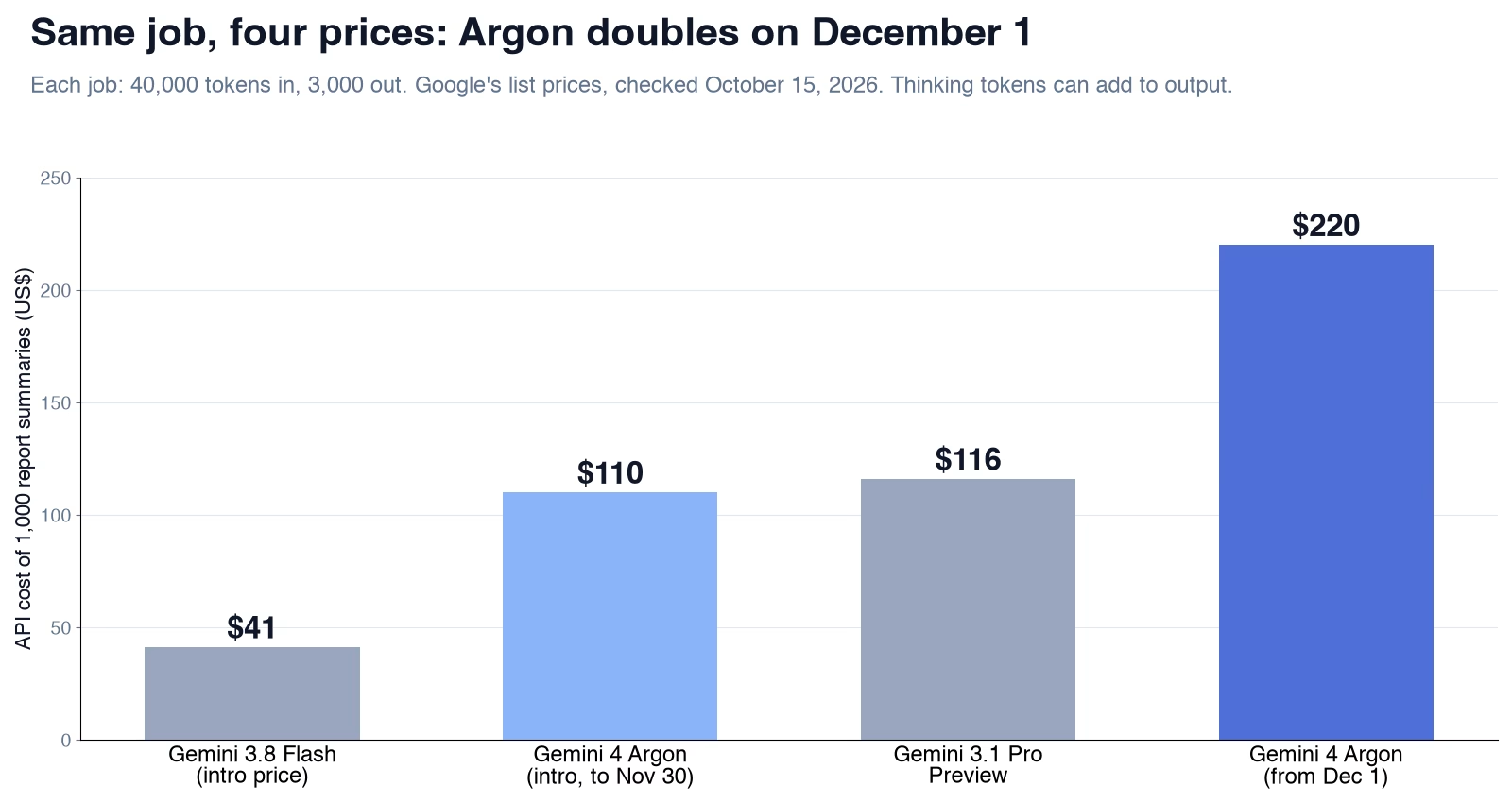
At the introductory price, Argon costs about the same as Gemini 3.1 Pro Preview for this job, about $110 for 1,000 reports. From December 1 it is about $220, twice as much. Gemini 3.8 Flash does the same 1,000 jobs for about $41. The question for a team is whether Argon’s answers are good enough on your work to justify that gap, and the guide to working out what an AI task really costs shows how to price your own jobs the same way.
Is Google AI Pro worth $19.99 for Argon?
Yes if you give Gemini a long, many-step job most weeks, and no if you mostly ask quick questions. The decision is less about the model and more about how often you hand over a job that takes real thought. Here is a quick way to sort yourself.
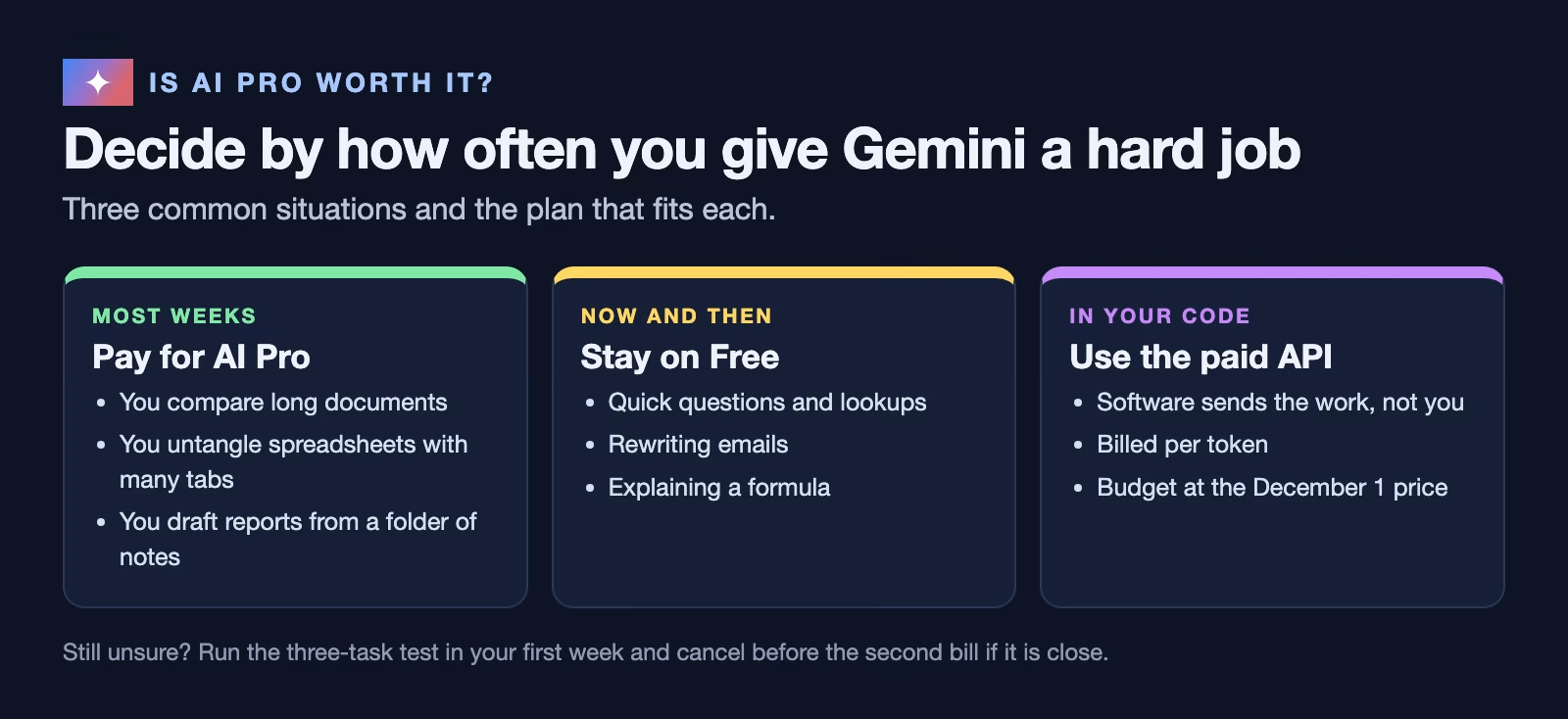
Pro is a good buy if, most weeks, you hand Gemini work like comparing several long documents, working through a spreadsheet with many tabs, or drafting a report from a folder of notes. Those jobs are where a stronger model saves you a second or third try. Pro also includes 5 TB of Google storage, so if you already pay Google for extra storage, check how much of the $19.99 you would be spending anyway. Google says Pro is sold in more than 150 countries and territories, so check that yours is on the list before you plan around it.
Stay on the free plan if you mostly ask short questions, rewrite emails, or look things up. For that work, a faster model gives you the same answer, and the extra limits would sit unused. If you are a developer, a subscription is the wrong purchase for your code. Use the paid API instead, as explained in when to use AI Studio and the Gemini API instead of the app.
How to test it on your own work in one week
Benchmarks tell you how a model does on someone else’s tasks. Your own three tasks tell you whether it is worth $19.99 to you. Pick them before you upgrade, so you are not tempted to choose tasks that flatter the new model.
- Choose three real tasks from last month that took you more than 20 minutes with AI help. One should involve a long file, one a messy spreadsheet, and one a piece of writing that needed several rounds.
- Write down what a good result looks like for each, in one sentence, before you run anything. This keeps you honest when the answers come back.
- Run each task on the model you use now, then on Argon, with the same files and the same first prompt. Changing the prompt between runs makes the comparison meaningless.
- Score each pair on the sheet below and note how many follow-up messages each one needed. Fewer follow-ups is where the time savings show up.
| Task | What good looks like | Current model | Gemini 4 Argon |
|---|---|---|---|
| Long file: compare payment terms in three supplier contracts | Every term found, with the clause it came from | Follow-ups: __ / Right? __ | Follow-ups: __ / Right? __ |
| Messy spreadsheet: find why two monthly totals disagree | Names the rows that cause the gap | Follow-ups: __ / Right? __ | Follow-ups: __ / Right? __ |
| Writing: turn meeting notes into a one-page update | Ready to send after one light edit | Follow-ups: __ / Right? __ | Follow-ups: __ / Right? __ |
If Argon wins two of the three tasks clearly, keep Pro. If the results are close, cancel before the next bill. A model that is better on paper but not on your work is not worth paying for every month. For a fair way to compare models, see how to test whether an AI model is good enough for your own work.
Common mistakes
- Paying for Pro and still using the default model. Check the model picker in the Gemini app shows Argon before you judge it, so you know which model gave you the answer.
- Treating Google’s scores as a guarantee. They are Google’s own tests, and your documents, formats and wording are different.
- Assuming the subscription covers your scripts. The API is billed separately, per token, and Argon is not on the API’s free tier.
- Building a budget on the introductory API price. The price doubles on December 1, 2026, so plan costs at $4 and $20 per million tokens.
- Uploading work files to a personal account. Check your company’s rules first, because a personal plan is not covered by your employer’s data agreement.
What to do this week
Pick your three tasks today and write down what good looks like for each. If you already pay for Google AI Pro, open the Gemini app, choose Gemini 4 Argon in the model picker and run them now. If you do not, decide whether those tasks come up often enough to pay $19.99 a month, then run the test in your first week so you can cancel before the second bill if the results are close. If you are not sure which Gemini model fits each kind of job, the Gemini model chooser covers the rest of the lineup.
Sources
- Google: Introducing Gemini 4 Argon (October 13, 2026 announcement, availability, API prices, 1M token limit, Google’s benchmark results)
- Google: Gemini plans (Free, AI Plus, AI Pro and AI Ultra prices and which include Gemini 4 Argon, checked October 15, 2026)
- Google Help: Gemini Apps limits and upgrades (usage multiples and context window by plan)
- Google AI for Developers: Gemini API pricing (Gemini 4 Argon, Gemini 3.1 Pro Preview and Gemini 3.8 Flash prices, introductory dates, no free tier for Argon)
Keep going
Same lessons in your feed
Short diagrams, hooks, and weekly tutorials on Substack, Instagram, X, and Facebook.