
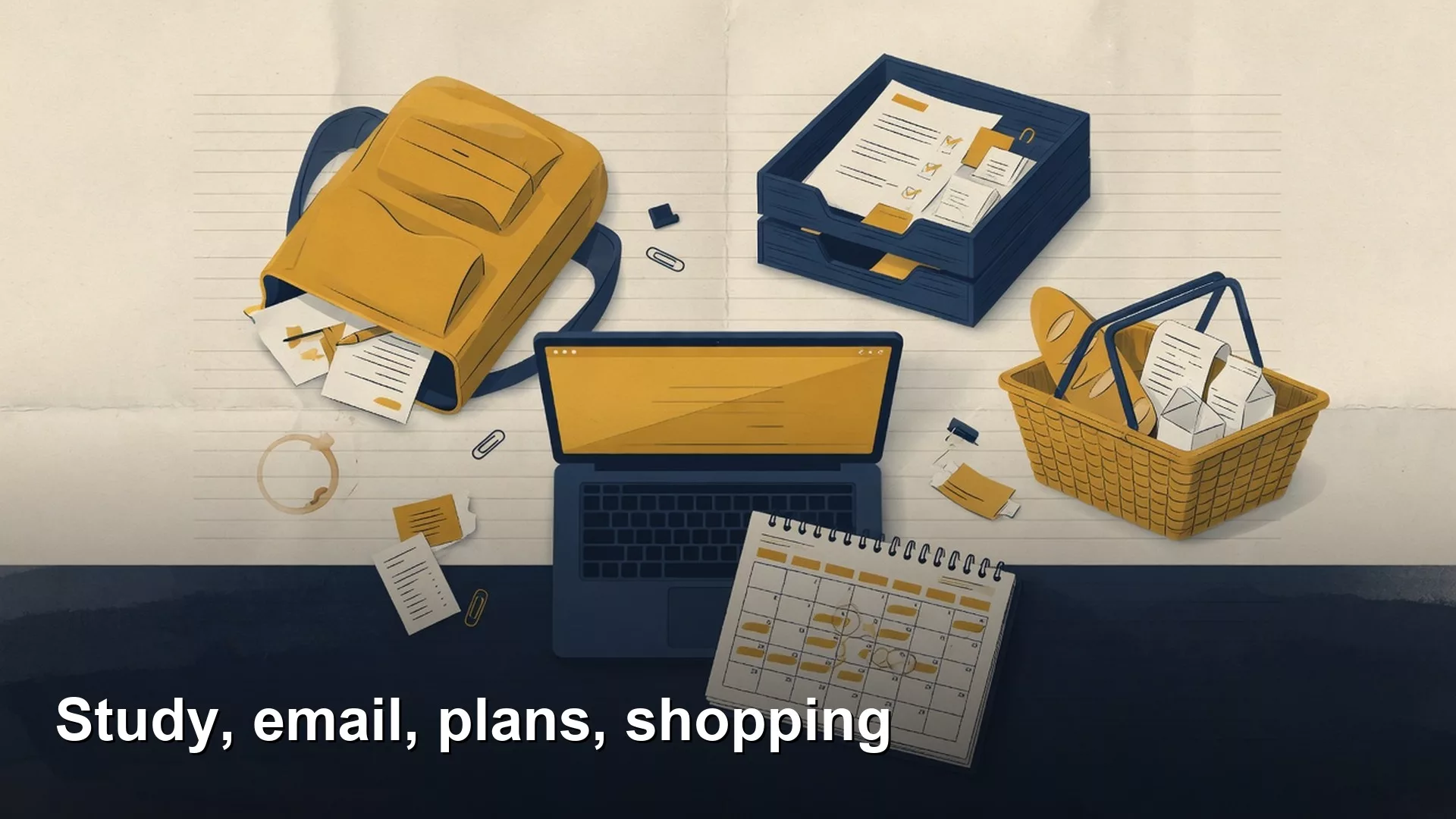
Jonah’s dining table at 8:47pm Thursday: BIO 214 notes with yellow highlighter through the Krebs cycle, a Lightning cable with the plastic chewed off near the plug, and one ChatGPT thread titled “quick help.” He asked for a midterm outline. Then a “quick email” to Mara. Then a Saturday in Chicago for two people. Then a 14-inch laptop comparison, because the 2019 MacBook fan had started screaming in lecture. He copied the email into Gmail at 9:11. Mara, his ops manager, got 92 words about the dentist at 9, the dock report, and a $1,199 laptop that would “help with the BIO 214 slides.” Four jobs. One thread. The price belonged in none of them.
This is Part 15 of Phase P, and Part 4 of Prompting for everyone. Part 1 treated the prompt as a work request. Part 2 packed context, constraints, and examples. Part 3 was the loop when the first answer is wrong. This part is the same packed brief, aimed at four jobs you will type this week: study, work email, plans, and shopping research. If the artifact is still a paragraph, keep AI for writing and questions next to this. Next in this series: When to stop prompting and do the task yourself.
What you’ll learn
- Why four jobs in one thread leak facts (Jonah’s $1,199 in Mara’s inbox)
- A study pack that explains, then quizzes you, and refuses to write the paper
- A work-email pack: named audience, one ask, a word cap, no extra topics
- A plans pack that names constraints and forces one decision
- A shopping pack that compares on criteria you name and leaves prices as a check, not a quote
One skill, four jobs

The intern test from Part 1 still holds. You still name the task, the reader, the facts you already have, the format, and what to avoid. You still add the Part 2 pack (context, constraints, a tiny example) and iterate on one error, the way Part 3 taught. What changes is the pack for this job. A study prompt that would be a decent email prompt will write your paper. An email prompt sitting on top of a laptop comparison will put a dollar amount in Mara’s inbox.
Vendors do not split your life into folders unless you do. ChatGPT, Claude, Gemini, and Grok all treat the thread as one pile of context. As of writing (August 2026) that is still true on the consumer apps. The model is not being sneaky. It is being helpful with whatever is still on the table. Jonah’s table had BIO 214, a dentist, Pilsen vs Logan Square, and a 14-inch replacement. Helpful glued them together.
Rule of thumb: One job, one chat. If the thread title is “quick help,” you already mixed the brief.
You can type “ignore the laptop, this is only the email.” I think a new chat is cheaper, because the laptop is still in the window even after the warning. Rename the thread with the job. Mara. BIO 214 quiz. Saturday Pilsen. 14-inch compare. Four names. Four sends.
Study: explain, then quiz me
The thin ask is “outline chapter 7 for my midterm.” Jonah sent that first. He got 1,400 words in essay voice, a thesis, and three body sections he could have pasted into the portal. That is the failure, even before the email leak. If the course treats the model as a tutor, use it as a tutor. If the syllabus forbids the tool, close the tab. The craft rule today is explanation plus quiz, never a document you could submit.
Paste the notes you actually have. Label the block. Tell the model to use only that block, and to say “I do not know” when a fact is missing. Then ask for a short explanation in a shape you can reread on the bus (8 bullets, not a chapter). Then ask for a quiz. Wait. Answer in the next message. Ask it to grade each answer against the notes, not against Wikipedia. That loop is study. The 1,400-word essay is unpaid ghostwriting with extra steps.
Jonah’s notes were two photocopied pages and a messy list: glycolysis in the cytoplasm, Krebs in the matrix, 2 ATP net from glycolysis, NADH and FADH2 mixed up again. A useful first reply is 8 bullets that keep those names straight, then 6 short questions that wait. A useless first reply is a polished essay about “the elegance of respiration.” He needed to know where the 2 ATP land.
If the quiz is too easy, that is a Part 3 iterate, not a new vendor. Say “these are recall questions, give me 4 that need a why.” If it writes the essay twice, start a new chat with the study template below. Do not keep arguing with a ghostwriter.
Work email: audience, ask, length
The thin ask is “write a quick email to Mara.” Quick is not a length. Mara is not a brief. Jonah’s dentist was at 9 Friday. Standup is 9:00. The recovery plan was already in his head: dock report by 8:30am, catch the 10:15 huddle. None of that was in the eight words. The model filled the vacuum with whatever else lived in the thread, including the $1,199.
Pack three things. Audience: Mara, ops manager, 30 seconds on her phone before standup. Ask: I will miss Friday 9:00 standup, dentist at 9, dock report by 8:30, I will be at the 10:15. Length: 70 words, no greeting fluff, no other topics. Avoid: laptops, class, weekend plans, “I hope this email finds you well,” a paragraph on how sorry you are. The writing tutorial already covered thank-you notes. This is the same skill with a manager in the To field.
Read the draft the way Part 3 taught. Scan names and dollars before you care about tone. If a class, a neighborhood, or a price appears, the email is mixed. Cut the extra line or start a fresh chat with only the email pack. You still send from Gmail or Outlook. The model drafts. You own the Send button.
Plans: constraints and a decision
The thin ask is “plan Saturday in Chicago.” That sentence has a city and a day. It has no budget, no party size, no weather, no neighborhood, and no decision. The model will hand you a brochure: River North steakhouse, a $45 architecture cruise, three neighborhoods, 11 pins. Jonah had two people, 10am to 7pm, $80 for food, no car, rain possible, and a preference he had not typed (Pilsen if the two options felt equal). The steakhouse blew the $80 before noon. The cruise was a paid add-on he did not request.
A plan is a decision plus a short list that fits the constraints. Pack the constraints in numbers you can check: window, dollars, headcount, transit, weather. Then force the decision in the prompt. “Pick one neighborhood. If two options are equal, pick Pilsen. Give a 6-stop list with times. Do not add paid tours I did not ask for.” Without that line, you get optionality dressed up as help. You still have to pick. You paid in rereading.
If the first itinerary still spends $140, that is one named error (Part 3), not a new city. Quote the $80. Ask for a rewrite of the food line only. Keep the neighborhood if it already works. Do not restack “make it better” on an 11-stop list.
Shopping: criteria you name
The thin ask is “best 14-inch laptop under $1,200.” Best is a vacuum. Under $1,200 sounds like a constraint and behaves like an invitation to invent a sticker. Jonah’s 2019 MacBook was heavy, the fan was loud, and he types for four hours of class plus the dock report. Those are criteria. Weight, RAM, keyboard. He never typed them. The model typed $1,199 with the confidence of a price tag. Specific is not sourced.
Name three criteria you can verify with your hands or a spec sheet. Ask for a table: model, those three columns, and a “where I should verify” column. Tell it not to invent current prices, stock, battery-hour claims, or review scores. “If you do not know a spec, write unknown. Leave price as check Best Buy, the manufacturer, or the campus store today.” OpenAI’s own prompting notes tell you to be specific. They do not tell you to treat a fluent dollar amount as a quote. As of writing, ChatGPT, Claude, Gemini, and Grok will all invent a neat number when you leave a hole labeled “price.”
Use the table to shortlist. Then you look the number up. The $1,199 might be close to a real SKU on Thursday and wrong on Friday, or a blend of two models. None of that belongs in Mara’s inbox or on a reimbursement form. Shopping research is a comparison on your criteria. Purchasing is a page you open yourself.
Pack the prompt, one job per chat

Four jobs, four recipes. Same intern brief underneath. Fill the brackets. Delete a line that does not apply. Do not paste last week’s mega prompt on top.
| Job | Packed recipe | Output you want | Ban |
|---|---|---|---|
| Study | Notes, explain, then quiz and wait | Short explanation plus questions, no submit-ready prose | Write the essay, outline I could turn in, extra sources |
| Work email | Audience + one ask + a word cap | 70 to 90 words Mara can use on a phone | Extra topics, greeting fluff, other jobs from the thread |
| Plans | Numbers for window, budget, people, then pick one | One neighborhood, a 6-stop list that fits | 11 options, paid add-ons, a brochure |
| Shopping | Three criteria you name, unknown allowed | A comparison table you can verify | Invented prices, stock, scores, a “best” trophy |
Study template (paste into a new chat, then paste your notes under it):
I am studying BIO 214, cellular respiration, exam Friday.
Use only the notes I paste below. If a fact is not in the notes, say you do not know.
First: explain the Krebs cycle in 8 bullets a first-year can use.
Then: quiz me with 6 short questions. Wait for my answers. Grade each one against the notes.
Do not write an essay, a paper, or a full outline I could submit.
If I ask you to write the essay, refuse and quiz me instead.
Work-email template:
Write an email from Jonah (ops intern) to Mara (manager).
Ask: I will miss Friday 9:00 standup. Dentist at 9. I will send the dock report by 8:30am and catch the 10:15 huddle.
Length: 70 words, no greeting fluff, no extra topics.
Facts only. Do not mention laptops, class, or weekend plans.
Plans template:
Plan Saturday in Chicago for two people.
Constraints: 10am-7pm, $80 food, no car, one neighborhood (Pilsen or Logan Square), rain possible.
Decide: pick ONE neighborhood and give a 6-stop list with times. If two options are equal, pick Pilsen.
Do not add paid tours I did not ask for.
Shopping template:
Compare three 14-inch laptops I might buy used or new.
Criteria I name: weight under 3.5 lb, 16 GB RAM, keyboard I can type on for 4 hours.
Do not invent current prices, stock, or scores. Leave price as "check Best Buy / manufacturer today".
Table: model, weight, RAM, keyboard notes, where I should verify.
If you do not know a spec, write unknown.
Run them in four chats, not one. Jonah’s email template would have been enough on its own. It was not enough under a shopping thread.
Worked example: Jonah’s $1,199 leak
Same Thursday. Four thin asks in the order he typed them. Watch what crossed the boundary.
| Job | Thin ask he sent | What came back | What leaked onward |
|---|---|---|---|
| Study | outline chapter 7 for my midterm | 1,400 words, essay voice, a thesis | BIO 214 slides showed up in the email |
| Work email | write a quick email to Mara | 92 words, dentist plus extras | Mara saw $1,199 and the class |
| Plans | plan Saturday in Chicago | 11 pins, steakhouse, $45 cruise | Unused, still sitting in the thread |
| Shopping | best 14-inch laptop under $1,200 | A confident $1,199 with no source | The dollar amount in Gmail |
The email he almost sent (and then did send, then unsent 40 seconds later when he reread it in Sent):
Mara, I will miss Friday 9:00 standup, dentist at 9. Dock report by 8:30. I will catch 10:15. I also found a 14-inch laptop at $1,199 that should handle the BIO 214 slides and the weekend maps. Sorry for the late note.
Three true sentences, then a purchase he had not asked her about, a class she does not manage, and a Saturday she is not on. The packed email template above, in a new chat, returns the first three sentences and stops.
A second beat, because unsending is luck. His roommate typed the same four jobs in Claude the next night, in four chats named by job. The Mara draft was 68 words. The laptop table said unknown on two specs and “check Best Buy Friday” on price. He still had to look the number up. He did not have to apologize for a SKU.
Common mistakes
- Stacking study, email, plans, and shopping in one thread titled “quick help.”
- Asking the model to write the essay or a submit-ready outline, then calling it studying.
- Sending “quick email to [name]” with no ask, no length, and no ban on extra topics.
- Asking for a plan with a city and a day, then being annoyed you received a brochure.
- Treating a fluent price, battery-hour claim, or star rating as a quote you can paste.
- Iterating tone on an email that already contains another job’s facts. Cut the leak, or start over.
- Pasting the same thin ask into four vendors. That is how the writing tutorial burned a thank-you. Change the pack, not the logo.
- Leaving the $1,199 in Sent because you only proofread for typos.
How to practice this week
Open four new chats. Paste the matching template. Fill the brackets with your names and numbers. For study, use notes you already own and stop if the syllabus says so. For email, read the draft for dollars and class names before you copy it. For plans, keep the version that picked one option. For shopping, keep the table that says unknown and check a live page for any price you care about. Save the four filled prompts in a note. Next in this series: When to stop prompting and do the task yourself. Previous: iterate when the first answer is wrong. Writing job family: AI for writing and questions. More paths: Learn.
Quick recap
- Same packed brief as Parts 1 to 3. Four jobs need four recipes and four chats.
- Study: explain, then quiz, then wait. Do not accept a paper you could submit.
- Email: audience, one ask, a word cap. Ban extra topics before you hit Send.
- Plans: constraints in numbers, then one decision. A brochure is not a plan.
- Shopping: criteria you name. A fluent $1,199 is still unsourced. Look the number up.
Sources
Research and further reading used for this article:
- OpenAI Help: Prompt engineering best practices for ChatGPT (be specific, iterate, do not treat fluency as a source)
- ChatGPT: Prompting overview (goal, context, and format in your own words)
- Anthropic: Prompt engineering overview (clear asks and when to add structure)
- Google: Gemini prompt design strategies (add context, break the prompt into parts)
- Anthropic: Getting started with Claude and Gemini / Grok (same intern brief, different doors)
- AMS: Prompting for everyone (this series)
- AMS: Iterate when the first answer is wrong (Part 3, the loop you still use inside each job)
- AMS: AI for writing and questions (the writing job family this email pack sits on)
Keep going
Same lessons in your feed
Short diagrams and hooks on Instagram, X, and Facebook.
Merch on Etsy
Open store → Boxplot Mouse Pad, Data Science Mouse Pad, Analytics Mouse Pad, Box Plot, Whisker Plot
View on Etsy →
Boxplot Mouse Pad, Data Science Mouse Pad, Analytics Mouse Pad, Box Plot, Whisker Plot
View on Etsy →
 Good Cheap Fast White Ceramic Coffee Mug, Data Science Mug, Data Mug, Analytics Mug, Statistics Mug, Programming Mug, Gift Mug, Coffee Mug
View on Etsy →
Good Cheap Fast White Ceramic Coffee Mug, Data Science Mug, Data Mug, Analytics Mug, Statistics Mug, Programming Mug, Gift Mug, Coffee Mug
View on Etsy →
 Dashboard to Excel Ceramic Coffee Mug
View on Etsy →
Dashboard to Excel Ceramic Coffee Mug
View on Etsy →
 You're On Mute White Ceramic Coffee Mug, Data Science Mug, Data Mug, Analytics Mug, Statistics Mug, Programming Mug, Gift Mug, Coffee Mug
View on Etsy →
You're On Mute White Ceramic Coffee Mug, Data Science Mug, Data Mug, Analytics Mug, Statistics Mug, Programming Mug, Gift Mug, Coffee Mug
View on Etsy →