Your company can now download Mistral Large 4, one of the biggest AI models anyone has released for free, and use it for internal work or inside your own product without paying Mistral. The one thing that needs a separate licence is running it as a hosted AI service for other businesses, and most teams will still find Mistral’s pay-per-use service cheaper and easier than running the model themselves.
Imagine your company’s legal team has said no to sending client documents to American AI services, and someone in a meeting says, “Mistral just made its biggest model free, so let’s run it ourselves.” Two questions land on your desk the same afternoon: are we actually allowed to, and what would it take? This guide answers both.
The weights of a model are the large files of numbers it learned during training; with the weights you can run the model on your own computers. An open-weight model is one whose weights anyone can download. Our guide to what “open” means for AI models covers the idea, and What is Mistral AI? covers the company and its other models.
What Mistral released
Mistral released the weights of Mistral Large 4, its largest model, on Hugging Face, the main website for sharing AI models. Hugging Face’s launch post (October 29, 2026) describes a model of about one trillion parameters, the internal numbers a model learns, of which about 49 billion are used for each word it reads or writes. It reads text and images, writes text, and handles a context of up to one million tokens, the chunks of text models work in, roughly three quarters of a word each.
That “uses only part of itself at a time” design is called a mixture of experts. It makes the model cheaper to run than its size suggests, but it does not make it small: all trillion parameters still have to sit in memory.
According to Mistral’s announcement (checked October 29, 2026), the weights follow a preview earlier in October that was only available through Mistral’s own service, and the model is now available through Mistral Studio, the Mistral API, OpenRouter, Microsoft Foundry, Nvidia-hosted endpoints and Hugging Face.
What Mistral says it is good at
The model card (checked October 29, 2026) and the Hugging Face post lean on coding, security work and agent tasks, where the AI carries out several steps toward a goal. Artificial Analysis, an independent group that tests models, places it fifth among open-weight models on its overall intelligence index, according to that post, and the model card adds that it scores level with GLM-5.3 on the group’s coding-agent index while using fewer tokens per task. It also supports more than 160 languages, including all official EU languages, which matters if your company works across Europe.
What the licence lets your company do
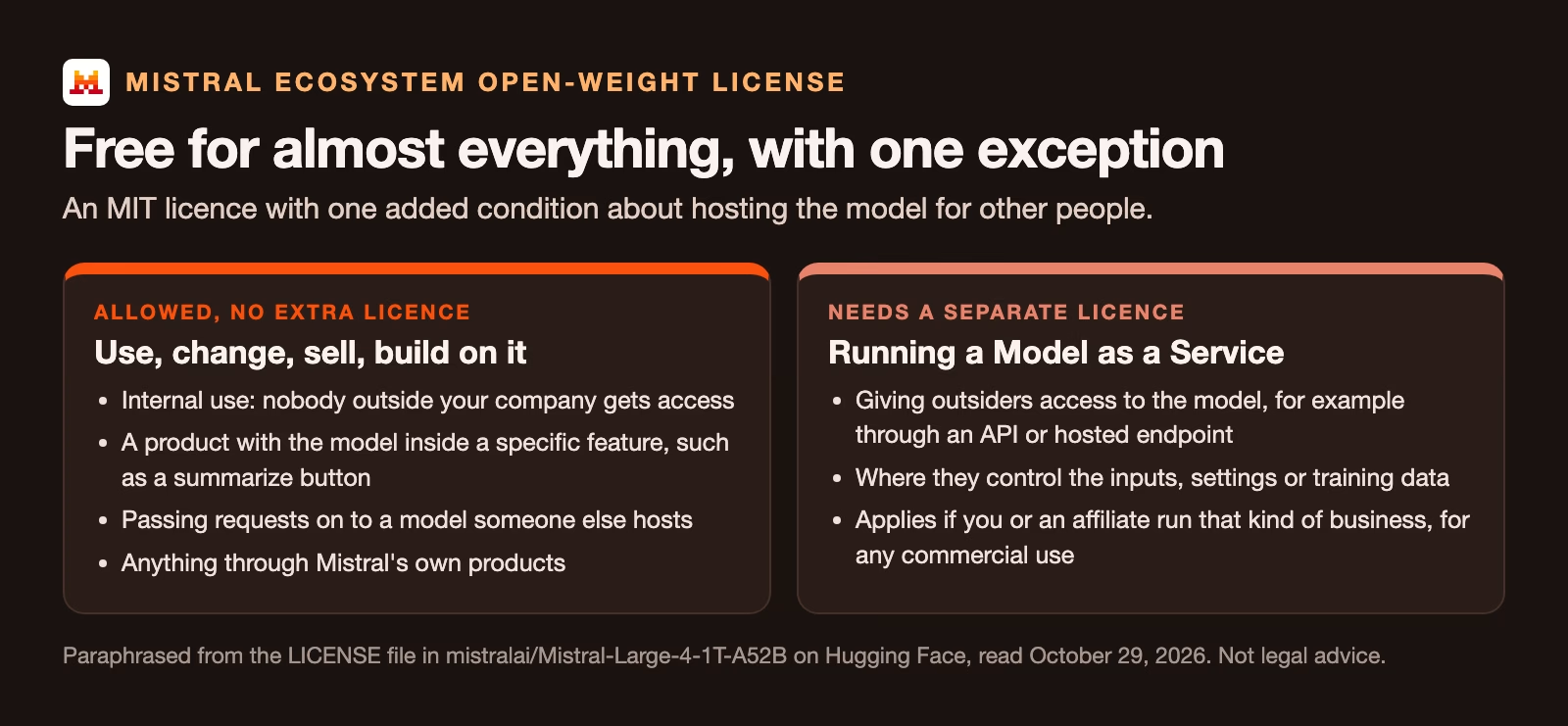
The licence is a modified MIT licence (MIT is short for the Massachusetts Institute of Technology, where this style of licence was written): you can use, copy, change and fine-tune the model (train it further on your own examples so it learns your style or subject), and sell things built on it, with one added condition about hosting it for others. MIT is one of the most permissive software licences there is. The full text is short, and you should read the LICENSE file on Hugging Face (read October 29, 2026) rather than a summary, including this one.
The one condition, in plain words
If your company or an affiliate runs a “Model as a Service” business, you need a separate commercial licence from Mistral before you use the model for any commercial purpose. The licence defines Model as a Service as giving a third party access to the model for running or training it, for example through an API (a connection other programs call) or a hosted endpoint, in a way that lets them control the inputs, the settings or the training data.
Three things are spelled out as not counting:
- Internal use. Any use that does not make the model available to people outside your company.
- A model inside a feature. An end-user product where the model’s abilities sit inside specific features, such as a “summarize this ticket” button in your help-desk software.
- Passing requests along. Sending requests on to a model someone else hosts, such as Mistral’s own API.
And anything you do through Mistral’s own products is always fine.
Three companies, three answers
The licence is easier to read with examples. These three are made up to show the boundaries, and anything close to the line deserves a lawyer’s reading.
| Your company | What it does with the model | Needs Mistral’s commercial licence? |
|---|---|---|
| A retailer | Runs it on its own servers for staff to search policies and draft emails | No: internal use |
| A help-desk software company | Adds a “summarize this ticket” button that uses the model behind the scenes | No: the model sits inside a specific feature |
| An AI hosting start-up | Sells API access where customers send any prompt to Mistral Large 4 | Yes: that is a Model as a Service business |
The middle case is where most software companies sit. A feature that uses the model behind the scenes is fine. A product whose main selling point is “send us any prompt and we run it on Mistral Large 4” is the hosted-service case.
What it takes to run it yourself
Running Mistral Large 4 on your own computers is a data-center job. Adding up the file listings on Hugging Face (October 29, 2026) gives about 1,061 GB for the main FP8 version and about 610 GB for the smaller NVFP4 version. FP8 and NVFP4 are ways of storing each number with fewer bits, which shrinks the files and the memory needed at some cost in accuracy.
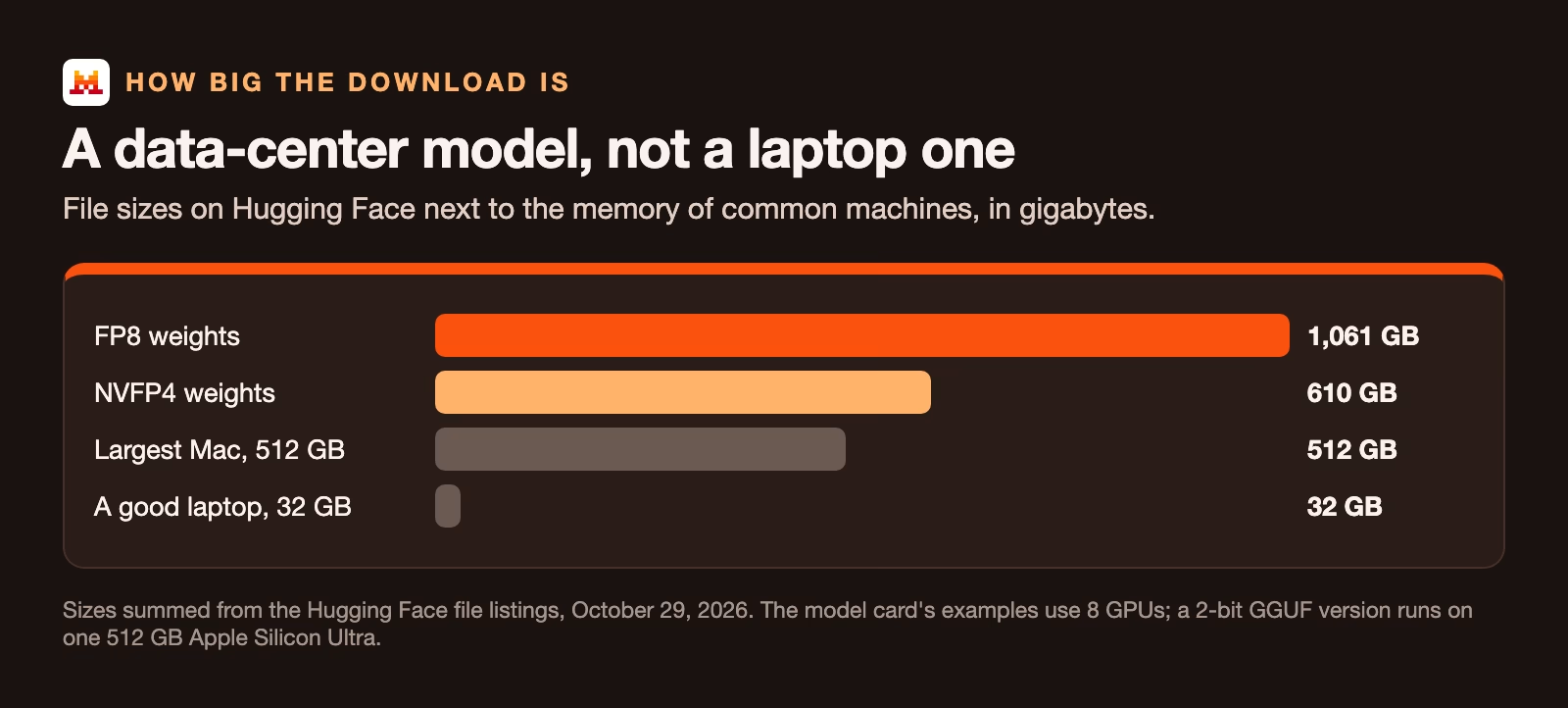
The model card shows examples on eight graphics processors (GPU) working together, the chips that run AI models fast, and the Hugging Face post (October 29, 2026) says the NVFP4 version needs Nvidia’s Blackwell generation of chips. The only single-machine option it mentions is a heavily compressed 2-bit version on an Apple Silicon Ultra with 512 GB of memory, which is a test bench, not a way to serve a whole company.
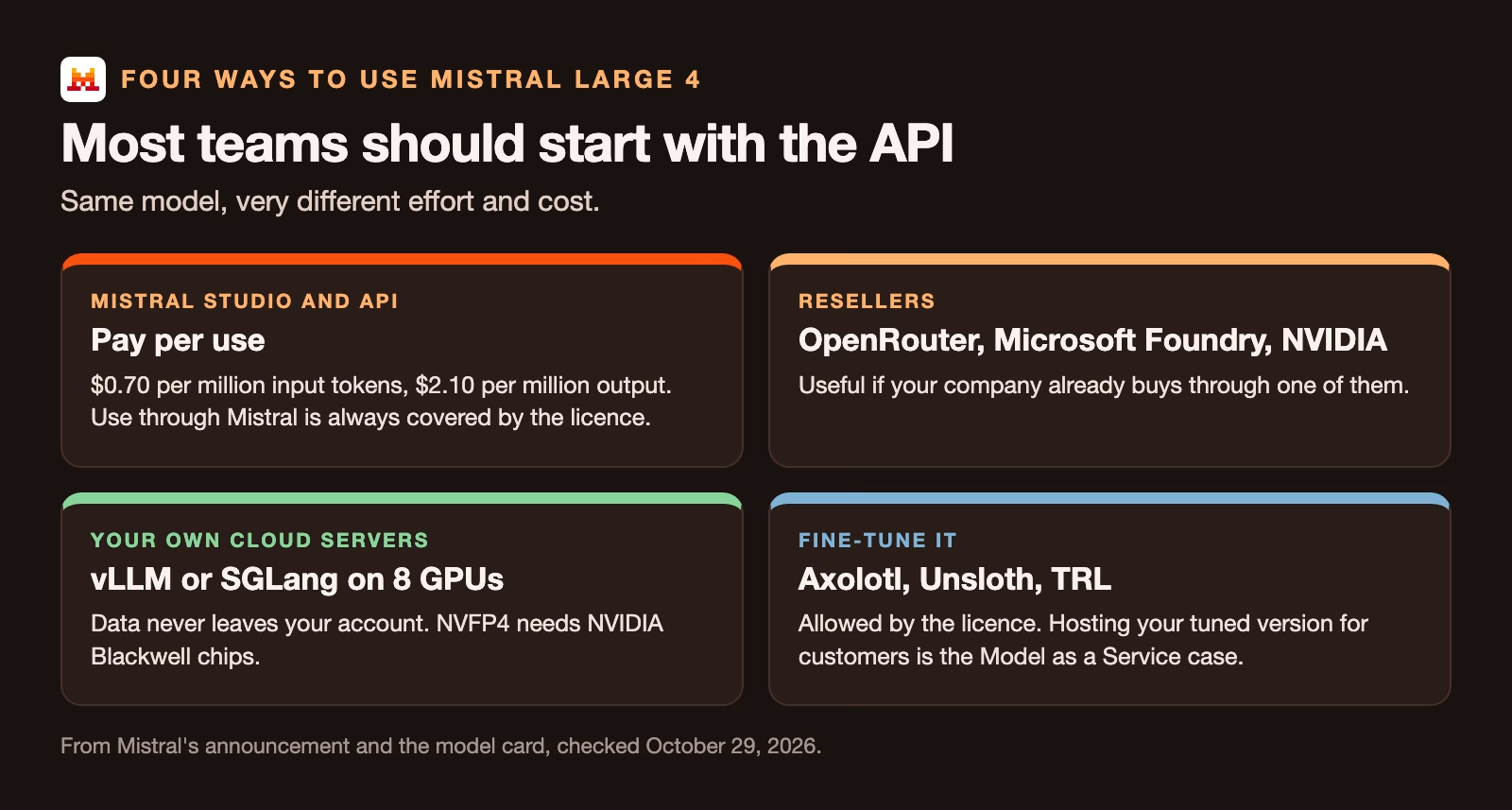
So “let’s run it ourselves” really means one of two things: rent eight top-end GPUs from a cloud provider in a region your legal team approves, or buy them. Either way you need someone who can run vLLM or SGLang, the server programs the model card recommends, and keep them running.
If you fine-tune it
Fine-tuning, training the model further on your own examples, is allowed, and the model card lists tools such as Axolotl and Unsloth that support it. The same hosting rule follows the tuned version, which the licence calls a derivative work. A version tuned on your support tickets and used by your own staff is internal use. The same tuned version sold to other companies as an API they can send anything to is the hosted-service case, even though you did the training.
Fine-tuning a model this size is itself a big GPU job, so it is rarely the first step. Most teams get further by writing better instructions and giving the model examples in the prompt, and only tune once they have a clear, repeated task where that falls short.
What it costs through the API
For most teams, the cheapest way to use Mistral Large 4 is to pay per use. Mistral’s announcement (checked October 29, 2026) lists $0.70 per million input tokens, $0.07 per million cached input tokens (text the model already read in a recent request) and $2.10 per million output tokens.
To feel what that means, price a real job. Say each run of a weekly report reads 40,000 tokens of notes and writes a 3,000-token summary, and you run it 1,000 times a month:
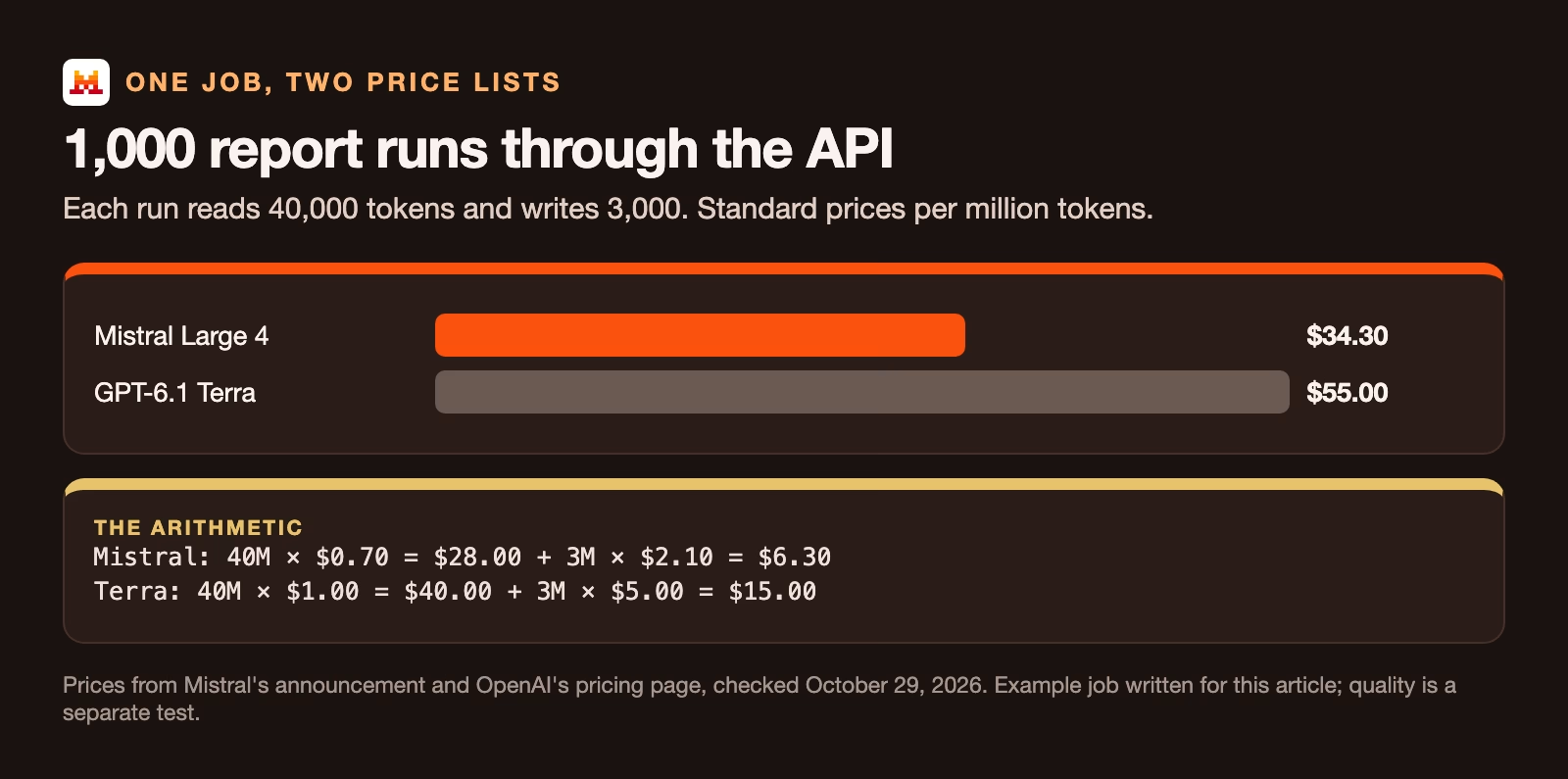
At those prices the month costs about $34 on Mistral Large 4, against $55 on OpenAI’s GPT-6.1 Terra at the $1 and $5 rates on OpenAI’s pricing page (checked October 29, 2026). Price is only half of a decision; the other half is whether the answers are good enough for your work, which you test on your own tasks. Our guide on how to work out what an AI task really costs walks through that test.
A rented eight-GPU server costs far more per month than $34 of API calls. Running it yourself makes sense when data rules forbid any outside service, or when your volume is so high that a server running around the clock is cheaper than paying per token. For a team spending a few hundred dollars a month on AI, neither is likely.
A worked example: answering the meeting question
Let’s go back to the meeting. Your legal team does not want client documents going to American services, and someone suggested running Mistral Large 4 yourselves. Here is how you would answer, step by step.
- Is it allowed? You would use it internally for your own staff, so the hosted-service condition does not apply. Yes.
- Does running it ourselves solve the legal worry? It does, because nothing leaves your servers. But so might Mistral’s own service, since Mistral is a French company. Ask legal whether a European provider meets the rule before you budget for GPUs.
- What would self-hosting take? Eight Blackwell-generation GPUs, in your data center or rented in an approved region, plus someone to run vLLM. That is a project with a budget line, not a weekend task.
- What would the API cost for our use? Count the documents you would send in a month, estimate tokens at roughly 1.3 per word, and multiply by the prices above.
- Is it good enough? Run five real tasks through Mistral’s API and your current tool, with names and client details removed, and compare the answers blind.
Most teams that walk through these five steps end up on the API first, with self-hosting as a later option once they know the model works for them.
Common mistakes
- Reading “open” as “anything goes”. The licence has a hosted-service condition. Read the LICENSE file.
- Assuming a laptop can run it. The smallest official version is about 610 GB.
- Comparing a GPU server’s monthly cost with a token price. Compare cost per month at your real volume.
- Treating Mistral’s own service as the same as self-hosting. Use through Mistral’s products is always allowed, but your data then goes to Mistral; check that against your data rules.
- Skipping the quality test. A cheaper model you have not tested on your own work is not a saving yet.
Try it this week
- Read the LICENSE file and write down, in one sentence, how your company would use the model. Then check that sentence against the three exceptions above.
- Sign up for Mistral Studio or use OpenRouter, and run five tasks you already know the right answers for.
- Price one month of your real volume with the API rates above.
- Only if data rules forbid every outside service, ask your cloud team for a quote on eight Blackwell GPUs in an approved region.
Quick recap
- Mistral Large 4’s weights are free to download from Hugging Face as of October 29, 2026.
- The licence is MIT with one condition: running it as a hosted AI service for others needs a separate licence.
- Internal use, features inside your own product, and use through Mistral’s products are covered.
- Self-hosting needs about 610 to 1,061 GB of model files and eight high-end GPUs.
- The API costs $0.70 per million input tokens and $2.10 per million output tokens.
- Test it on five of your own tasks before you switch anything.
Sources
- Mistral Ecosystem Open-Weight License (LICENSE file) (full licence text, read October 29, 2026)
- Hugging Face: Welcome Le Chonk, Mistral Large 4 on Hugging Face (October 29, 2026: size, architecture, hardware, Artificial Analysis ranking)
- Hugging Face model card: mistralai/Mistral-Large-4-1T-A52B (languages, recommended serving, 8-GPU examples, file listing; checked October 29, 2026)
- Mistral AI: Mistral Large 4 (Le Chonk) is now open weight (API prices, where to access it, licence summary; checked October 29, 2026)
- OpenAI API pricing (GPT-6.1 Terra prices used for comparison; checked October 29, 2026)
Keep going
Same lessons in your feed
Short diagrams, hooks, and weekly tutorials on Substack, Instagram, X, and Facebook.