
When you present numbers to senior people, lead with what you want them to do, what could go wrong, and when they need to decide. That earns more trust than any chart. Say you spent three days on an analysis and built a slide with twelve charts. In the meeting, a director asks, “So what do you want from us?” You start flipping through slides while someone checks their messages, and the decision slips to “let’s talk about it later,” which usually means the work sits in a shared drive and dies. Your SQL (the standard language for asking a database for data) was fine. The story never earned trust.
This post is the last in a series on the analyst career path. The earlier posts covered the ladder of analyst levels and the portfolios that get interviews. Here we cover how to speak and write once you already have the data: a simple four-step spine for live rooms, and a short email layout for written recommendations when you are not sure of the answer.
is decision reliability, not charismaSenior stakeholders (directors, vice presidents, founders, budget owners) are not mainly grading your taste in charts. They are asking a plainer question: if I act on this person’s advice, how often will I regret it? Trust grows when your numbers hold up under questions, when your caveats arrive before anyone has to drag them out of you, and when your requests are specific enough to put on a calendar.
Trust does not come from any of these habits:
- Always being the most confident voice in the room.
- Never saying “I do not know,” which only works until someone checks.
- Agreeing with what the executive already believed.
- Drowning the room in charts so nobody can challenge a single claim.
Trust is closer to steady judgment, confidence that matches the evidence, and clean next steps. That is the senior signal the ladder post described: decision quality. Storytelling is how decision quality becomes visible when you only get a few minutes on someone’s calendar.
Rule of thumb: If a senior leader can only remember your mood and not your request, you gave them atmosphere and not analysis.
The story spine: context, number, uncertainty, ask
Use four beats in order. You can expand each beat for a long memo, but you should still be able to say all four out loud in under two minutes.
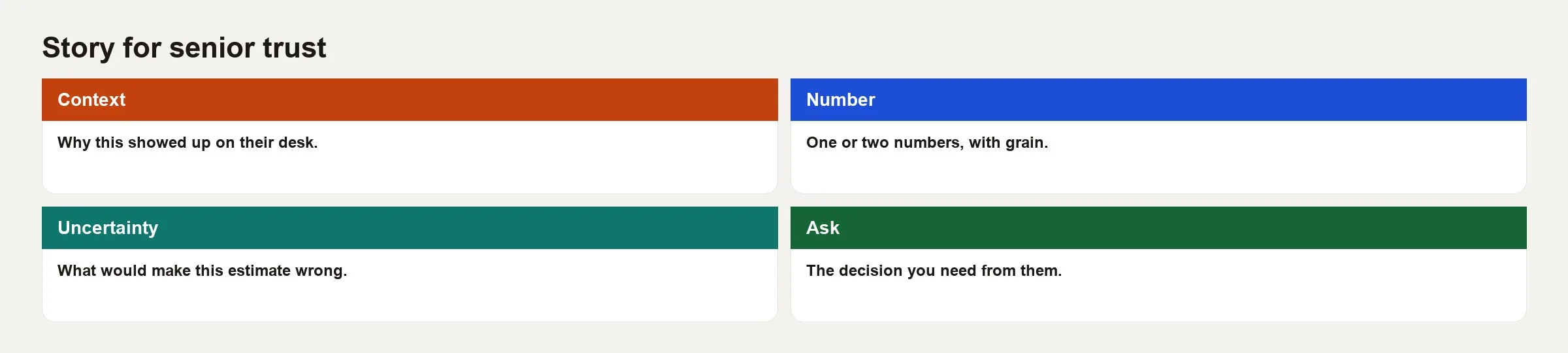
1. Context: why we are here
Give one or two sentences that name the decision window and the limit you are working within. For example: “We need to choose whether to delay the pricing change until after third-quarter renewals.” Or: “Our customer success team has fixed capacity, so we can pilot at most two save campaigns.” Context is not a history of the company since its founding. It is the frame that makes the number mean something.
Bad context sounds like “As you all know, retention is important.” Good context sounds like “Enterprise renewals land in 19 days, so we must choose message A or message B this week.”
2. Number: the few facts that change the decision
Lead with one to three numbers, not twelve. Each number needs a unit, a comparison, and a clear description of what one row of data stands for. Here is one that works: “Enterprise customer churn is 3.1% over the last quarter, up 0.8 percentage points from the quarter before, measured on active contracts at the start of the quarter.” A number stated that way is something senior people can argue with productively.
Put the supporting charts after your spoken lead, or move them to appendix slides. If the room only ever sees chart 7, you have lost the spine of the story. Clear, labeled, accessible charts still matter, as the earlier post on inclusive data products explained, but they support the claim and are not the claim itself.
3. Uncertainty: what could make this wrong
Senior people trust analysts who bring up the weak spots early, before anyone else can find them. Name the top one or two risks: two teams defining a metric differently, incomplete data, a sample that does not represent everyone, too few records, events that post late, or an outside factor you cannot remove. Then say what you did about it or what would settle the question.
Naming uncertainty does not mean embarrassing yourself. It sets the boundaries of what you are claiming. “I am confident the number is going up, but I am not confident in the exact 0.8 points because late renewals keep posting for 10 days” is how a grown-up talks. “The dashboard says 3.1%” with no caveats invites someone to correct you in public, because a dashboard (a screen of charts that tracks key numbers) shows a number without the limits behind it.
4. Ask: the decision or resource you need
End with a verb such as approve, delay, pilot, fund, stop, or assign, and include timing. For example: “Approve a two-week delay on the price change for enterprise products. We need a decision by Thursday afternoon, and the pricing committee owns it.” Vague asks like “thoughts?” produce vague outcomes because nobody knows what answer is wanted.
If you truly need a discussion rather than a decision, say what decision the discussion feeds and when it closes. Open-ended workshops with no end date are where analysis turns into office folklore.
Worked example: the same analysis, two stories
Situation: Your product team wants to change the limit on the free plan. You have analyzed how many free users become paying customers and how much support work the change would create.
Weak story (common): You walk through data sources, then a funnel, then a group of users who signed up in the same month, then a support ticket trend, then a competitor slide, and you finish with “happy to take questions.” No one is sure what you recommend. Engineering hears risk and the growth team hears upside, so nobody owns a decision.
Strong story (using the spine):
- Context: “We are choosing whether to lower the free-plan limit in the next release. Support staffing is fixed for the quarter.”
- Number: “In a similar 2024 change, the share of free users who became paying customers rose about 12% relative to before, while support tickets per free user rose about 18% in the first three weeks. So we got more paid signups and measurably heavier support.”
- Uncertainty: “The 2024 change also included a redesign of the screens, so I cannot fully separate the effect of the limit. New users today skew more toward phones, which may make the support load worse than in 2024.”
- Ask: “Ship the limit change only if we also fund two temporary support staff for four weeks, or roll it out to 20% of new free signups first. We need a decision by Friday to keep the release on schedule.”
The analyst and the underlying work are the same in both versions, but the trust outcome is very different. The second version invites the executives to make a real tradeoff, while the first one gives them a tour of charts.
The email skeleton (when the meeting is a thread)
Many “presentations” are really emails that get forwarded when you are not in the room. Write every one of them so it still makes sense when someone forwards it.
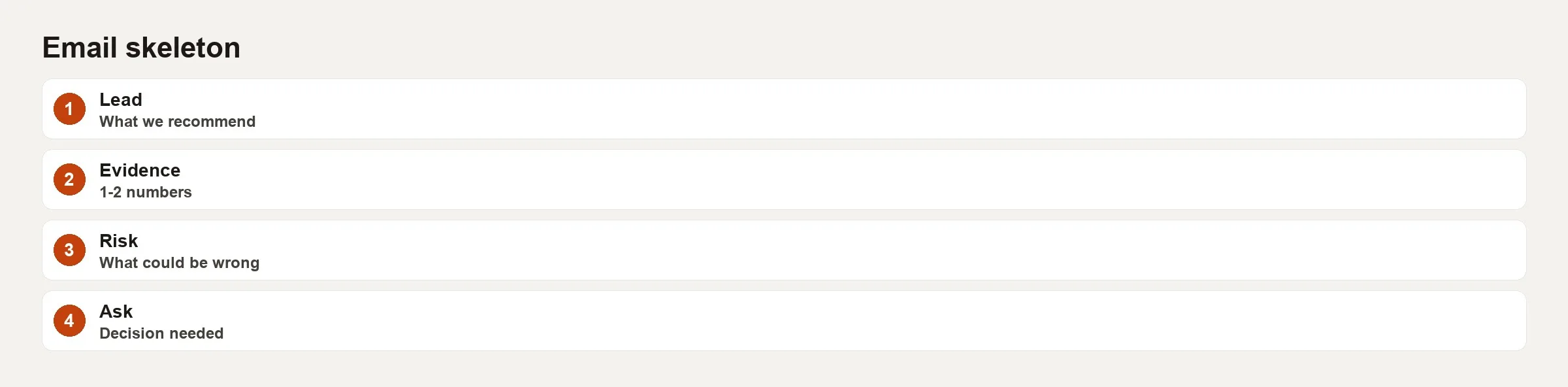
| Part | Line to write |
|---|---|
| Lead | What we recommend |
| Evidence | 1 to 2 numbers |
| Risk | What could be wrong |
| Ask | Decision needed (when and who) |
Here is a template you can paste into a new email:
Subject: Decision needed by {date}: {topic}

Lead:
I recommend {action} because {one reason}.

Evidence:
1) {metric, value, comparison, grain}
2) {optional second metric}

Risk / uncertainty:
This could be wrong if {main risk}. Mitigation: {check or staged rollout}.

Ask:
Please {approve / choose A or B / fund X} by {deadline}.
Owner after decision: {name}.
I will {next step after yes/no}.

Appendix (links):
- Full analysis
- Dashboard
- Metric definition
Here is the same template filled in:
Subject: Decision needed by Thu 3pm: delay enterprise price change?

Lead:
I recommend delaying the enterprise price change until after the renewals batch
completes (about 19 days) to avoid stacking two shocks on the same accounts.

Evidence:
1) 34% of enterprise ARR renews in the next 30 days (contracts active as of Monday).
2) In last year's mid-renewal price change, logo churn in that window was 1.4 pts
   higher than adjacent windows (same definition as finance board pack).

Risk / uncertainty:
Renewal-risk estimate uses opportunity stage data that lags by a few days.
If sales closes early renewals this week, exposure shrinks; I will refresh Tuesday.

Ask:
Pricing committee: approve delay yes/no by Thursday 3pm.
If no, I need a targeted exception list from sales ops by Wednesday noon.
I will publish the refreshed exposure table Tuesday 10am.
The subject line includes a deadline, which tells the reader when to act. The lead is a recommendation instead of “sharing some analysis,” so nobody has to guess your view. The risk comes with a fix and a refresh plan, which shows you have already thought about how to be wrong. That combination is what senior readers can scan in half a minute.
Live room habits that protect the spine
- Say the ask before slide 2 if the culture allows it. Some rooms want theater, but most want relief.
- Keep one idea per slide on the main path, and put method detail in the appendix so the room can follow along.
- Talk to blockers first. Anyone who can block the decision should see a short version of the email layout before the meeting, so nothing surprises them.
- Answer the question asked, then steer back to the spine. Do not tour your entire notebook (a document that mixes code, results, and notes) because someone asked about a filter.
- Write decisions down in the meeting notes: what was decided, what was put off, who owns it, and by when.
- Separate facts from recommendations with your wording, such as “The data shows… I recommend…”, so that people who disagree can aim at the right layer.
Language patterns that raise or burn trust
| Prefer | Avoid |
|---|---|
| “The number is clearly going up; my estimate is within a rough range because…” | “The number is 12.437% so we must…” |
| “I recommend A over B because…” | “It would be interesting to explore…” |
| “This is observational; a pilot would test…” | “This proves the feature causes revenue” |
| “Finance definition, as used in the board report” | “Users” with three silent filters |
| “Decision needed by Thursday” | “Whenever you get a chance” |
Shared metric vocabulary helps here. If the room argues about what a word means, you do not have a storytelling problem yet, you have a definition problem, so keep a link to the written metric definition. The series on defining metrics exists so you are not inventing language under pressure. When you talk about experiments, stay humble about what caused what, because overclaiming is a fast way to lose senior trust for good.
When storytelling is not the bottleneck
Sometimes the spine is clear and the organization still will not decide. The cause can be politics, missing owners, or incentives that reward delay. Storytelling cannot fix a company that punishes bad news or never says who gets to decide. Your job in that setting is still to make the recommendation easy to read, write down that no decision was made, and protect your own integrity. After that, ask whether the career ladder you want exists there at all, or whether your portfolio needs updating for a different kind of employer.
Common mistakes
- Mystery novel structure. Saving the answer for the end loses busy people before they reach it.
- Chart tours. Twelve visuals without a spine are a museum and not a meeting.
- Hidden uncertainty. Someone else will find it, and they will find it at a worse moment.
- No ask. Analysis without a verb becomes optional reading, so nobody acts on it.
- False precision. Fake decimals signal insecurity and do not show rigor.
- Causal overclaim. Senior leaders remember who misled them about “impact.”
- A different story in email, slides, and hallway chats. Consistency is part of trust.
- Treating every question as a new project. Park questions that are off the spine in a follow-up list.
Quick recap
- Senior trust comes from reliable decisions and does not come from showmanship.
- Tell the story as context, then number, then uncertainty, then ask.
- Lead with one to three numbers that change the decision, and move the rest to the appendix.
- Bring risks up early, with a fix or a refresh plan attached.
- Write emails so they survive being forwarded: lead, evidence, risk, ask, and deadline.
- Practice until a colleague can repeat your recommendation after hearing it once.
How to practice this week
- Pick one analysis you already finished, or a project from your portfolio, because reviewing finished work shows your habits more honestly than a new project.
- Write the four beats in four sentences: context, number, uncertainty, and ask.
- Rewrite it using the email layout, with a deadline in the subject line.
- Delete any chart that does not support your one to three numbers, or move it to the appendix.
- Give the short version to a colleague in two minutes, then ask them to repeat your recommendation and your ask back to you.
- If they cannot, tighten the story until they can. Senior leaders run this same test on you in real time, so it is better to run it first.
This closes the analyst career path series. Know the level your work is being judged at, show your judgment in what you produce, and speak so that decisions can happen. To build the technical depth that feeds better stories, keep going through Learn, SQL, and metrics.
Sources
- Harvard Business Review. Archives on persuasive communication and decision-ready recommendations (search “how to write a memo that works” style guidance; use as craft ideas, not rigid rules). https://hbr.org/topic/subject/persuasive-communications
- Barbara Minto / Pyramid Principle materials (answer-first structure widely used in management communication). Overview references via official publisher pages for The Pyramid Principle. https://www.barbaraminto.com/
- Edward Tufte. The Visual Display of Quantitative Information (classic on integrity of visual evidence). Publisher info: https://www.edwardtufte.com/tufte/books_vdqi
- W3C WAI. Making content understandable (clarity principles that transfer from web a11y to analytical communication). https://www.w3.org/WAI/fundamentals/accessibility-principles/
- Google re:Work. Unbiasing and structured decision practices (helps separate evidence from advocacy cleanly). https://rework.withgoogle.com/
Keep going
Same lessons in your feed
Short diagrams, hooks, and weekly tutorials on Substack, Instagram, X, and Facebook.