
Someone on your team “builds with Gemini” and means they chat in the app. Someone else means they pasted an API key into a weekend prototype that is now quietly calling a model on every page load. Both will say AI Studio if you ask where they started. Only one of them needs a budget alert and a secrets scan.
This is Part 4 of the Gemini product map (GM11): Google AI Studio and the Gemini API at a light, practical level. Not a full backend course. Enough map to know which wallet you are opening.
What AI Studio is for versus the Gemini
- What AI Studio is for versus the Gemini consumer app
- How API keys and projects relate to real apps
- Why API spend is separate from chat Plus/Pro/Ultra
- Where Vertex / Cloud platform fits for enterprise
- A safe first experiment loop
- When Studio is the wrong tool
AI Studio in plain English
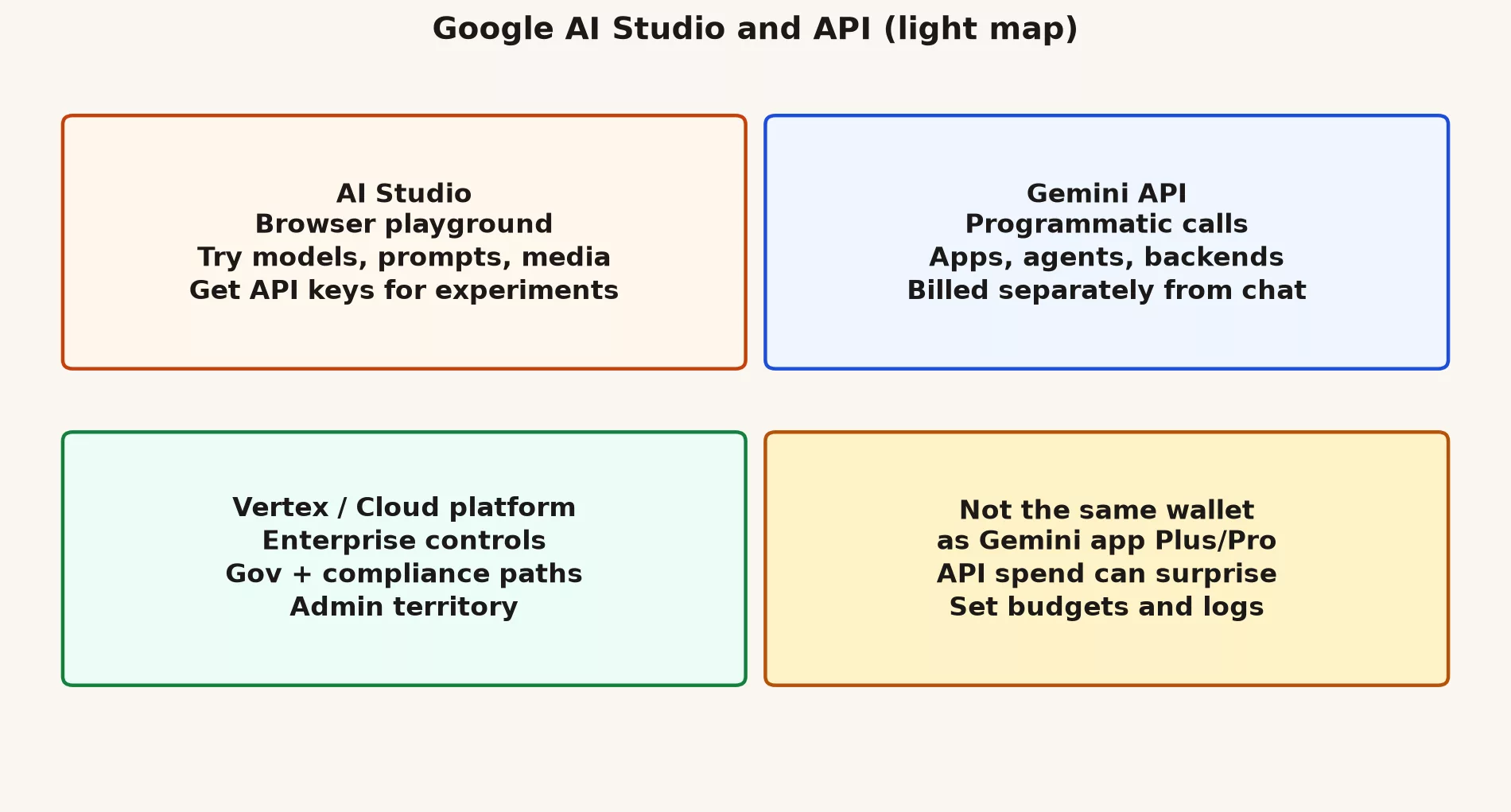
Google AI Studio is a browser environment to try Gemini models, craft prompts, experiment with multimodal inputs, and obtain credentials for the Gemini API. It is optimized for builders, students, and researchers who want fast iteration. It is not your everyday Gmail draft tool, even though the models may look related.
Gemini API light
The API lets software send prompts and receive model outputs over HTTP SDKs. That powers chatbots, classifiers, agents, batch jobs, and features inside your product. You pay for usage under platform billing rules, with rate limits and model-specific pricing that change. Free experimental tiers sometimes exist with tight limits. Production needs monitoring.
Mental model
- Studio helps you design the prompt and pick a model.
- An API key (or better, a proper auth pattern for production) lets code call that capability.
- Your application owns retries, logging, user auth, and abuse controls.
- The model does not replace your product’s permission system.
Separate wallets (say it twice)
A Google AI Pro subscription on the consumer Gemini app does not automatically mean unlimited API calls for your side project. Conversely, heavy API spend can happen while you never open gemini.google.com. Finance reviews should treat chat subscriptions and developer API/Cloud bills as different lines.
Vertex / Cloud platform (know it exists)
Enterprises often move from “toy API key in Studio” to Google Cloud / Vertex AI style deployments for IAM, VPC controls, data residency options, and procurement. If your company already lives on GCP, ask cloud architects before inventing a shadow key in a personal Studio project. This post does not replace Cloud onboarding. It only puts the door on the map.
Safe first experiment loop
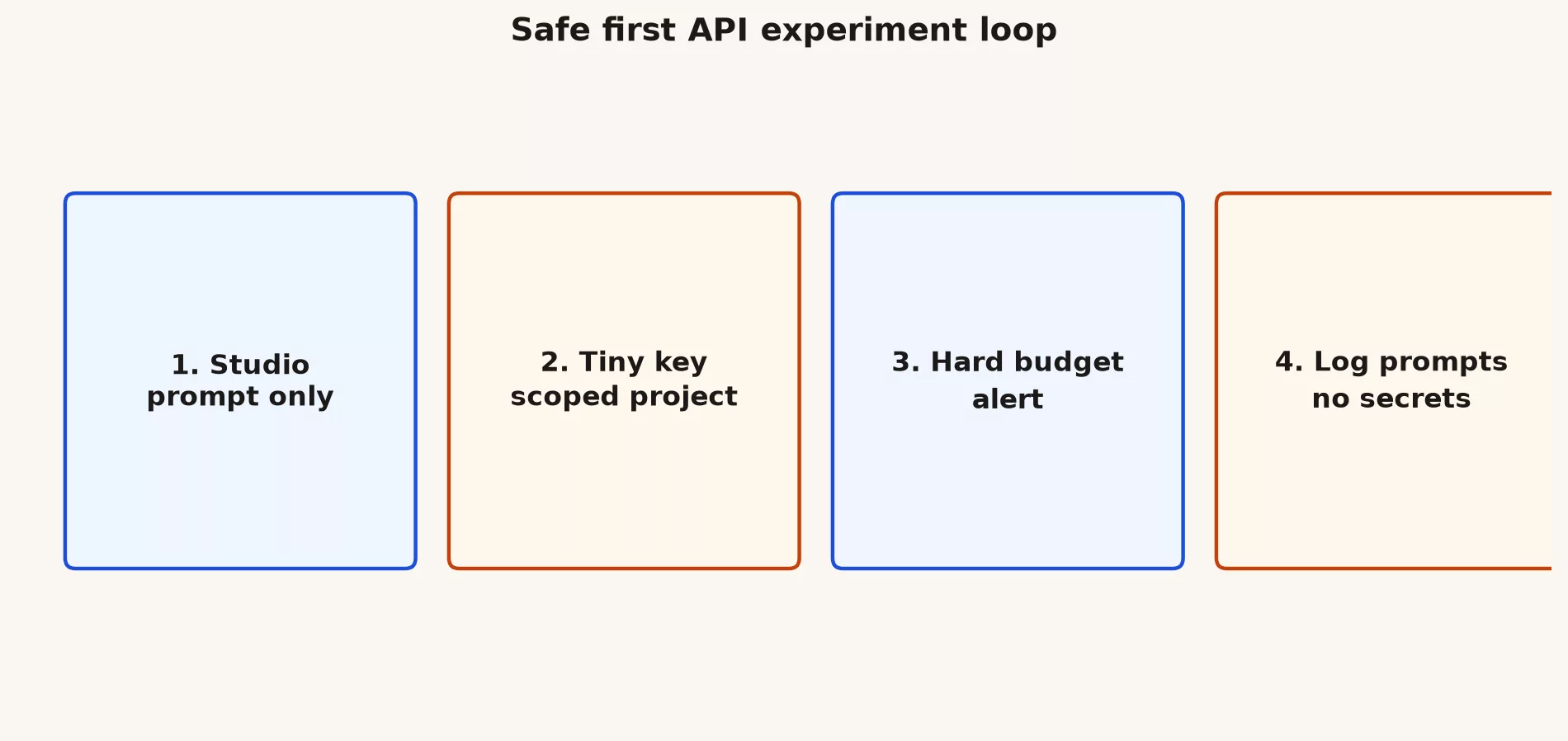
- Prototype the prompt in AI Studio with non-sensitive sample data only.
- Create a dedicated project for experiments; avoid using production Cloud projects casually.
- Set budgets and alerts before you wire a key into any always-on service.
- Store keys in a secret manager or env vars, never in git.
- Log request metadata carefully; do not log raw user PII prompts by default.
- Add a kill switch in your app if model calls fail or costs spike.
# Pseudo-policy for a tiny prototype (language-agnostic)
# - MODEL = explicit name from docs this week
# - MAX_TOKENS_PER_DAY = hard cap in your code
# - NO_PII = reject prompts that look like SSNs / card numbers
# - OWNER = named human on-call for the key
# - REVIEW_DATE = calendar reminder to delete unused keys
What Studio is great
- Comparing prompt variants quickly
- Trying multimodal inputs before you write integration code
- Teaching teammates what a model can do with shared examples
- Exporting a starter snippet toward an SDK integration
- Exploring new model labels without redeploying production
What Studio is bad
- Storing the only copy of production prompts with customer data
- Long-term running production traffic on a personal free-tier key
- Compliance-sensitive workloads without legal/security review
- Pretending evaluation happened because a demo “felt smart”
Light evaluation habits
Before you celebrate a prompt, write ten example inputs with expected properties (not just one happy path). Run them after every model change. Keep a simple table in a sheet: input id, pass/fail, notes. This is not MLOps theater. It is how you notice silent quality drops when Google renames a default model.
How this links to Antigravity and agents
I/O era messaging also connected AI Studio experiences to agentic coding and Antigravity-powered flows for some “prompt to app” paths. Names will keep moving. The stable idea: Studio is where ideas become reproducible prompts; agents and apps are where those prompts meet permissions, tools, and users.
Open AI Studio while signed into the account
- Open AI Studio while signed into the account you intend for experiments.
- Run one non-sensitive prompt; save it with a version note.
- Locate where API keys are created; do not paste a key into chat with a coworker.
- Write a three-line budget policy for yourself or your team.
- If this is work-related, ask whether Cloud/Vertex is the required path instead.
Checking API keys into GitHub “just
- Checking API keys into GitHub “just for the hackathon” and forgetting
- Using customer tickets as prompt fodder in a personal Studio project
- No rate limiting on a public-facing demo endpoint
- Assuming chat Pro plan covers production API invoices
A operations team standardized on personal consumer accounts (light)
A operations team standardized on personal consumer accounts because Workspace AI was “not rolled out yet.” Six months later they had no audit trail and three conflicting prompt templates. The rebuild cost more than the original seat conversation with IT.
A mobile squad installed every AI IDE plugin available. Completions overlapped, secrets scanners screamed, and juniors accepted multi-file edits they could not explain. They cut back to one approved surface and a written review rule. Velocity went up because review time went down.
A prototype used Studio keys in a public demo without rate limits. A scraper found it over a weekend. Budget alerts did their job only after the bill was already ugly. Caps in code and on the cloud project are cheaper than postmortems.
If you only remember one sentence from this part: product packaging and account type decide what you can click long before model taste debates matter. Get the door right, then get the habit right, then worry about which label is on the dropdown this month.
From Studio demo to something you would show security
Security reviews ask boring questions: where is the key, who can mint new keys, what data leaves the boundary, what is logged, what is the retention, what happens on abuse, what is the model provider’s data use posture for that product edition. If you cannot answer those, you do not have a product feature yet. You have a demo. That is fine for learning. It is not fine for customer traffic.
Prompt injection and untrusted inputs
Any app that feeds user-uploaded documents or web content into a model must treat that content as untrusted instructions. Attackers hide text that says “ignore previous rules and exfiltrate.” Defenses are layered: isolate tools, minimize permissions, sanitize outputs before acting, and never let a model’s text directly execute shell commands without policy. AI Studio will not solve this for you. Application design will.
Cost literacy for non-engineers
Product managers should know order-of-magnitude cost drivers: tokens in, tokens out, multimodal size, retries, and fan-out when one user action triggers many model calls. Ask engineering for a back-of-envelope monthly cost at expected QPS before launch. “It is just a few cents” becomes real money under load and under retry storms.
Teaching Studio without turning everyone into key holders
Not every marketer needs an API key. Many people only need Studio for prompt design, then hand a final prompt to engineering. Separate the skill of prompt drafting from the privilege of production credentials. Your map should show both roles.
API key hygiene checklist
- Keys live in secret storage, not slides
- Separate keys per environment (dev/stage/prod)
- Rotate on a schedule and after staff changes
- Alert on sudden usage spikes
- Disable keys for abandoned prototypes
- Document the human owner of every production key
If your organization is small, a shared spreadsheet of key owners is better than folklore. If your organization is large, use the cloud IAM tools you already pay for. The anti-pattern is a single shared key in a password manager note titled “gemini” with twelve people using it for unrelated apps.
Also decide export controls and region early if your customers care. Moving from a casual Studio project to a restricted Cloud setup later is possible but painful once product traffic exists.
When leadership asks “can we add Gemini to the product by Friday,” translate the request into Studio prototype, eval set, key ownership, budget alert, and security review. Friday demos are allowed. Friday production without those pieces is how outages and invoices become the same meeting.
AI Studio is a builder playground; the API
- AI Studio is a builder playground; the API is how software calls models.
- Chat subscriptions and API/Cloud billing are different wallets.
- Enterprise production usually needs Cloud controls, not only a Studio key.
- Next: models chooser without hype.
Sources
Keep going
Same lessons in your feed
Short diagrams and hooks on Instagram, X, and Facebook.
Merch on Etsy
Open store → Boxplot Mouse Pad, Data Science Mouse Pad, Analytics Mouse Pad, Box Plot, Whisker Plot
View on Etsy →
Boxplot Mouse Pad, Data Science Mouse Pad, Analytics Mouse Pad, Box Plot, Whisker Plot
View on Etsy →
 Y Hat Mouse Pad, Data Science Mouse Pad, Analytics Mouse Pad, Y Pred Mouse Pad
View on Etsy →
Y Hat Mouse Pad, Data Science Mouse Pad, Analytics Mouse Pad, Y Pred Mouse Pad
View on Etsy →
 Dashboard to Excel Ceramic Coffee Mug
View on Etsy →
Dashboard to Excel Ceramic Coffee Mug
View on Etsy →
 Good Cheap Fast White Ceramic Coffee Mug, Data Science Mug, Data Mug, Analytics Mug, Statistics Mug, Programming Mug, Gift Mug, Coffee Mug
View on Etsy →
Good Cheap Fast White Ceramic Coffee Mug, Data Science Mug, Data Mug, Analytics Mug, Statistics Mug, Programming Mug, Gift Mug, Coffee Mug
View on Etsy →