
You edit a SQL model. A teammate edits the same file. Emailing model_v2_FINAL.sql back and forth is how weekends die. Git is a system for tracking versions of files, trying changes on branches, and combining work without inventing filename archaeology.
This is a straightforward introduction for analysts and analytics engineers: repositories, commits, branches, remotes, and a minimal daily loop. Hosted tools like GitHub and GitLab add review and CI on top.
What you’ll learn
- What a repository and a commit are
- Why branches exist
- How remotes relate to your laptop
- A simple daily workflow
- Common mistakes and how to recover calmly

Repository
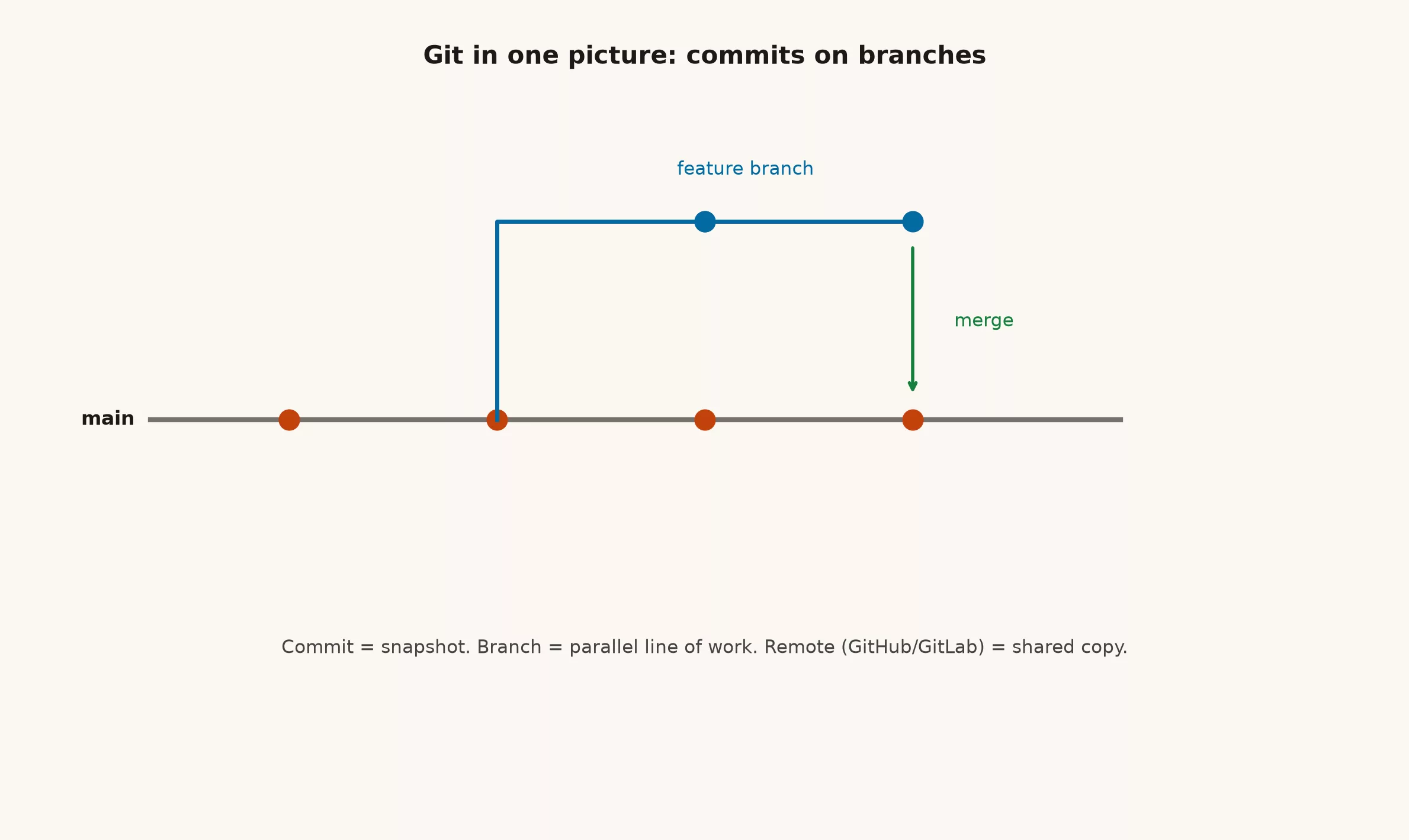
A repository (repo) is the project’s tracked folder plus history. Locally it lives on your machine. Remotely it lives on GitHub, GitLab, or similar so the team shares one timeline.
Commit
A commit is a snapshot with a message. Good messages say why, not only what: “Fix active customer grain to 90-day payments” beats “updates.” Small commits are easier to review and reverse.
Branch
A branch is a movable label pointing at a line of commits. Create a branch for a change, commit there, open a pull/merge request, get review, then merge into main. This keeps experiments from breaking the default line everyone ships from.
Basic loop
git pull
git checkout -b fix/active-customer-grain
# edit files
git status
git add path/to/file.sql
git commit -m "Fix active customer grain to 90-day payments"
git push -u origin fix/active-customer-grain
# open PR, review, mergeRemotes, clone, push, pull
| Command idea | Meaning |
|---|---|
| clone | Copy remote repo to your machine |
| pull | Fetch and integrate remote updates |
| push | Publish your commits to remote |
| fetch | Download remote info without merging yet |
Why analytics teams need git
Metrics definitions are code. Dashboard-as-code is code. Notebooks that generate executive numbers are code. Without version control you cannot answer “what changed last Thursday before the board number moved.” With git you can.
Pull requests and review
A pull request (PR) is a conversation around a branch. Reviewers check grain, tests, and naming. CI can run SQL linters or dbt tests. Review is not bureaucracy when money-facing metrics are involved; it is cheap insurance.
Common mistakes
- Huge commits that mix formatting and logic
- Committing secrets or credentials
- Working on main without a branch for risky changes
- Rewriting shared history without team agreement
- Ignoring
git statusuntil things feel haunted
Recovery without panic
Most mistakes are recoverable if you committed recently. Learn git status, git log, and how to undo unstaged edits. For shared branches, prefer revert commits over silent history rewrites. Ask for help early; git problems compound when you invent fixes under time pressure.
Minimal skills checklist
- Clone and open a repo
- Create a branch
- Commit with a clear message
- Push and open a PR
- Respond to review comments
- Pull main regularly to reduce merge pain
Quick recap
- Git tracks history so teams can change files safely
- Commits are snapshots; branches isolate work
- Remotes share history; PRs add review
- Analytics logic deserves version control
- Small clear commits beat giant mystery dumps
Write examples from your own workplace. A named dashboard fight teaches more than a generic industry claim, and it keeps the post useful when the logos on the architecture slide change again next year.
If two teams argue about a number, put both definitions on one page with owners and timestamps. Clarity beats a forced compromise that nobody trusts enough to use in a real decision meeting.
Ship a small artifact this week: a definition card, a quality check, a retired vanity chart, or a one-page brief. Momentum compounds faster than another strategy deck about becoming data driven someday.
Teach newcomers where the source of truth lives on day one. Onboarding is a data-system surface. If new hires learn the wrong table first, you will spend months undoing that habit in code review and Slack threads.
When something breaks, fix the rule or the automated test that should have caught it. Heroic manual checks do not scale, and they disappear the week everyone is out on holiday or buried in a launch.
Prefer plain words in meetings until everyone shares a definition. Jargon is fine after that. Before that, jargon is just a way to lose the people who will actually act on the analysis.
Keep a short change log for metrics, pipelines, and critical dashboards. Future you will need the date a definition shifted, and you will not find it in a year-old screenshot buried in a slide archive.
Measure one concrete thing that proves the new approach beats the old habit: fewer reconcile hours, faster ticket answers, lower duplicate rates, or fewer “which number is right” threads per month.
Resist boiling the ocean. One domain, one partnership, one metric strip, or one retrieval evaluation set is enough to learn. Expansion is easier after you have a win people can point at without squinting.
Document the messy edge cases in the open. Hidden footnotes become tribal knowledge, and tribal knowledge becomes an outage when the only person who remembered the footnote changes teams.
Write examples from your own workplace. A named dashboard fight teaches more than a generic industry claim, and it keeps the post useful when the logos on the architecture slide change again next year.
If two teams argue about a number, put both definitions on one page with owners and timestamps. Clarity beats a forced compromise that nobody trusts enough to use in a real decision meeting.
Ship a small artifact this week: a definition card, a quality check, a retired vanity chart, or a one-page brief. Momentum compounds faster than another strategy deck about becoming data driven someday.
Teach newcomers where the source of truth lives on day one. Onboarding is a data-system surface. If new hires learn the wrong table first, you will spend months undoing that habit in code review and Slack threads.
When something breaks, fix the rule or the automated test that should have caught it. Heroic manual checks do not scale, and they disappear the week everyone is out on holiday or buried in a launch.
Prefer plain words in meetings until everyone shares a definition. Jargon is fine after that. Before that, jargon is just a way to lose the people who will actually act on the analysis.
Keep a short change log for metrics, pipelines, and critical dashboards. Future you will need the date a definition shifted, and you will not find it in a year-old screenshot buried in a slide archive.
Measure one concrete thing that proves the new approach beats the old habit: fewer reconcile hours, faster ticket answers, lower duplicate rates, or fewer “which number is right” threads per month.
Resist boiling the ocean. One domain, one partnership, one metric strip, or one retrieval evaluation set is enough to learn. Expansion is easier after you have a win people can point at without squinting.
Document the messy edge cases in the open. Hidden footnotes become tribal knowledge, and tribal knowledge becomes an outage when the only person who remembered the footnote changes teams.
Write examples from your own workplace. A named dashboard fight teaches more than a generic industry claim, and it keeps the post useful when the logos on the architecture slide change again next year.
If two teams argue about a number, put both definitions on one page with owners and timestamps. Clarity beats a forced compromise that nobody trusts enough to use in a real decision meeting.
Ship a small artifact this week: a definition card, a quality check, a retired vanity chart, or a one-page brief. Momentum compounds faster than another strategy deck about becoming data driven someday.
Teach newcomers where the source of truth lives on day one. Onboarding is a data-system surface. If new hires learn the wrong table first, you will spend months undoing that habit in code review and Slack threads.
When something breaks, fix the rule or the automated test that should have caught it. Heroic manual checks do not scale, and they disappear the week everyone is out on holiday or buried in a launch.
Prefer plain words in meetings until everyone shares a definition. Jargon is fine after that. Before that, jargon is just a way to lose the people who will actually act on the analysis.
Keep a short change log for metrics, pipelines, and critical dashboards. Future you will need the date a definition shifted, and you will not find it in a year-old screenshot buried in a slide archive.
Measure one concrete thing that proves the new approach beats the old habit: fewer reconcile hours, faster ticket answers, lower duplicate rates, or fewer “which number is right” threads per month.
Resist boiling the ocean. One domain, one partnership, one metric strip, or one retrieval evaluation set is enough to learn. Expansion is easier after you have a win people can point at without squinting.
Document the messy edge cases in the open. Hidden footnotes become tribal knowledge, and tribal knowledge becomes an outage when the only person who remembered the footnote changes teams.
Write examples from your own workplace. A named dashboard fight teaches more than a generic industry claim, and it keeps the post useful when the logos on the architecture slide change again next year.