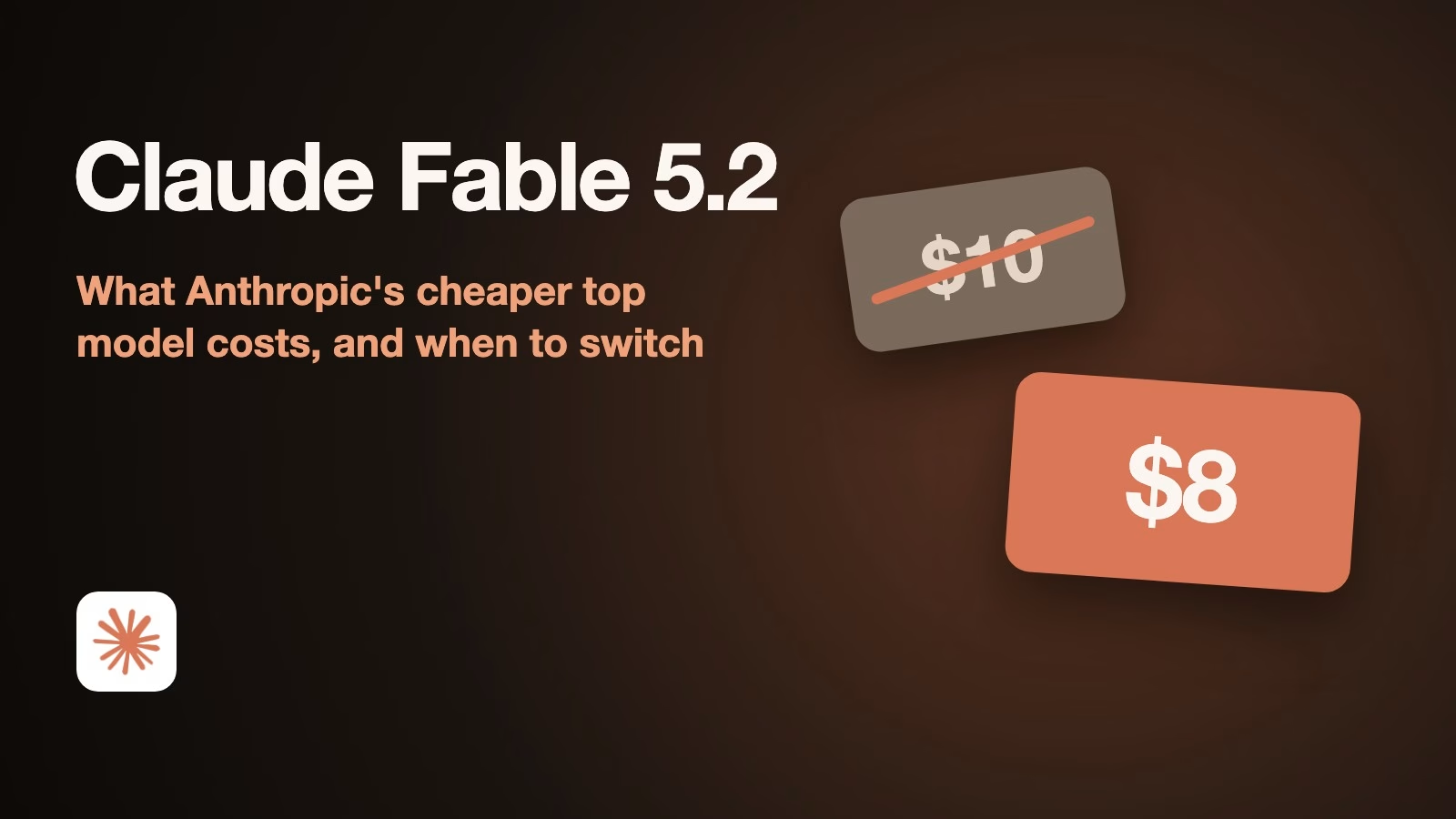
Claude Fable 5.2 is the newest and strongest version of Claude, Anthropic’s AI assistant, and it costs 20% less than the version before it, so if you pay for Claude by how much you use, switching usually saves money straight away. It came out on November 9, 2026 according to Anthropic’s launch post, which also says it answers up to 30% faster, but plenty of everyday jobs never needed the strongest version in the first place.
Imagine you run the same long report through Claude every week: a stack of sales notes goes in, a ten-page summary for leadership comes out. You switched it to Fable 5.1 a few months ago because the summaries were sharper, and the monthly bill went up with it. Now there is a cheaper Fable, and you want to know whether to move the report, keep it where it is, or go back to a cheaper version of Claude.
This guide covers what Fable 5.2 is, who can use it in the Claude apps, what it costs next to Fable 5.1, Opus 5.5 and Sonnet 5.5, what changes if you call it from code, and a one-afternoon test that tells you which version your report needs. For the general method behind the cost maths, see our guide on working out what an AI task really costs.
What is new in this version?
Two things are new: a lower price with faster answers, and better results on hard multi-step work, according to Anthropic. Fable 5.2 is the newest model in Anthropic’s Fable line, its most capable and most expensive tier, sitting above Opus, Sonnet and Haiku. Anthropic released it on November 9, 2026, together with Claude Mythos 5.2, in its launch post. Mythos 5.2 is the same model with fewer safety blocks for security and life-science work, and it is open only to organisations Anthropic has verified through its programmes for those fields.
The headline changes are price and speed. Anthropic’s pricing page (checked November 15, 2026) lists Fable 5.2 at $8 per million input tokens and $40 per million output tokens for developers, against $10 and $50 for Fable 5.1. A token is a chunk of text, roughly three-quarters of an English word, and it is the unit AI companies use to measure and bill text. Anthropic also says Fable 5.2 produces its output up to 30% faster than Fable 5.1, which is its own measurement.
Anthropic’s post also publishes benchmark scores, the results on fixed sets of test tasks that companies use to compare models. On its own charts Fable 5.2 beats Fable 5.1 on every test shown, often by a wide margin. On AutomationBench, a test of business workflows, Anthropic’s launch post reports 51.4% for Fable 5.2 against 31.4% for Fable 5.1 and 42.5% for Opus 5.5. Anthropic ran these tests, so treat them as a hint about where to look, not as your result.
Where Opus 5.5 still fits
The same launch post tells everyday users to “start with Claude Opus 5.5”, which Anthropic calls its strongest daily driver. Fable is the model for the hardest jobs: long tasks with many steps, difficult code, and analysis where a better answer is worth a higher bill. That framing matters for the decision later in this guide, because the cheapest correct answer often comes from Opus.
Who can use it in the Claude apps?
Fable 5.2 is on paid Claude plans only, and on most of them it can use up to half of your weekly usage limit. That comes from Anthropic’s plans page and the launch post, both checked November 15, 2026.
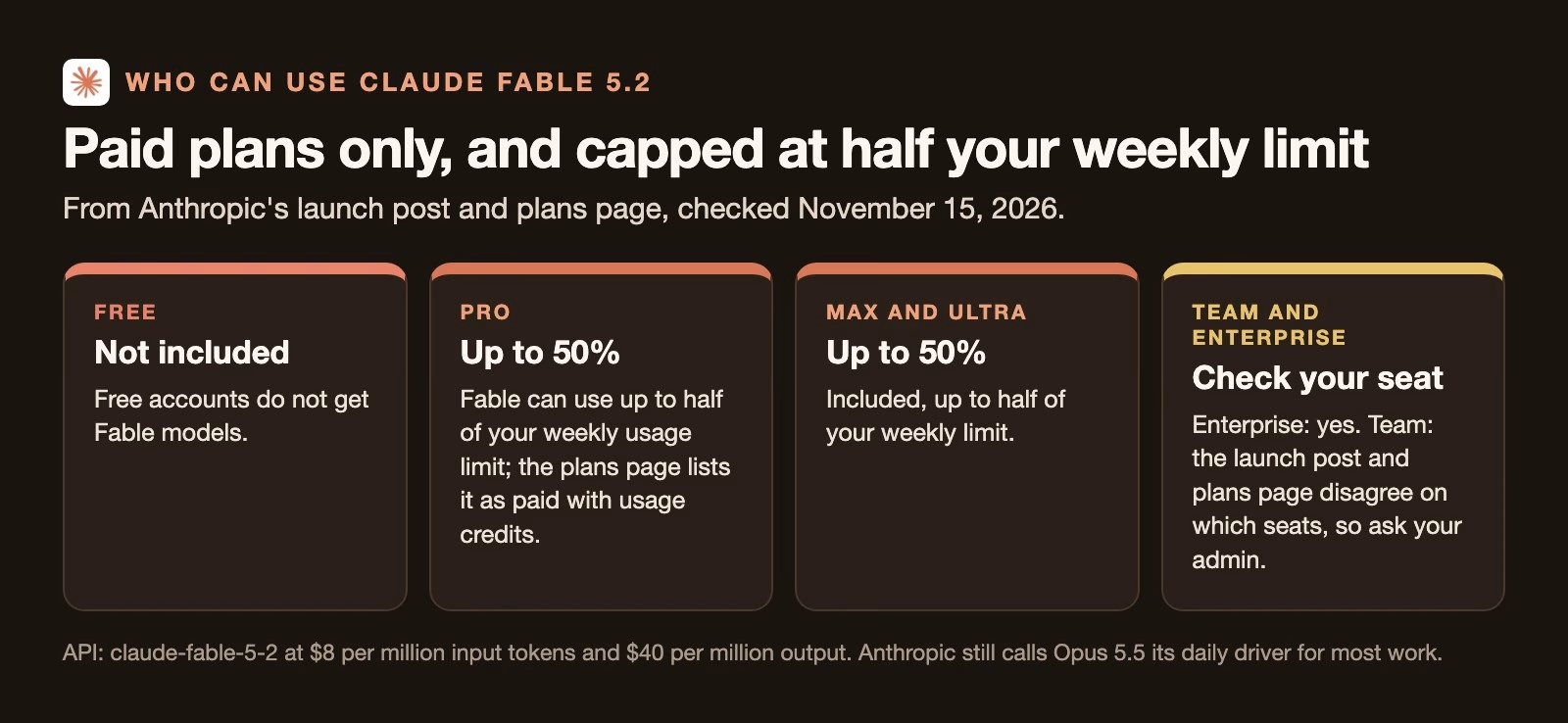
- Free: no Fable model.
- Pro: the November 9 launch post says Fable can use up to 50% of your weekly limit, while the plans page (checked November 15, 2026) lists it as paid with usage credits.
- Max and Ultra: included, up to half of your weekly limit, per the plans page on November 15, 2026.
- Enterprise: included.
- Team: the launch post and the plans page disagree about which seats get it, so ask your administrator before you plan around it.
Fable uses your allowance faster than Opus or Sonnet, so if you spend a whole week’s half on Fable by Wednesday, the rest of the week runs on the other models. Anthropic’s post also mentions a launch offer of one to three extra Fable resets for eligible paid plans, depending on how long you have subscribed.
How much does it cost per use?
Through the API it costs $8 per million input tokens and $40 per million output tokens, according to Anthropic’s pricing page (checked November 15, 2026). The API, short for application programming interface, is how your own programs and tools call Claude directly and pay per token instead of a monthly plan.
| Model | Input, per million tokens | Output, per million tokens | Batch (in / out) |
|---|---|---|---|
| Fable 5.1 | $10 | $50 | $5 / $25 |
| Fable 5.2 | $8 | $40 | $4 / $20 |
| Opus 5.5 | $4 | $20 | $2 / $10 |
| Sonnet 5.5 | $2 | $10 | $1 / $5 |
| Haiku 5.5 (prompts up to 100,000 tokens) | $0.10 | $0.50 | $0.05 / $0.25 |
Two discounts on the same pricing page (checked November 15, 2026) change the maths a lot. The Batch API, for jobs that can wait up to a day for an answer, halves the price to $4 and $20. Prompt caching, where you send the same long instructions or documents again and pay only a fraction for the repeated part, drops repeated input to $0.20 per million tokens. There is also a fast mode at $16 and $80 that Anthropic says generates output up to 2.5 times faster.
The weekly report, priced
Here is the report from the start of this guide at list price. Each run reads 20,000 tokens of notes and writes 3,000 tokens of summary, and the chart prices 1,000 runs, which is about 19 years of weekly reports but under three years of a daily one.
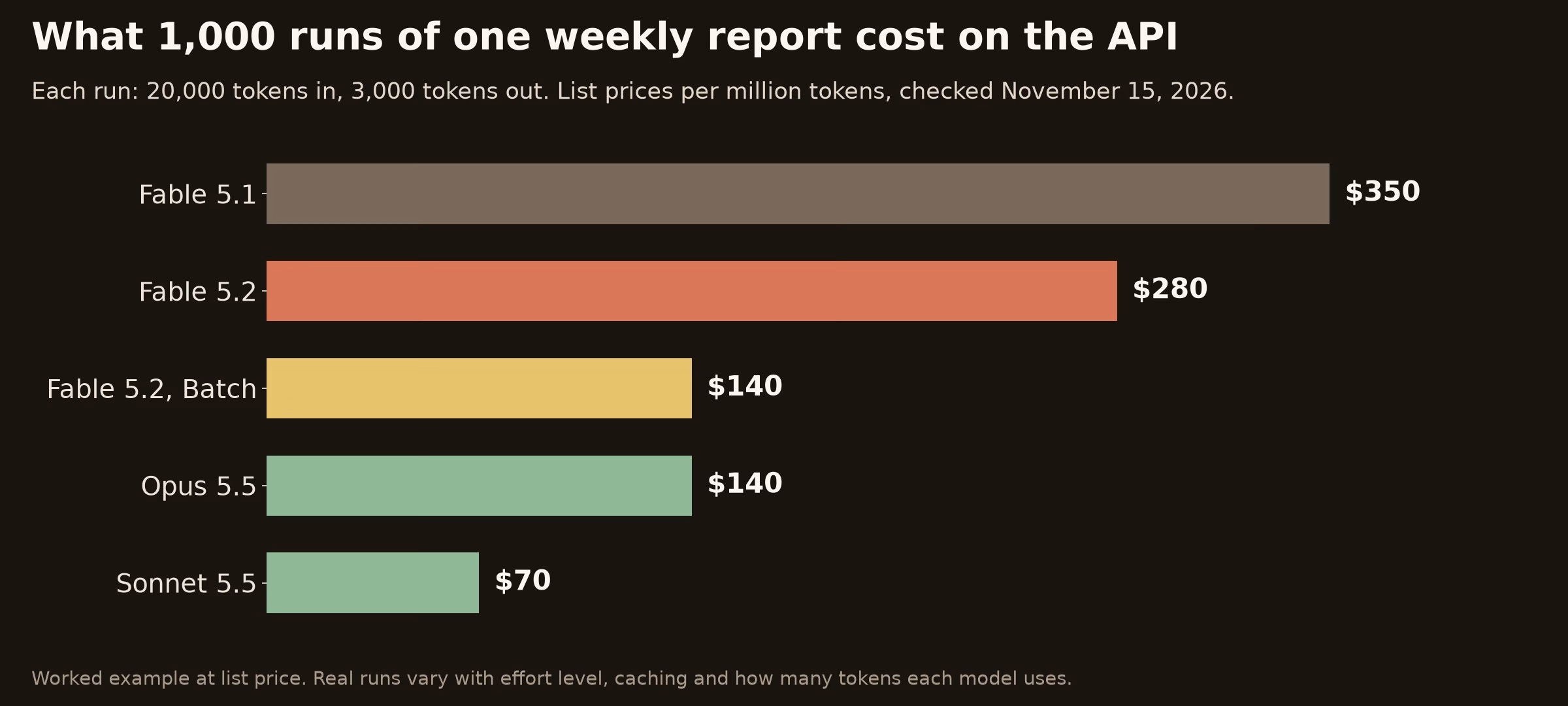
At list price Fable 5.2 saves $70 per 1,000 runs over Fable 5.1, which is the 20% cut and nothing more. The bigger savings sit elsewhere: running the same report through the Batch API halves it to $140, and Opus 5.5 does it for $140 at full speed. Sonnet 5.5 is a fifth of the Fable 5.1 price.
Two cautions keep this honest. First, models do not use the same number of tokens for the same job, and Fable thinks before it answers, which adds output tokens; Anthropic says Fable 5.2 uses fewer tokens than 5.1 at the medium effort setting. Second, the pricing page notes that this model family uses a tokenizer, the part that splits text into tokens, that counts about 30% more tokens for the same text than older Claude models did. Measure a few real runs before you trust any estimate, including this one.
What changes if you call it from code?
If your own code calls Fable 5.1 today, changing the model name to claude-fable-5-2 is not quite enough. Anthropic’s what’s new page for Fable 5.2 (checked November 15, 2026) lists settings that now return an error.
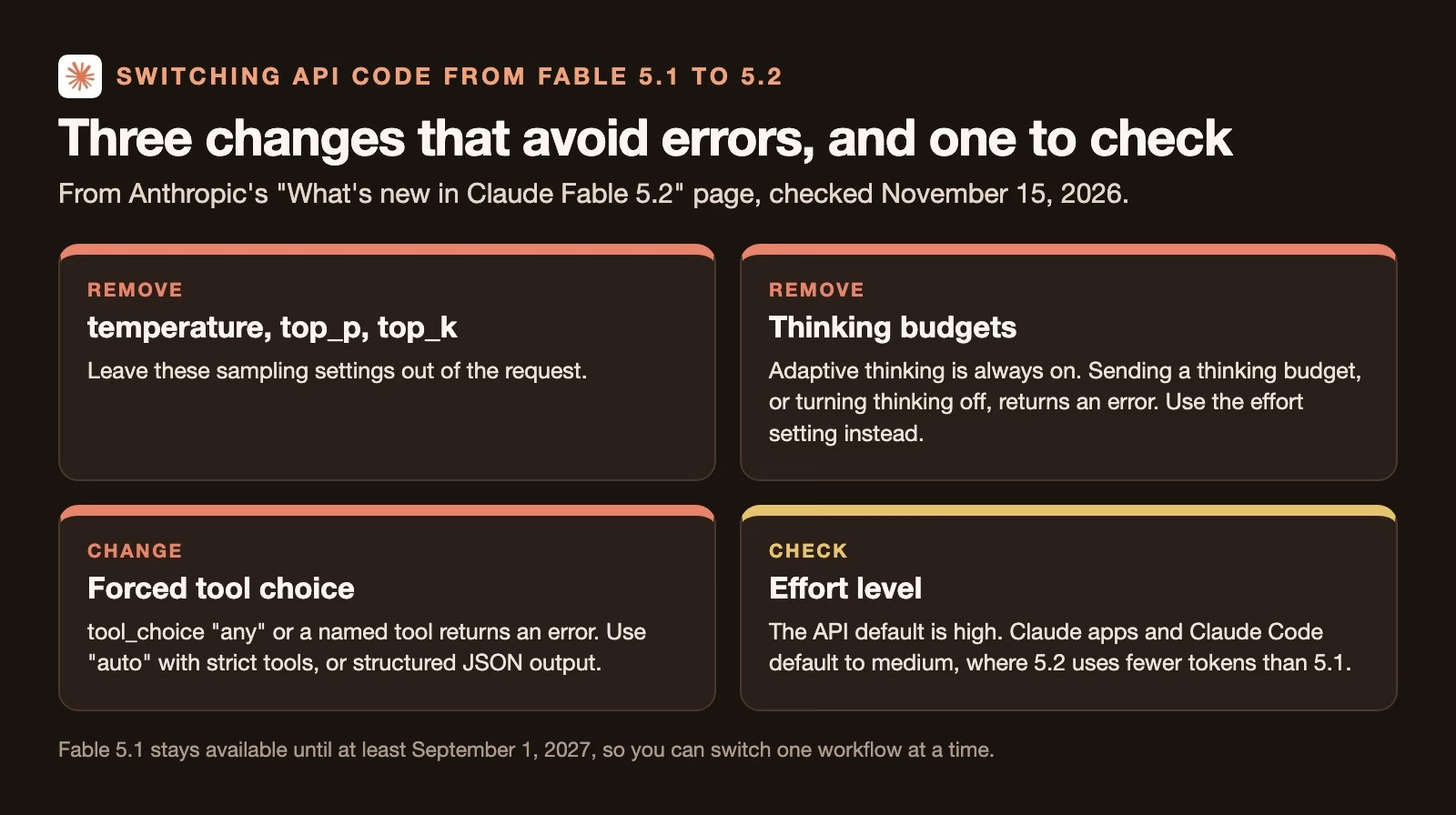
- Sampling settings. Leave out
temperature,top_pandtop_k. These settings used to control how random the wording was. - Thinking budgets. Thinking, the model’s working-out before it answers, is now always adaptive. Sending a fixed thinking budget or switching thinking off returns an error. You control depth with the effort setting instead, which runs from low to max.
- Forced tool choice. Forcing the model to call a particular tool returns an error. Use the automatic setting with strict tool definitions, or ask for structured JSON output (JSON is a plain text format for data that programs can read).
- Effort level. The API default is high. Anthropic says the Claude apps and Claude Code default to medium.
The same page warns about behaviour changes that need no code fix but can surprise you. On long tasks with many steps the model can end a turn early, more often at low and medium effort. It also follows style rules very closely, so a strict sentence-length rule in your prompt can make the writing choppy.
No rush to move everything
Anthropic’s deprecations page (checked November 15, 2026) lists Fable 5.1 as active and not retiring before September 1, 2027. You can move one workflow at a time and keep the old one running while you compare.
Should you switch from Fable 5.1?
If a job already runs well on Fable 5.1 and you call it through the API, switching is usually worth it: the same tier at 20% less. Make the code changes above and compare ten outputs side by side before you move the job for good.
If you are paying for Fable because it was the best model when you set the job up, use the switch as a reason to test downwards. Many reporting and summarising jobs that moved to Fable for quality turn out to be just as good on Opus 5.5 at half the Fable 5.2 price. The only way to know is to run your own cases.
If you use Claude through a Pro or Max plan rather than the API, the decision is about your weekly limit, not money. Keep Fable for the few hard jobs each week and let Opus handle the rest, so you do not run out of Fable allowance halfway through the week.
A one-afternoon test for your own work
This test tells you which model a job needs, using ten real examples and a blind comparison. It works the same in the Claude app or through the API.
- Pick ten past inputs for the job, such as ten weeks of sales notes, including two that gave you trouble before.
- Run them on Fable 5.2, Fable 5.1 and Opus 5.5 with the same prompt and the same effort setting. Through the API, record the input and output tokens each run used.
- Hide the model names. Rename the outputs A, B and C so you cannot tell which is which.
- Score each output against a short checklist you wrote first: are the numbers right, is anything important missing, would you send it unchanged?
- Price the winner. Multiply the average tokens by the list prices in the table, then by how often the job runs.
If Opus scores within a point of Fable on your checklist, use Opus. If Fable is clearly better on the two hard cases, keep Fable for this job and check whether Batch can halve the bill. Our guide to testing whether a cheaper model is good enough has a longer version of the same method.
Common mistakes
- Switching the model name and nothing else, which breaks API calls that still send
temperatureor a thinking budget. - Comparing models at different effort levels, which mixes up the model with the setting.
- Trusting the 20% figure for your bill, when token counts differ between models and runs.
- Spending a week’s Fable allowance on easy work, so it is gone when a hard job arrives.
- Taking the launch benchmarks as your result, when Anthropic ran them and your job is not on the list.
- Forgetting Batch, which halves the price of any job that can wait.
Try it this week
- Pick one job you run on Fable 5.1 or Opus 5.5 today.
- Run ten past inputs on Fable 5.2, Fable 5.1 and Opus 5.5 at the same effort level.
- Score the outputs blind with a five-point checklist.
- Price the winner at list price and at the Batch price.
- Write down which model the job will use and why, so the next price change is a five-minute decision.
Quick recap
- Claude Fable 5.2 launched on November 9, 2026, at $8 in and $40 out per million tokens.
- That is 20% less than Fable 5.1, and Batch halves it again.
- It is on paid plans only, usually capped at half your weekly limit.
- Opus 5.5 costs half as much and is Anthropic’s recommended daily model.
- API code needs changes: no sampling settings, no thinking budgets, no forced tools.
- Fable 5.1 stays available until at least September 2027, so test before you move.
Sources
- Anthropic: Introducing Claude Fable 5.2 and Claude Mythos 5.2 (release November 9, 2026; price cut, speed claim, plan access, benchmarks, Opus 5.5 advice)
- Claude API pricing (Fable 5.2, Fable 5.1, Opus 5.5, Sonnet 5.5 and Haiku 5.5 prices, Batch, caching, fast mode, tokenizer note; checked November 15, 2026)
- Claude docs: What’s new in Claude Fable 5.2 (settings that return errors, effort defaults, behaviour changes; checked November 15, 2026)
- Claude docs: Model deprecations (Fable 5.1 not retiring before September 1, 2027; checked November 15, 2026)
- Claude plans and pricing (Fable access by plan; checked November 15, 2026)
- VentureBeat: Anthropic releases Claude Fable 5.2 and Mythos 5.2 (launch coverage, November 9, 2026)
Keep going
Same lessons in your feed
Short diagrams, hooks, and weekly tutorials on Substack, Instagram, X, and Facebook.