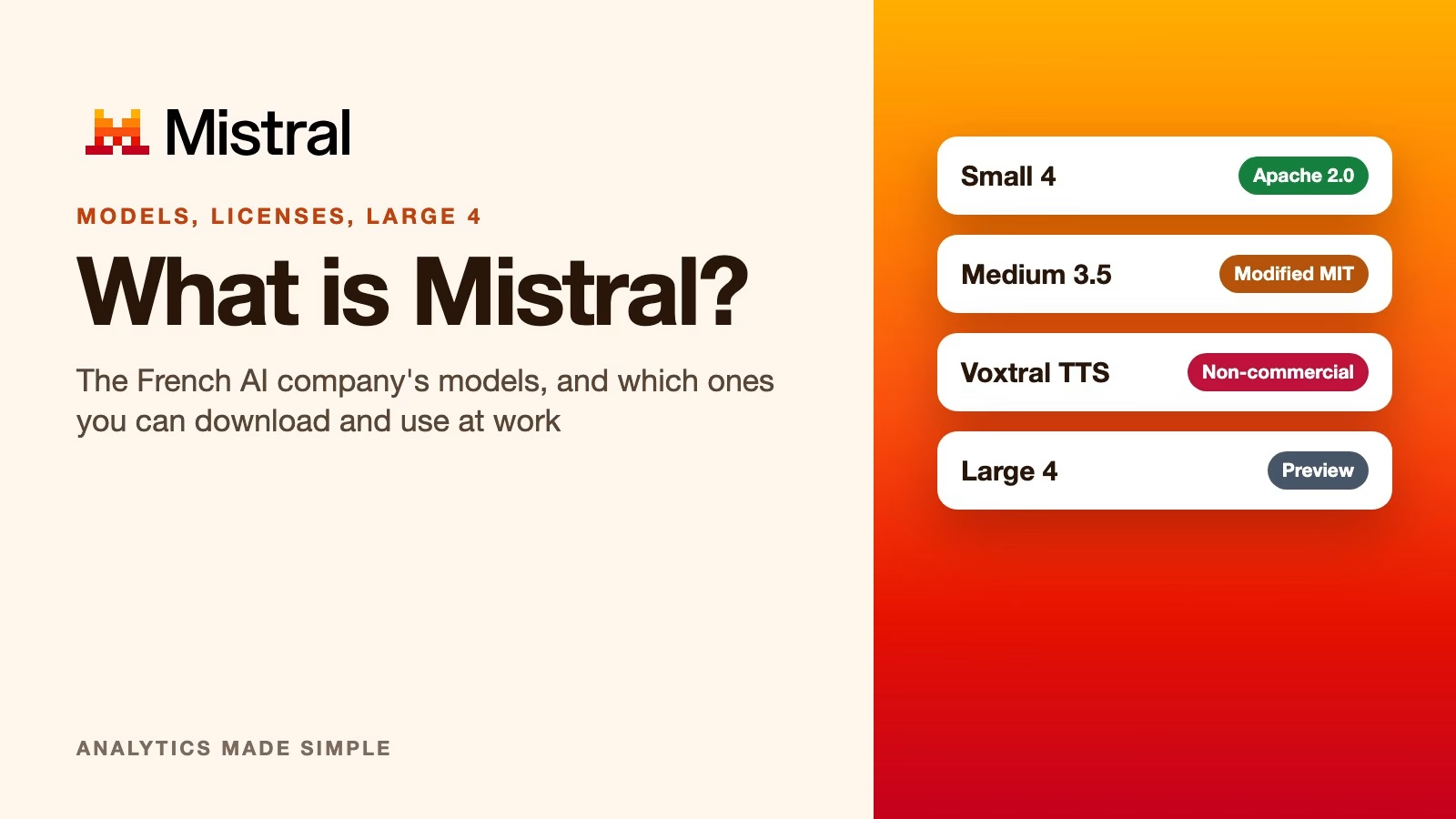
Mistral AI is a French company that makes AI models, and many of them you can download and run on your own computers. Before you pick one for work, check its license, because each Mistral model has its own: some you can use freely, one forbids commercial use, and some you can only reach through Mistral’s paid service.
Imagine your team answers customer support tickets, and the tickets cannot leave your company’s servers. Someone suggests Mistral because “it’s open.” That is partly true. Mistral publishes more downloadable models than most AI companies, but the word open covers several different licenses, and the newest flagship model was still in preview in October 2026.
Mistral AI was founded in Paris in 2023. This post explains what the company offers, which of its models you can download, what its new Mistral Large 4 model is, and how to choose one for a real job, using Mistral’s model list checked on October 8, 2026.
What does Mistral make?
Mistral makes three kinds of things: a chat assistant, a service for developers, and the models themselves. Each one suits a different person, so start with the one that matches what you want to do.
The chat assistant is called Vibe. It used to be called Le Chat, and Mistral’s Vibe page now says “Le Chat is now Vibe” (checked October 8, 2026). It runs on the web, on phones, and inside code editors, with modes for everyday chat, longer work tasks, and coding. If you only want to ask questions, Vibe is all you need.
The developer service is called Studio. It lets programmers call Mistral’s models from their own apps through an API, which is a way for one program to send requests to another. The models are the third part, and the rest of this post is about them, because that is where Mistral differs most from other AI companies.
Which Mistral models can you download?
Most current Mistral models can be downloaded, but under different licenses. A license is the set of rules that says what you may do with the model, such as using it in a product you sell. The figure groups the current models by license, as Mistral’s model list showed them on October 8, 2026.
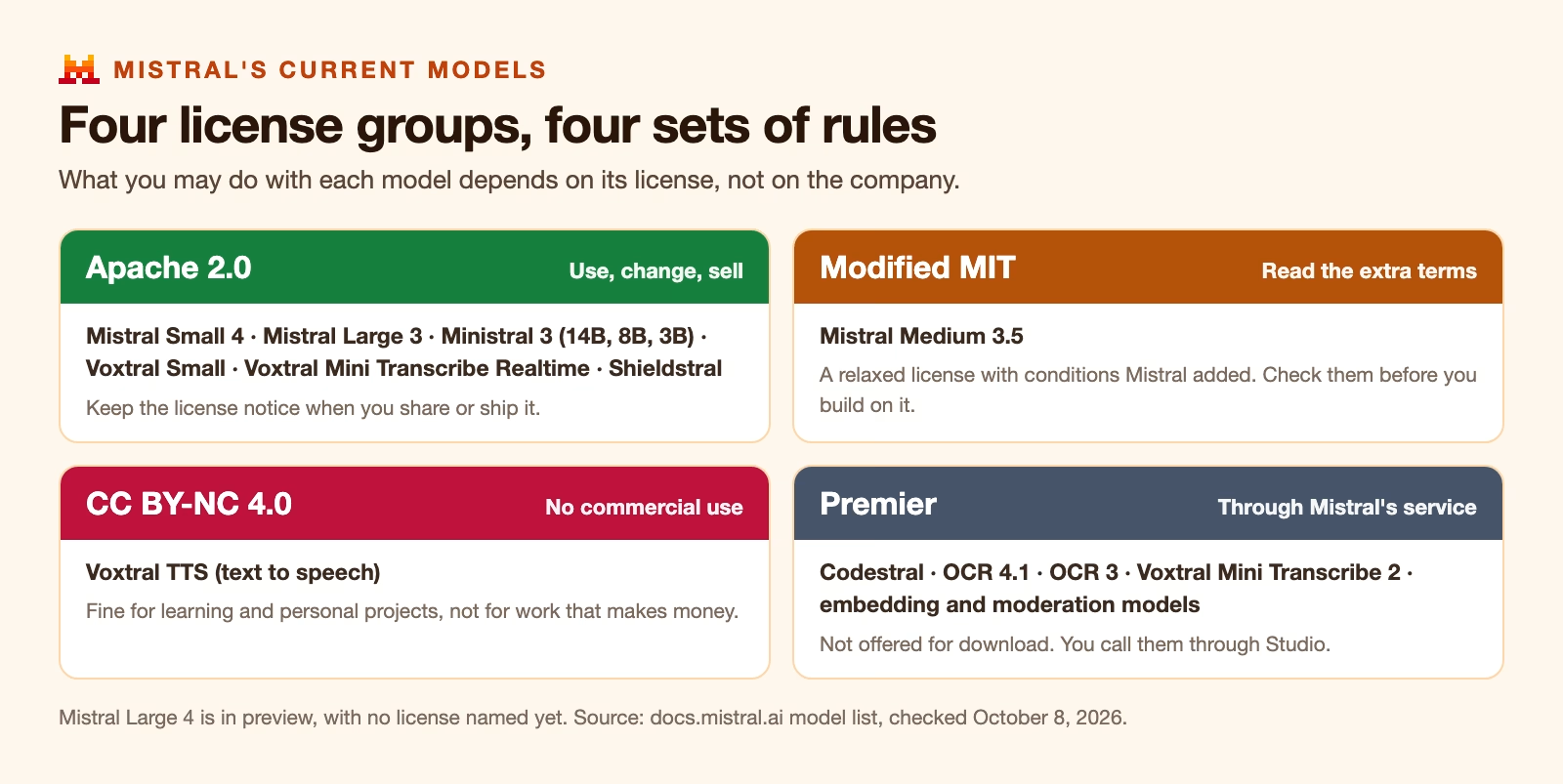
Apache 2.0 is the most relaxed group. It lets you use, change, and sell products built on the model, as long as you keep the license notice. Mistral Small 4, Mistral Large 3, the three Ministral 3 models, and the Shieldstral safety model are all in this group.
Mistral Medium 3.5 uses a modified MIT license. The MIT license is a short, relaxed license named after the Massachusetts Institute of Technology, where it was first written, and modified means Mistral added its own conditions, so read them before you build on it. Voxtral TTS, where TTS stands for text to speech, turns written text into a spoken voice. It uses CC BY-NC 4.0, a Creative Commons license (that is the CC) where BY means you must credit the maker and NC means non-commercial: you cannot use it in work that makes money.
The last group is marked Premier. These models, such as Codestral for code and the OCR models, short for optical character recognition, which read text from scanned documents, are not offered for download, so plan on using them through Mistral’s service. The earlier post on open-weight versus open-source models explains why these labels matter.
What is Mistral’s newest model?
Mistral Large 4 is the company’s newest and largest model, released as a public preview on October 6, 2026, according to Mistral’s announcement. A preview means you can try it through Studio, but details can still change before the full release.
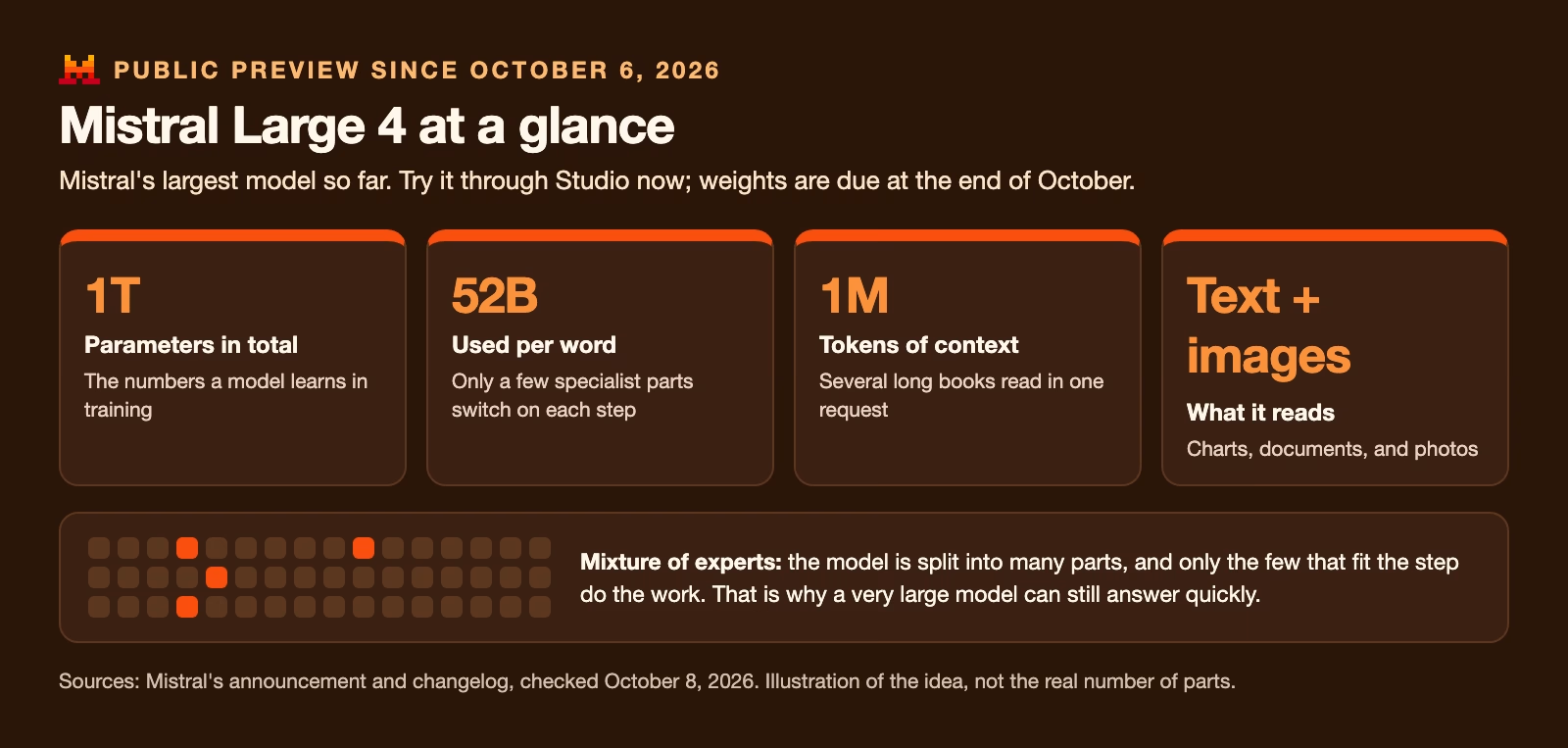
It has 1 trillion parameters, which are the numbers a model learns during training, but only 52 billion are used for each word it writes. That design is called mixture of experts: the model is split into many specialist parts, and only a few switch on for each step. The result is a very large model that answers faster and cheaper than its size suggests.
Mistral’s changelog says it has a context window of 1 million tokens. The context window is how much text the model can read at once, and a token is roughly three quarters of a word, so it can take in several long books in one request. It also reads images, such as charts and scanned pages.
The weights are not out yet. Weights are the trained model files you download to run it yourself, and the announcement says they will be released at the end of October 2026. The model list does not name a license for it yet, so wait for the model card before you plan anything around it. A model card is the page that comes with a model and explains what it is for, how it was tested, and its license; the post on how to read a model card walks through one.
How to pick a Mistral model for a job
Pick by the job and by where the model must run, then check the license. Bigger models give better answers, but they need far more computer memory, so the right choice is the smallest one that does the job well.
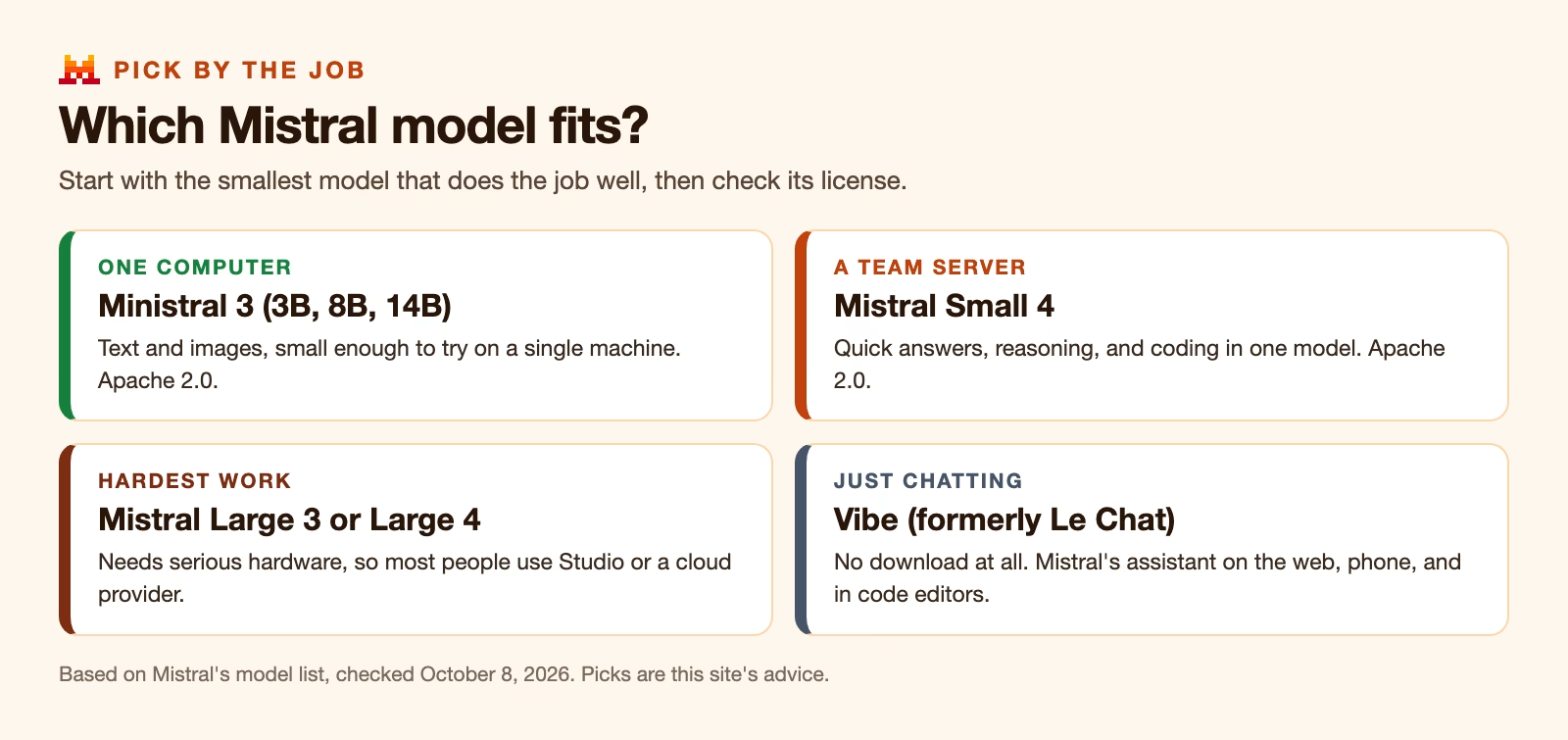
The Ministral 3 models come in 3, 8, and 14 billion parameter sizes and read both text and images. The smaller ones are the ones to try on a single computer. Mistral Small 4 combines quick answers, step-by-step reasoning, and coding in one model, which makes it a sensible default for a team server. Mistral Large 3, and Large 4 once its weights arrive, need serious hardware, so many teams use them through Studio or a cloud provider.
Where the model runs is its own decision. The post on hosted versus downloaded models covers the trade-off between running a model yourself and paying a service to run it.
A worked example: the support tickets
Back to the support team from the start of this post. Here is how the choice could go, step by step, as a practice example.
- The tickets must stay on your servers, so a downloaded model is the only option. That rules out the Premier models.
- You plan to use it in a paid support product, so the license must allow commercial use. Apache 2.0 fits, and the modified MIT license needs a careful read first.
- Your server is one machine with a single graphics card, so Large 3 is too big. You test Ministral 3 8B and Mistral Small 4 on 50 old tickets with known good answers.
- Small 4 gets more right and still fits your server, so you pick it, and you write down the version from the model list, 26.03, so you know exactly what you tested.
That last step matters more than it seems. Mistral labels each release with a year and month, and it retires older versions on fixed dates, so a model you rely on today will be replaced. The model list shows those dates.
Things to watch for
Mistral moves fast, and a few details trip people up. Check them before you commit.
- “Open” is not one thing. Read each model’s license, not the company’s reputation.
- Large 4 is a preview. Its download date and license were not final on October 8, 2026.
- Versions retire. Mistral’s model list gives a retirement date for older models, so plan to retest when yours is replaced.
- Old names linger. Guides that mention Le Chat mean the assistant now called Vibe.
Recap
- Mistral AI is a French company with a chat assistant (Vibe, formerly Le Chat), a developer service (Studio), and many downloadable models.
- Each model has its own license: Apache 2.0 for most, modified MIT for Medium 3.5, non-commercial for Voxtral TTS, and download-free Premier models through the service.
- Mistral Large 4 launched in preview on October 6, 2026, with 1 trillion parameters, 52 billion in use per word, and weights due at the end of October.
- Pick the smallest model that does your job, check its license, and write down its version.
Try it this week: open Mistral’s model list, find one Apache 2.0 model small enough for your computer, and read its model card from top to bottom before you download it.
Sources
- Mistral AI: Models overview (current models, licenses, versions, retirement dates)
- Mistral AI: Introducing Mistral Large 4 (preview date, parameters, mixture of experts, weights timing)
- Mistral AI: Changelog (Large 4 public preview and 1M context window)
- Mistral AI: Vibe (Le Chat is now Vibe; modes and platforms)
Keep going
Same lessons in your feed
Short diagrams, hooks, and weekly tutorials on Substack, Instagram, X, and Facebook.