Meta’s Llama models are free to download, but they are not “open source” in the legal sense, so you have to follow Meta’s own license before you use one at work. In practice that means four things: the license text itself, its list of uses Meta forbids, a short text file crediting Meta that you must include with your product, and the words “Built with Llama” somewhere your users can see them. Check all four before real customers start using what you built.
Imagine you open a customer contract because your sales team flagged one clause, 8.3. It says your company uses “only OSI-approved open source” software in anything customers see, and OSI is the group that decides which licenses officially count as open source. Your team spent three weeks building a product-recommendation feature on Llama 4 Scout, one of Meta’s free-to-download models, and marketing already called it “powered by open source Llama.” But Scout comes under Meta’s own license, not an open source one, so clause 8.3 is now untrue. You start drafting an urgent note to your legal team.
The clause that is already wrong
Clause 8.3 is already inaccurate if you deploy under that wording. Scout is downloadable, and that makes it open-weight, not open source. The grant that ships with those weights is the Llama 4 Community License Agreement, effective April 5, 2025. MIT, Apache 2.0, and other OSI-approved open source licenses (standard licenses that let anyone use, change, and share software with few conditions) are a different family, with different rules. Calling the bot “open source Llama” in a contract tells the customer they bought rights Meta never put in the box.
The customer actually asked for that sentence. Question 14 of the proposal request was a security checkbox: “Does the vendor use open source components, and can we have the license?” Sales wrote “open source Llama” to make the checkbox green. Nobody opened the file named LICENSE. Engineering thought they had, because they had opened a different LICENSE file: the Apache 2.0 text that ships with Muse Glimmer. Glimmer is a Meta model. Scout is a Meta model too. The two do not share a grant.
This is not legal advice. If your parent company, your EU office, or a service with 700 million users is in play, sit down with counsel and read the live text on llama.com together.
An application with 18,400 monthly active users is nowhere close to that 700 million line. A regional grocer’s shopper portal is not a global consumer platform. So the clause is still wrong, just wrong in the opposite direction from the scare story people tell about Meta “banning commercial use.” Commercial use is part of the grant for most organizations. The real trap on this desk is a promise the files do not support, plus three missing pieces: a copy of the license agreement, a notice file, and the words “Built with Llama” somewhere a customer can see them.
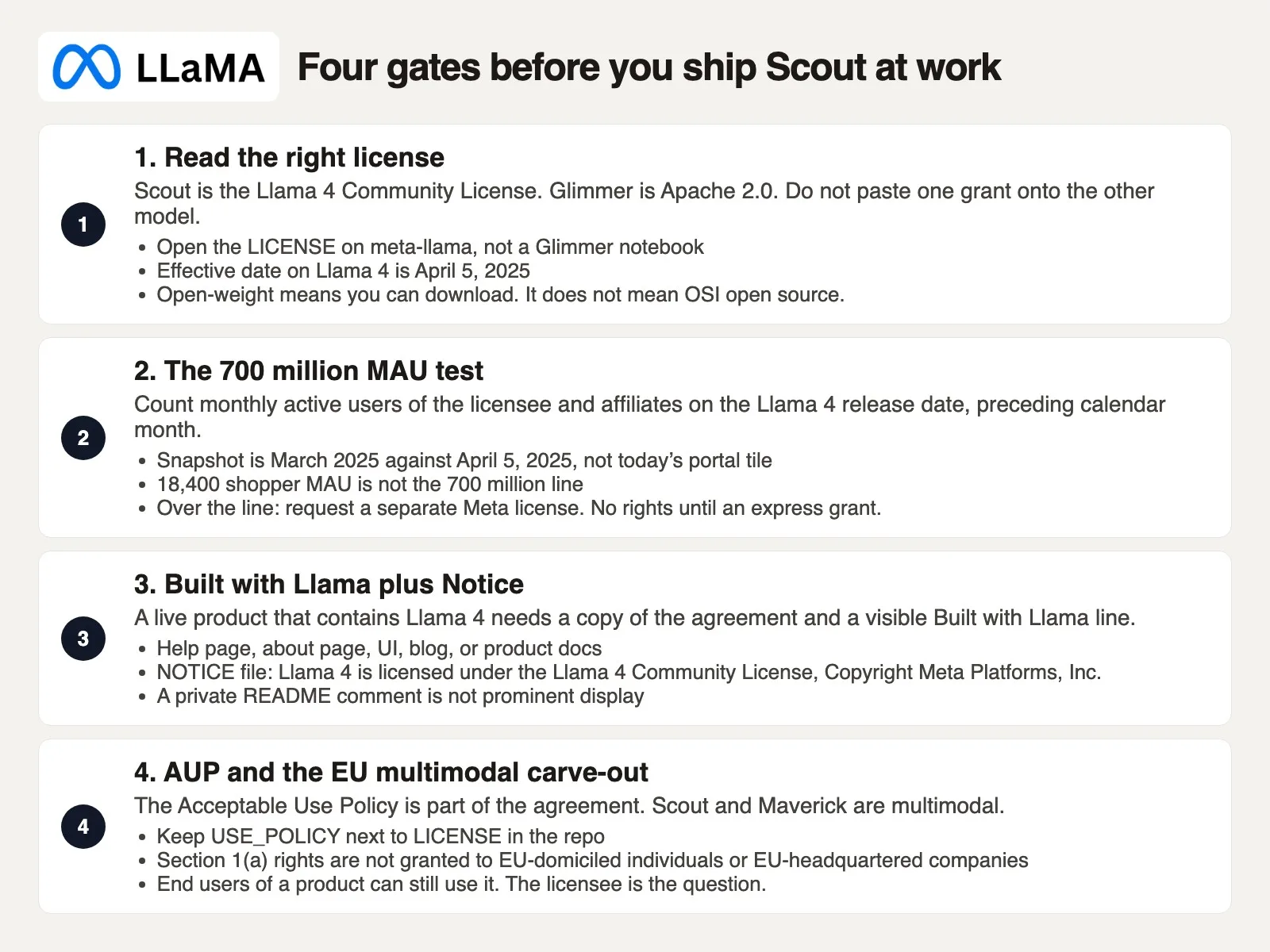
Walk those four gates in order. Skip one and you get a frantic afternoon: a live bot, a yellow highlight in a contract, and a README (the main information file that ships with a project) that describes a different model than the one actually running.
Rule of thumb: If the contract, the code repository (the project’s shared code folder), and the Hugging Face model card do not name the same license, stop shipping copy. Fix the files before you argue about tone.
Open-weight is not Apache
Open-weight means you can pull the finished parameters, the numbers that make up the trained model, and run them yourself. On Hugging Face that is the meta-llama account for Llama 4 Scout and Maverick. You accept a gated license while logged in, and that text is the Community License, not a vibe. The official copy also lives in Meta’s meta-llama/llama-models repository on GitHub and on llama.com. The license URL there may redirect to developer.meta.com, but it lands on the same agreement.
Apache 2.0 is a different animal. It is approved by the Open Source Initiative (OSI), the nonprofit that decides what counts as open source. It comes with a patent grant, a notice file convention, and a well-worn path for using, changing, and shipping code freely. In August 2026 Meta released Muse Glimmer, a 30-billion-parameter local-agent model, under Apache 2.0. That model sits on a different Hugging Face account, called meta-models. This is why your engineer’s notebook had Apache boilerplate in it: they had been playing with Glimmer on a Mac the week before, and copied the license header into grocery-faq/README.md because both pages said Meta at the top. The bot in production loads Scout weights, though, and Scout is not Glimmer. Glimmer’s Apache file simply does not cover it.
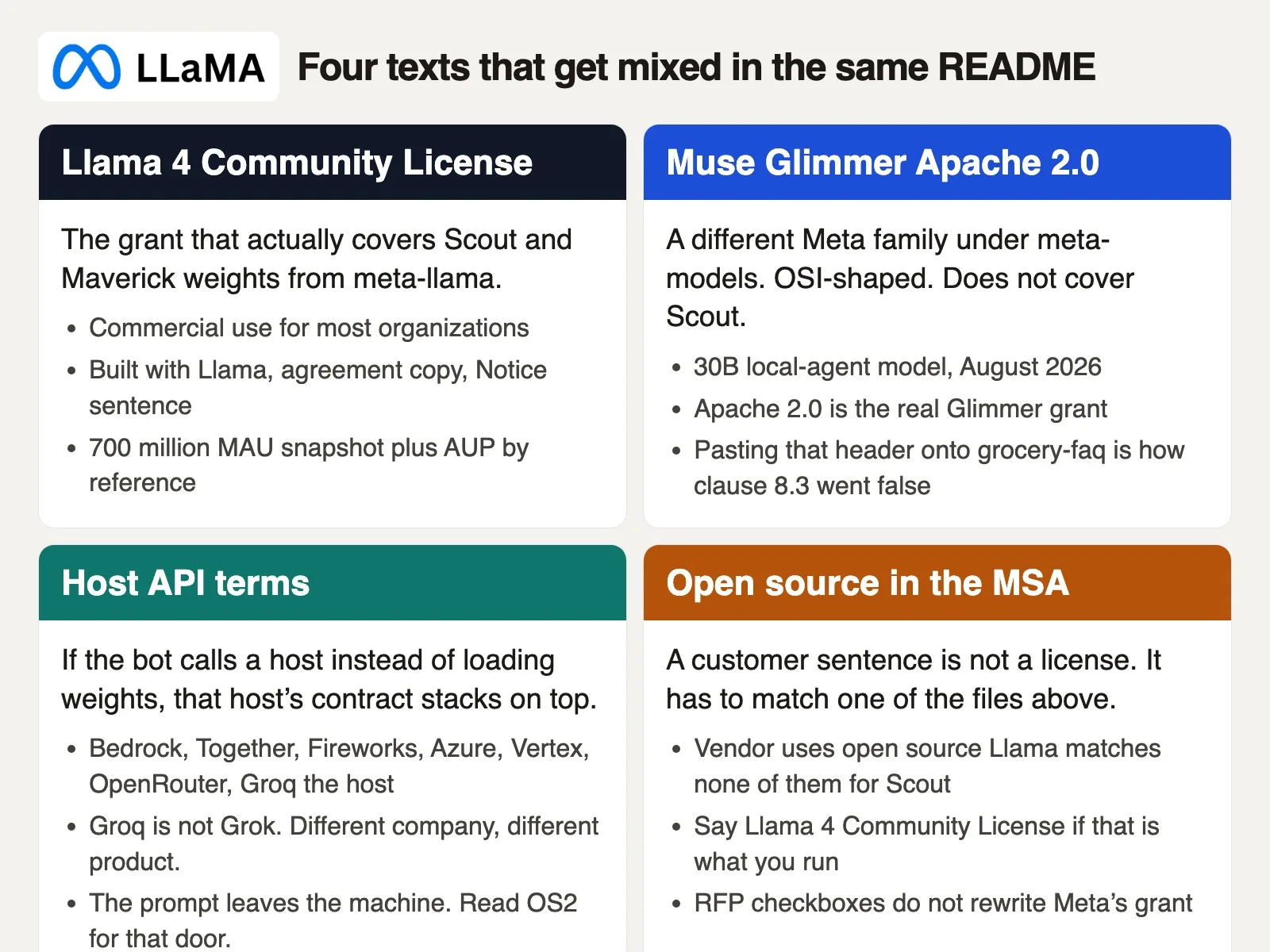
Four separate texts get mashed together in Slack. Keep them in separate folders in your head.
- The Llama 4 Community License: the grant for Scout and Maverick weights. It allows commercial use for most organizations, requires attribution, sets a 700-million-monthly-user snapshot test, and pulls in Meta’s acceptable use rules by reference.
- Muse Glimmer’s Apache 2.0: a different Meta model family, on a different Hugging Face account, under a license you could honestly call open source in the OSI sense, if you were shipping Glimmer instead of Scout.
- Host terms: if the FAQ bot later calls Bedrock, Together, Fireworks, Azure, Vertex, OpenRouter, or Groq (the host that runs the model, not Grok the xAI chatbot), you stack that host’s own rules on top of Meta’s grant. The prompt now leaves your machine for theirs.
- The contract sentence: what you actually told the customer. It has to match one of the three files above. “Open source Llama” matches none of them for a Scout-based bot.
Llama 2 and Llama 3.0 did not let you use their outputs to train other models. Llama 3.1 and later, including Llama 4, do allow it, but only if you distribute that new model and start its name with the word “Llama.” So a grocery FAQ model trained on Scout transcripts is still Llama paperwork. It is not a clean-room Apache artifact you can relicense as you please.
The 700 million monthly active user line
Section 2 of the Community License is the line that leaks into every blog post as “Llama is free unless you are huge.” Read the actual test, not the summary. Here is the plain version: count the monthly active users (MAU) of the licensee’s products, plus those of its affiliated companies, in the month before the Llama 4 release date. If that count topped 700 million, you have to request a separate license from Meta. Meta may grant that license at its own discretion. Until Meta expressly grants it, you are not authorized to use the Community License rights at all.
The date that matters is the Llama 4 release date, April 5, 2025, not the month you happened to go live with oat milk questions. The count is the calendar month right before that, so March 2025. Later growth does not rewrite that snapshot for this version of the agreement, though a future Llama version can ask the same question again on its own release date. Read the live text the week you pull the weights, because these terms can change.
Affiliated companies sit inside that sentence too. The grocery FAQ bot has 18,400 monthly users, and that number is not close to the threshold. The real question is different. Did the company that clicked “I Accept” on Hugging Face, or a parent company above it, have more than 700 million monthly users back in March 2025? A regional grocer almost never does. A small tool sitting underneath a global consumer platform might. So the compliance team needs to ask who actually clicked Accept on the Hub. Was it the company entity that signed the contract, or one engineer’s personal account? A personal accept on a work project is its own separate mess. Put the company’s name on the accept. Then do the affiliate math once, and write it down.
If you clear 700 million users on that snapshot, there is no friendly “please attribute us” fallback path. You stop, you request a separate license, and you wait for an express grant from Meta. There is no public royalty table for that case in the Community License. There is a closed door until Meta opens it for you.
For the shopper portal, this gate is a one-line note in the deal file: “March 2025 monthly users of the licensee plus its affiliates, well under 700 million; portal now at 18,400.” Write that note once. Do not confuse this week’s incident count with a license threshold set over a year earlier.
Built with Llama and the notice file
Redistribution is where engineering assumed “we run this ourselves, so we owe nobody a badge.” The Community License disagrees. The moment you distribute, or make available, the Llama materials, or a product that contains them, two rules kick in. You have to include a copy of the license agreement with those materials. And you have to prominently display the words “Built with Llama” somewhere a customer would actually see them: a website, a user interface, or a piece of product documentation.
The grocery FAQ bot counts as a product, since shoppers reach it from the portal. The license does not spell out a pixel size for “prominently.” It also does not mean an obscure comment buried in a private code repository that legal can never see. Put the words somewhere a customer or a reviewer can find without opening a debugger: the help page footer, the about page, or the internal product document sales already attached to the contract. One visible line beats five clever ones sitting in a slide deck nobody shipped.
You also have to keep this exact attribution inside a plain-text notice file that travels with copies of the materials:
Llama 4 is licensed under the Llama 4 Community License, Copyright © Meta Platforms, Inc. All Rights Reserved.
That single sentence is the whole notice requirement. Do not replace it with Apache’s own notice appendix. And do not skip the file just because the bot is “only an API wrapper around a compressed model file.” That compressed file, usually saved in a format called GGUF, is still Llama 4 material under the license.
Three files belong in the code repository next to the model card. Use this table as a lookup, not a menu to pick from.
| File | What it does | In the grocery FAQ project on day 12 |
|---|---|---|
LICENSE (Llama 4 Community License) | The grant: use, copy, modify, distribute, plus the monthly-user and attribution conditions | Missing. The Apache 2.0 text from Glimmer sat here instead. |
USE_POLICY | Banned uses, plus the EU multimodal carve-out, both pulled into the agreement by reference | Missing. |
NOTICE | The required one-sentence Llama 4 attribution | Missing. |
Paste the whole pack in at once, then fill in the visible line on the help page. Recheck the source URLs the week you actually ship.
# grocery-faq/docs/licenses/  (Scout bot, not Glimmer)
# Recheck llama.com the week you ship. As of writing: September 2026.

docs/licenses/LLAMA_4_COMMUNITY_LICENSE.txt
  # Full Llama 4 Community License Agreement
  # github.com/meta-llama/llama-models  and  llama.com/llama4/license/

docs/licenses/USE_POLICY.txt
  # Llama 4 Acceptable Use Policy
  # llama.com/llama4/use-policy/

docs/licenses/NOTICE
  Llama 4 is licensed under the Llama 4 Community License, Copyright © Meta Platforms, Inc. All Rights Reserved.

# Visible "Built with Llama" (pick at least one, then keep it)
help.html        # footer on /help/faq-bot
about.html       # same line, link to docs/licenses/
docs/product.md  # the PDF sales attaches to Schedule C

# Do not paste Apache 2.0 from Muse Glimmer into this folder.
# Glimmer is meta-models, 30B, different grant.
If you later train a new model on Scout’s outputs and distribute it, one more naming rule kicks in. That new model’s name has to start with “Llama.” That is attribution baked into the filename, and it does not replace the notice file you still owe on the original materials.
Acceptable use and the EU multimodal carve-out
The Community License pulls in the Llama 4 Acceptable Use Policy (AUP) by reference, so agreeing to one means agreeing to both. The public copy lives at llama.com/llama4/use-policy/, which may redirect, and inside the llama-models repository under models/llama4/USE_POLICY.md. Read the live list yourself. Put a copy of USE_POLICY.txt in the license pack, so the next engineer does not have to go hunting on GitHub during an afternoon like the one that opened this post.
One line in that policy is not a generic rule: the EU multimodal carve-out. Llama 4 Scout and Maverick are multimodal, meaning they can read images as well as text. For those two models, one rule is strict. The usage rights in section 1(a) of the Community License are not granted at all if the licensee is a person living in the European Union, or a company whose main office is there. Meta’s own FAQ page (llama.com/faq/, sometimes redirected to developer.meta.com) says plainly that this restriction sits on the licensee. It does not sit on every shopper who types a question into the bot.
End users of a product built on these models can still use that product while physically in the EU. A company whose main office sits outside the EU can distribute those products, including to EU customers. An EU-based employee of a non-EU company can use the multimodal models for that company’s work, though not for personal side projects. A non-EU subsidiary of an EU parent company can be the licensee on paper, as long as EU affiliates stay out of the development work. Those are FAQ answers, not a substitute for a lawyer’s opinion. People usually make the same mistake: thinking “we cannot sell groceries in France.” The real question is whether the Irish entity in the org chart is the one fine-tuning Scout’s image features.
Cross-border setups like this raise real compliance questions worth asking early. If the licensee is the US grocery chain and the Dublin office just buys bananas, this gate is probably a short memo, not a shutdown. If the Hugging Face account, the code repository, and the contract all name the Irish company as the vendor, stop and read the FAQ with counsel before you turn on any camera feature. The FAQ bot today only handles text: stock levels, store hours, pickup cutoffs. Product wants photos of crushed cartons next quarter, and that is multimodal work. The carve-out cares about that whole family of models, not about whether the very first prompt happened to be a product code.
Meta’s pages still showed this restriction active in the Llama 4 acceptable use policy when checked in September 2026. License terms move over time, so re-open the file yourself when you pull a new model version. Do not quote this paragraph directly inside a contract.
What to send engineering before signing
Once you understand the four gates, you can write one short message instead of an alarmed essay. Subject line: “Schedule C 8.3 is wrong. Scout is not Apache, not OSI.” Attach the three-file license pack and a screenshot of the 18,400-user tile from the portal. Keep the body short enough to read before standup.
- Strike “open source Llama” from the contract, the proposal response, and the sales one-pager. Replace it with “Llama 4 Scout under the Llama 4 Community License.” If the customer specifically wants OSI open source, that is a separate model conversation, since Glimmer is Apache-licensed and Scout is not.
- Delete the Apache 2.0 header pasted in from the Glimmer notebook. Put the Community License, the acceptable use policy, and the notice file in
docs/licenses/, and commit them before the next customer call. - Add “Built with Llama” to
/help/faq-botand the about page today. Link to the license folder, and put the same line in the product document sales already sent out. - Write the monthly-user note: licensee plus affiliates, March 2025 snapshot compared with 700 million, current portal count 18,400. Confirm who clicked Accept on Hugging Face, using a company account rather than a personal login.
- Name the actual licensee entity. If it turns out to be the Dublin company, pause the image feature and read the EU multimodal FAQ before the carton-photo project starts. A text-only FAQ for US shoppers is not a free pass to skip what headquarters signed.
- Do not promise “it runs on one box” in the same contract schedule until someone reads how Scout’s total parameter count differs from its active parameter count. That is Monday’s homework, not a license question.
Engineering gets to keep the bot. Having 18,400 users on a grocery FAQ is a completely normal shape for the Community License: commercial, attributed, covered by the acceptable use policy, nowhere near the 700 million gate. Drop the Glimmer header, add the notice file, fill in the help footer, and rewrite clause 8.3 so no future dispute can quote a sentence the files never actually supported.
Before you add carton photos or a second model, read the next post in this series: Llama sizes: laptop vs server. Scout’s model card talks about 17 billion active parameters, but the weights you actually load are the whole mixture. The next compliance headache is usually a hardware claim in a contract schedule, copied from a blog post that mixed up those two numbers. Get the license straight first, then worry about the RAM.
Series notes
This is Part 2 of Learn Llama (LL2). The earlier post covered what Llama actually is; the next one covers sizes, laptop versus server.
Sources
Primary vendor pages, checked in September 2026. llama.com paths may redirect to developer.meta.com.
- Llama 4 Community License Agreement (effective April 5, 2025; grant, Built with Llama, notice sentence, 700 million monthly-user commercial terms)
- GitHub meta-llama/llama-models (LICENSE pointer plus the
models/llama4license and policy files) - Llama 4 Acceptable Use Policy (prohibited uses; EU multimodal carve-out on section 1(a) rights)
- Llama FAQ (EU restrictions: licensee versus end user, non-EU distributors, employees, affiliates)
- Meta: The Llama 4 herd (Scout and Maverick as multimodal Llama 4 models)
- Hugging Face meta-llama (gated Llama 4 weights; accept the Community License on the real account)
- Hugging Face meta-models and Meta’s Muse Glimmer announcement (30B, Apache 2.0, not the Llama 4 Community License)
- Apache License 2.0 (the grant Glimmer actually uses)
- Open Source Initiative: The Open Source Definition (why “open source Llama” is the wrong label for the Community License in a contract)
- What Llama is: a model family, not a single chatbot · What “open” means for AI weights and licenses · Meta Llama from scratch
Keep going
Same lessons in your feed
Short diagrams, hooks, and weekly tutorials on Substack, Instagram, X, and Facebook.