
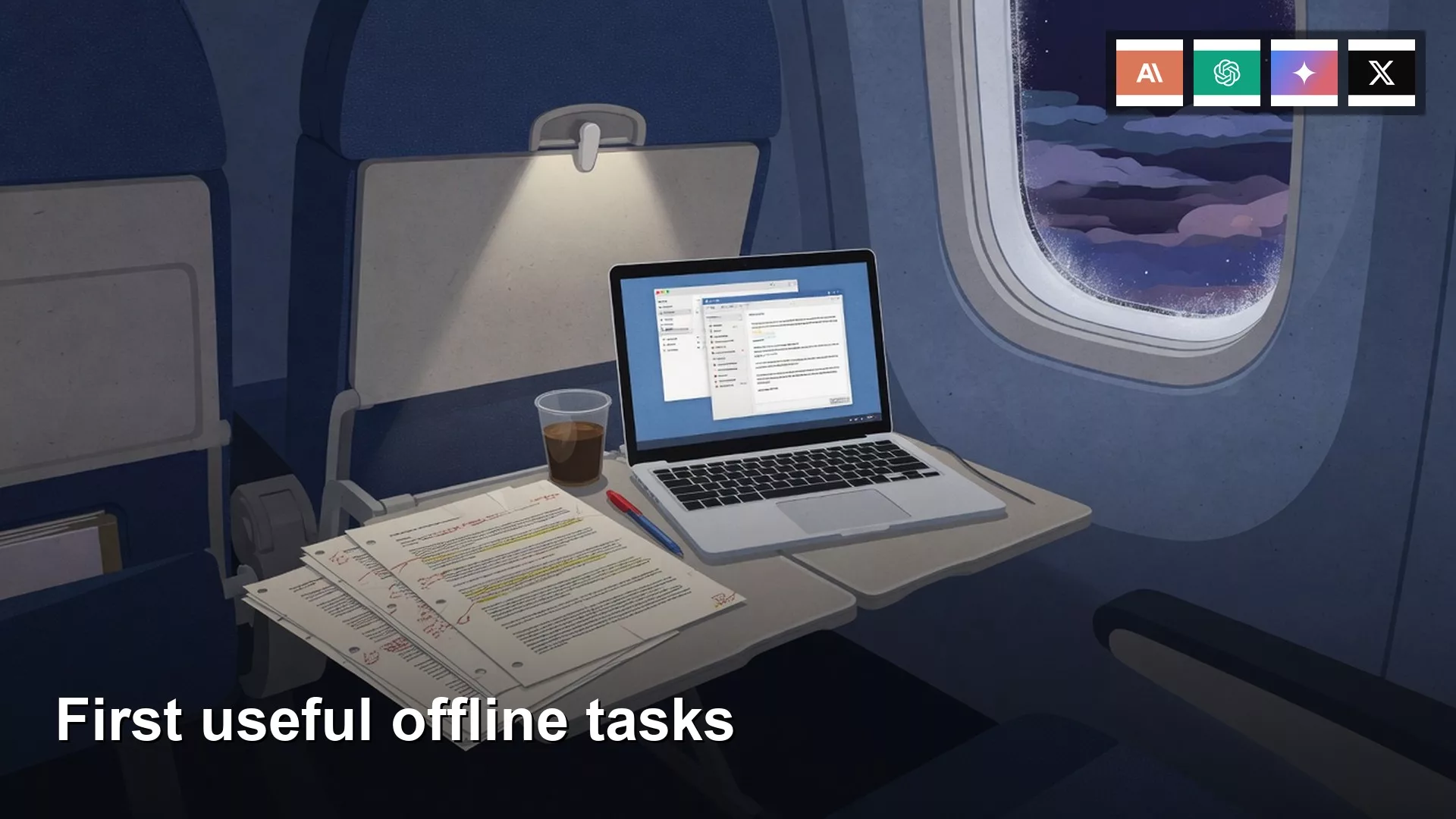
Hana’s 6-hour SFO to JFK flight had no working wifi. She had already typed a card number into the portal, watched $14 authorize, and sat through nine minutes of “Connecting…”. On the laptop: a 7B-class model from the local stack in the last part, and sku8841_customer_note.txt, 2,400 words. Line 1 still said “As an AI language model, I understand your frustration with the delay.” Northline Retail was waiting on SKU 8841, a three-week slip out of the Tracy warehouse. She needed a customer note. She had a frozen weight file and a seat-back that would not load a status page.
This is OS11, Part 4 of Run open models from scratch. OS8 was the hosted chat door. OS9 was a desktop runner from zero. OS10 was one local stack you stick to (Ollama-style). This page is the first useful work that stack can do when the network is gone: airplane mode, a cafe whose router is down, a basement with no signal. Next is OS12, hardware: RAM, GPU, heat, battery. Definitions still live in Open-source AI explained (OS1 on weights and licenses, OS2 on hosted vs local). If the file is not allowed to leave, P4 still applies. If you only needed a thank-you and you have wifi, the chooser is still the shorter path. More paths: Learn.
Three jobs that do not need the web
- Which four jobs a local 7B can finish without wifi: rewrite, outline, extract fields, quiz yourself
- Four paste-ready prompts that keep the model on YOUR file
- Two jobs to skip: live web facts, and anything that must be true tomorrow (citations, current prices)
- How to pack the model the night before so airplane mode is not a download
- How Hana’s 2,400-word draft got a first pass at seat 22A
Offline is a location you packed
Offline means the weights are already on disk and the prompt never needs a host. You pulled the file on wifi in OS10. You ran ollama list (or you looked at LM Studio’s downloaded list, or you pointed llama.cpp at a GGUF in a folder you can see). The line you care about is a local tag, not a cloud id. Then you flip airplane mode. A 7B-class file is the laptop animal from the size part of the other series. It will remix the tokens you paste. It will not open Northline’s portal. It will not fetch Tracy’s new ETA.
If you open Groq (the inference company, spelling with a q, not xAI’s Grok) in a browser, you are on a host. Same for Together, Fireworks, ChatGPT, Claude, Gemini, and Grok the product. Same for an Ollama cloud id if you left that on. The 6-hour flight does not care what the weight file is named. Location is the noun. This page assumes the 7B is sitting in RAM, not in a tab.
The model’s knowledge is frozen at training time. As of writing (August 2026) that cutoff is whatever the Hugging Face card said the night you pulled. Treat the 7B as a rewriter and a drill partner for notes you already have. Read size and license on wifi. On the plane you read your own file.
Rule of thumb: If the sentence has to survive contact with a browser, wait for the browser.
Four jobs a 7B can finish in airplane mode

These four share a grain. The truth is already in a file you brought. Quality will be smaller than a ~$20 closed chat. Fine, when the other option is staring at line 1 for six hours.
Rewrite your own draft. Keep every number, name, and date. Change the voice. Name the audience in one line (“Northline ops, they already know the SKU”). Ban “As an AI” and brochure adjectives. $18,400 of delayed cases stays $18,400 or you reject the pass. Do not ask for a better ETA. The 7B cannot see Tracy.
Outline a messy file. Ask for H2s and one sentence per section, drawn only from the paste. You still own the heading names. If the model invents “Market context,” delete it. Gaps are allowed as questions. New research is not.
Extract fields from YOUR file. Owner, date, SKU, amount, next action. Ask for a table. Write “NOT IN FILE” for guesses. Maya Chen, Luis Ortiz, 12 September 2026, and 400 cases lived in standups_aug.txt. They did not live in the 7B.
Quiz yourself. Eight to twelve questions, answers hidden, scored against the same notes. Wrong answers send you back to the file. Thursday’s vendor call is the point.
Two jobs to skip, and two cousins

Skip live web facts. “What is Northline’s current SLA.” “Did Tracy post a new ETA this morning.” A 7B will answer in a calm paragraph. It cannot see the warehouse. Hana would have sent a wrong Friday, in writing, to a buyer who already had the real Friday in another tab on the ground.
Skip citations, current prices, and anything that must be true tomorrow. A made-up URL looks like a source. A price from a training year looks like a quote. After you land, those sentences become a cleanup job you did not budget. Plan names move. Token rates move. As of writing (August 2026) you re-check the vendor page the week you click Buy. You do not let a 7B fill the cell.
Two cousins sit in the same skip bin: legal cites you will publish, and UI labels that move (as of writing, confirm Ollama and LM Studio the week you click). Frozen weights are not this morning’s feed. If the answer has to match a page you can open later, park it. Leave a stub (“ETA: confirm on landing”) instead of a fake date.
Good offline jobs vs skip
The four yes rows are the plane. The two no rows are why the $14 portal did not matter.
| Job | Offline first choice? | What you paste | What you still do |
|---|---|---|---|
| Rewrite your draft | Yes | The draft plus audience and a cut list | Check every number against the original |
| Outline a messy file | Yes | The file, ask for H2s and one sentence each | Delete sections the file never earned |
| Extract fields | Yes | YOUR notes, not a website | Confirm names and dates in the paste |
| Quiz yourself | Yes | YOUR notes or a crib sheet | Score against the same notes |
| Live web facts | No | Do not paste a question the file cannot answer | Wait, then open the source |
| Citations, current prices, tomorrow’s truth | No | Leave a stub | Browser after you land |
Four paste-ready prompts
Run these against a local 7B-class model you already pulled. Replace the FILE block. Do not add a request for live URLs, prices, or citations. The comments at the top are a preflight you do on wifi, the night before, not at 35,000 feet.
# Preflight on wifi (OS10 stack). Then airplane mode.
# ollama list
# Confirm the 7B-class tag is local, not a cloud id.
# Do not pull on the plane. There is no plane wifi that will finish 4.7 GB.

# 1) REWRITE. Paste your draft only.
You are editing MY draft. Do not add facts I did not write.
Strip openings like "As an AI" and brochure filler.
Keep every number, name, and date exactly as written.
Audience: [who]. Tone: plain, short sentences.
If you would need the web to write a sentence, write NOT IN FILE instead.
DRAFT:
"""
[paste]
"""

# 2) OUTLINE. Same file, headings only.
Using ONLY the text I paste, make H2s and one sentence per section.
Do not add a Market context or Sources section unless those words are in the file.
List gaps as questions, not as new claims.
FILE:
"""
[paste]
"""

# 3) EXTRACT FIELDS.
From the text I paste, return a markdown table with columns:
owner | date | sku_or_id | amount | next_action | evidence_quote
Use NOT IN FILE for empty cells. No extra rows from memory.
FILE:
"""
[paste]
"""

# 4) QUIZ.
From the text I paste, write 10 questions. Hide answers under each question as "ANSWER:".
Ask me to reply first. Then score me against this same text, not against your training.
FILE:
"""
[paste]
"""
What that block is for: four jobs, one paste habit. The FILE fence is the quality control. If the fact is not between the quotes, the model may not invent it. You still read. Small models skip instructions. Hana’s first rewrite tried to add “according to industry reports.” She deleted the clause and added that phrase to the cut list for pass two.
Worked example: 2,400 words at seat 22A
Hana started with prompt 1. The 7B took about 40 seconds on a 400-word chunk, so she split the 2,400 words into six pastes. Pass one killed “As an AI language model, I understand your frustration with the delay.” The new opening named SKU 8841, the three-week slip, and Tracy. $18,400 stayed $18,400. Eleven minutes, including the reread.
Prompt 2 made five H2s: what slipped, who is waiting, what we still owe, dates we can stand behind, what we will confirm on landing. The model offered a sixth, “Comparable retailer delays,” which was not in the file, so she dropped it. Prompt 3 ran on standups_aug.txt (47 bullets). Maya Chen, Luis Ortiz, 12 September 2026, 400 cases, and two NOT IN FILE cells for the carrier bill of lading. Those empty cells were the win.
Prompt 4 was the last hour: ten questions on the eight SKUs. She missed two dates the file already had. She still had no new ETA, and she had a draft that no longer sounded like a chatbot, plus an outline and a table of owners. The $14 portal never connected. The job that needed the portal was the job she skipped.
Same stack, cafe with a dead router
Tuesday on Valencia Street, the wifi card on the counter says “down, sorry.” Same 7B, same four prompts, standups_aug.txt plus a one-page vendor agenda. Extract owners. Outline the 2:30 call. Quiz the SKUs while the cortado cools. Do not ask Groq or Grok for a Llama price. Those are hosts. A cafe is a rehearsal because you can cheat with a hotspot. If your hand reaches for that, the skip bin is talking. Put the phone face down and finish the rewrite. The local stack is only as offline as your next tab.
Offline does not mean uncensored-and-legal
- Pulling a 4.7 GB file after the cabin door closes. Pack the 7B on wifi. List it. Then airplane mode.
- Pasting a topic (“write about warehouse delays”) instead of YOUR draft. Offline quality lives in the paste.
- Asking for sources, prices, or this morning’s ETA. The 7B will comply with a paragraph you will have to unwind.
- Leaving an Ollama cloud id selected because the local 7B felt slow. You changed location. OS10’s list is the map.
- Pasting a 40-page PDF on top of 2,400 words and wondering why the model forgets line 1. Chunk it.
- Sending the first rewrite. Read the numbers. Small models drop a zero with a straight face.
- Calling Groq when you mean Grok, or treating either as a file on the laptop.
Summarize, rewrite, extract, then stop
Pick one file you already have (a draft, meeting notes, a crib sheet). On wifi, confirm the local 7B-class tag with ollama list or the LM Studio downloaded list. Flip the machine into airplane mode for 30 minutes. Run prompts 1 and 3. Check every number. Write one stub for a fact you refused to invent. Next is OS12: why that 40-second chunk made the fan loud and what RAM has to do with it. The stack you are practicing on is still OS10.
Useful offline, nothing heroic
- Pack the 7B on wifi. Airplane mode is not a download.
- Rewrite, outline, extract, quiz: all on YOUR file.
- Skip live web facts, citations, current prices, and anything that must be true tomorrow.
- Paste the draft, not a topic. Chunk 2,400 words. Read the numbers.
- Leave a stub instead of a fake ETA. Check the stub after you land.
Sources
- Ollama (local runner; confirm the model line is local, not cloud)
- LM Studio (desktop runner with a downloaded list you can inspect)
- llama.cpp (engine under many local apps; point it at a GGUF you already have)
- Hugging Face: Model cards (size, license, cutoff: read on wifi)
- Hugging Face: GGUF (the packed file format many laptop builds load)
- Groq (hosted inference; not xAI Grok; not offline)
- AMS OS10: one local stack and AMS OS2: hosted vs local
- AMS P4: privacy, run it yourself
Keep going
Same lessons in your feed
Short diagrams, hooks, and weekly tutorials on Substack, Instagram, X, and Facebook.
Merch on Etsy
Open store → SQL Order of Operations Coffee Mug – Data Science Gift
View on Etsy →
SQL Order of Operations Coffee Mug – Data Science Gift
View on Etsy →
 Naive Bayes Mouse Pad, Data Science Mouse Pad, Analytics Mouse Pad, Bayesian Mouse Pad
View on Etsy →
Naive Bayes Mouse Pad, Data Science Mouse Pad, Analytics Mouse Pad, Bayesian Mouse Pad
View on Etsy →
 Imbalanced Classes Mouse Pad, Data Science Mouse Pad, Analytics Mouse Pad, Imbalanced Mouse Pad
View on Etsy →
Imbalanced Classes Mouse Pad, Data Science Mouse Pad, Analytics Mouse Pad, Imbalanced Mouse Pad
View on Etsy →
 You're On Mute White Ceramic Coffee Mug, Data Science Mug, Data Mug, Analytics Mug, Statistics Mug, Programming Mug, Gift Mug, Coffee Mug
View on Etsy →
You're On Mute White Ceramic Coffee Mug, Data Science Mug, Data Mug, Analytics Mug, Statistics Mug, Programming Mug, Gift Mug, Coffee Mug
View on Etsy →