
The standup slides into a 45-minute wander. Someone asks, “How are we doing?” Someone else opens a dashboard with twelve charts. A third person says revenue is “basically fine.” Nobody writes down a decision. Two weeks later the same meeting happens with newer screenshots.
Data culture is often sold as tools. Tools help. But the scarce skill in most rooms is asking a question that can be answered, checked, and tied to a next action. Analysts feel this when a Slack message says “pull numbers on churn” with no time window, segment, or decision attached. Leaders feel this when they sense the room is optimizing for activity, not clarity.
This guide is a practical ladder for better data questions in meetings. It is a standalone playbook, not a series chapter. For metric definition habits, see the Metrics series. For quality checks that should follow bold claims, see Data quality. Stewardship and ownership language shows up in Data stewardship. Broader learning paths live at Learn. When AI drafts the answer too quickly, keep verification habits from How to check AI-written SQL and the Practical AI series.
What you will learn
- Why vague questions create dashboard theater
- A question ladder from curiosity to decision-ready asks
- Templates for status, diagnosis, experiment, and forecast meetings
- A worked rewrite of a messy product review agenda
- Roles: who asks, who answers, who decides
- Practice drills and a meeting card you can copy
What a good data question does
A useful data question makes four things explicit enough to work:
- Object: what entity or process (customers, orders, tickets, campaigns).
- Measure: what metric or observation, with a definition pointer if it is loaded.
- Scope: time range, segment, geography, product, channel.
- Use: decide, monitor, diagnose, or explore (and what happens with the answer).
You do not need a legal contract in every stand-up. You need enough that two people would pull the same table. “How is growth?” fails. “Did weekly activated accounts in US self-serve rise or fall week over week for the last six weeks, and are we above the plan line we agreed in Q2?” can be answered, argued, and improved.
The question ladder
Think of questions climbing in decision power. Lower rungs are fine for exploration. Meetings that only live on the bottom rung feel busy and resolve nothing.
- Rung 1: Curiosity. “What is going on with retention?” Useful as a seed, not as a meeting goal.
- Rung 2: Description. “What happened to 4-week retention for cohorts that started in March vs April?”
- Rung 3: Comparison. “How does that compare to plan, to last year, or to the control group?”
- Rung 4: Diagnosis. “Which segments and steps explain most of the change, and what did we rule out?”
- Rung 5: Decision. “Given this evidence, do we ship, iterate, or stop, and what will we measure next week?”
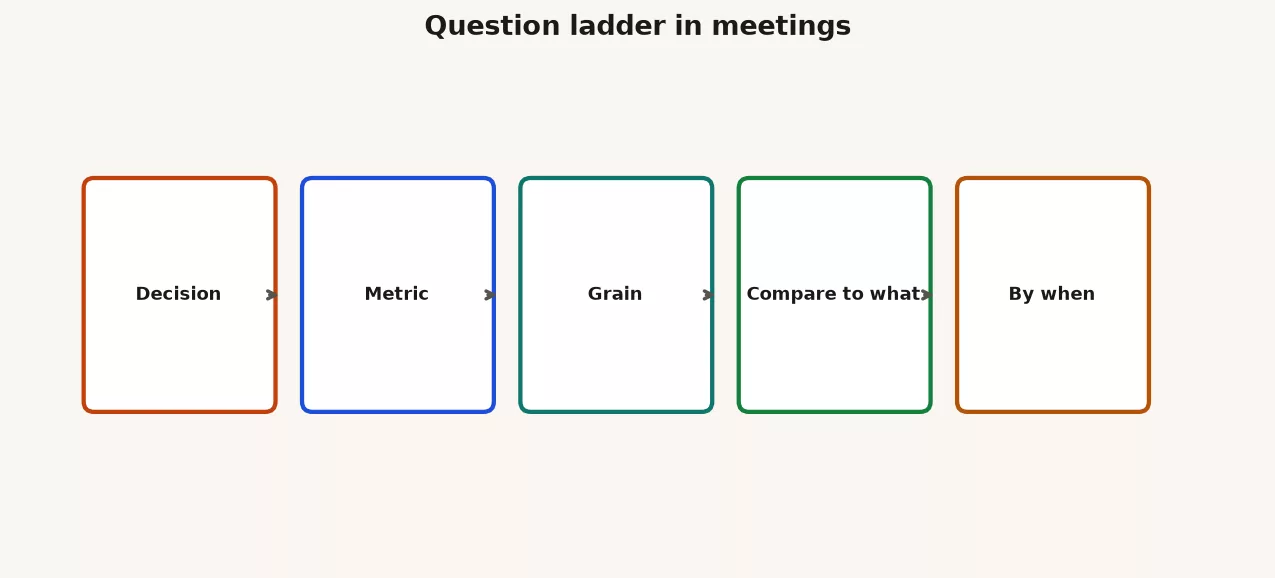
Climbing does not mean every chat must end in a board decision. It means you name which rung you are on. Exploration meetings that pretend to be decision meetings burn trust. Decision meetings that never leave curiosity burn calendars.
Question templates by meeting type
Status / business review
- What is the primary metric, definition link, and owner?
- What is the time window and comparison baseline (plan, prior period, forecast)?
- What changed, by how much, and is the change larger than normal noise?
- What will we do differently before the next review if we are off track?
Incident / “the number looks wrong”
- When did it break (first bad point) versus when did we notice?
- Is this a tracking issue, a pipeline issue, a definition issue, or a real world change?
- What independent check supports that hypothesis?
- Who is blocked, and what temporary decision rule do we use until fixed?
Experiment / launch review
- What was the pre-registered primary metric and success threshold?
- What was the unit of randomization and the analysis window?
- What guardrails moved, and did any segment reverse the average?
- Ship, iterate, or stop, and what is the next measurable bet?
Forecast / planning
- What drivers are in the model, and which are assumptions vs measured?
- What is the prediction interval or scenario range, not only the point?
- What early indicators would tell us the plan is wrong by week two?
- What decision freezes if the low scenario hits?
Rewrite the room: worked example
Original product review agenda (real energy, weak questions):
- Growth update
- Engagement deep dive
- AI insights
- Open discussion
What actually happens: twelve charts, three anecdotes, one AI summary that invents a segment story from a screenshot, no owner for next week.
Rewritten agenda with questions on the ladder:
- Description: Did weekly activated accounts (definition link) for US self-serve move week over week across the last eight weeks?
- Comparison: Are we above or below the Q3 plan line, and by how many accounts?
- Diagnosis: Which acquisition channel explains the largest share of the miss, after we check tracking health?
- Decision: Do we reallocate 20% of paid budget from Channel A to Channel B for two weeks, and what leading metric must improve by Friday?
Supporting table the facilitator can put in the invite:
| Agenda item | Question rung | Owner | Artifact |
|---|---|---|---|
| Activated accounts trend | Description | Growth analyst | One chart + definition link |
| Plan variance | Comparison | Finance partner | Plan vs actual table |
| Channel contribution | Diagnosis | Growth + data eng | Breakdown + tracking note |
| Budget reallocation | Decision | Product lead | Yes/no + success metric |
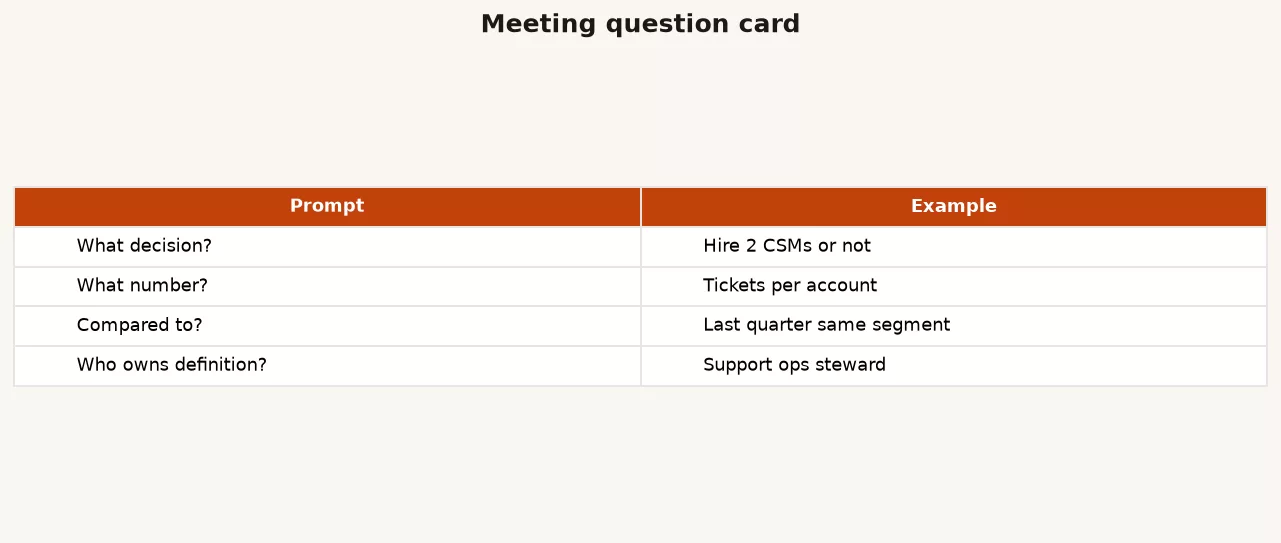
The meeting card is the portable version: question, rung, metric, scope, owner, decision space, and “what would change our mind.” Print it or paste it into the doc template.
Facilitation moves that unlock better questions
- Timebox curiosity. Five minutes to list hunches, then force a rung-2 rewrite.
- Ban orphan metrics. If nobody owns the definition, it is a discussion topic, not a decision input.
- Separate “is the data wrong?” from “is the business wrong?” Different owners, different next steps.
- Write the decision options before the charts. Charts in search of a question create theater.
- End with a sentence: “We decided X, measured by Y, next check on Z date.”
- Park AI summaries until the question is clear. Models are great at polishing vague nonsense into confident paragraphs.
Roles: asker, answerer, decider
Meetings go sideways when one person is forced to be all three.
- Asker clarifies the decision and success criteria (often the product or business owner).
- Answerer provides evidence, uncertainty, and alternatives (analyst, analytics engineer, sometimes finance).
- Decider chooses among options and accepts residual risk (manager or accountable owner).
Analysts can coach askers up the ladder without taking the decision. Deciders can refuse to decide on rung-1 vibes without being “anti-data.” Answerers can say “that question is not answerable with current tracking” as a professional output, not a failure.
Phrases that upgrade a weak ask in the moment
Keep these in your pocket:
- “What decision will this change this week?”
- “What is the time window and comparison?”
- “Which definition of that metric are we using?”
- “Are we checking data health or business health first?”
- “What would falsify this story?”
- “Is this explore, monitor, diagnose, or decide?”
- “Who owns the follow-up number by Friday?”
Said with curiosity, not gotchas, these lines save hours of chart tourism.
Common mistakes
- Starting with the dashboard instead of the decision.
- Mixing definition debates into every status meeting. Schedule definition work; do not hijack every review.
- Accepting averages that hide segment reversals when the decision is segment-specific.
- Treating AI narrative as evidence.
- Asking for “all the data” with no grain or scope.
- No owner for the next measurement.
- Confusing confidence in tone with quality of evidence.
- Never writing the decision down, so the next meeting re-opens it.
Practice
Before your next recurring review, take the last agenda and rewrite each bullet as a question with a rung label. Cut any item that cannot name a metric or a decision space. Add one “what would change our mind” line. After the meeting, score yourself: did you leave with a written decision or only with “good discussion”?
Second drill: collect five Slack asks from the past month. Upgrade each to include object, measure, scope, and use. Share the before/after with your team as a living style guide. If SQL is involved, require the upgraded question before anyone spends an afternoon on a query, human or AI-written.
A short script for the first five minutes
If you run the meeting, open with a fixed sequence: (1) What decision is on the table today, even if the answer is “no decision, explore only”? (2) What metric and definition link will we trust for that conversation? (3) What time window and comparison? (4) What would make us stop and fix data quality instead of debating the business? People resist scripts until they feel a meeting end on time with a written outcome. After two or three cycles, the script becomes culture instead of pedantry.
When remote attendees join late, paste the four answers in chat so the room does not restart from rung 1. When someone brings a surprise chart, park it in a “side quest” list unless it changes the named decision. Side quests can be real work. They do not get to steal the only hour you had for a ship-or-stop call. Your future self, reading the notes, will thank you for the boring clarity.
Quick recap
- Good data questions specify object, measure, scope, and use.
- The ladder runs curiosity → description → comparison → diagnosis → decision.
- Name the rung so the meeting matches the work.
- Templates differ for status, incidents, experiments, and forecasts.
- Facilitation and roles matter as much as charts.
- Write decisions and next measurements; polish without evidence is still theater.
Sources
- Wong, Dona M. The Wall Street Journal Guide to Information Graphics (practical clarity on matching questions to visuals; book reference).
- Few, Stephen. Now You See It / perceptual and analytical design principles for answering questions with data (book reference; see also https://www.perceptualedge.com/).
- Hubbard, Douglas W. How to Measure Anything (decision-focused measurement framing; book reference).
- Google, HEART framework overview (example of goal-driven metric questions for product work): search for “Google HEART framework Measuring UX” and the original CHI paper by Rodden, Hutchinson, and Fu.
- Analytics Made Simple, Metrics series: https://analyticsmadesimple.com/series/metrics/
- Analytics Made Simple, Learn hub: https://analyticsmadesimple.com/learn/
Merch on Etsy
Open store → Imbalanced Classes Mouse Pad, Data Science Mouse Pad, Analytics Mouse Pad, Imbalanced Mouse Pad
View on Etsy →
Imbalanced Classes Mouse Pad, Data Science Mouse Pad, Analytics Mouse Pad, Imbalanced Mouse Pad
View on Etsy →
 Mute Mouse Pad, Data Science Mouse Pad, Analytics Mouse Pad, You're On Mute
View on Etsy →
Mute Mouse Pad, Data Science Mouse Pad, Analytics Mouse Pad, You're On Mute
View on Etsy →
 Y Hat Mouse Pad, Data Science Mouse Pad, Analytics Mouse Pad, Y Pred Mouse Pad
View on Etsy →
Y Hat Mouse Pad, Data Science Mouse Pad, Analytics Mouse Pad, Y Pred Mouse Pad
View on Etsy →
 You're On Mute White Ceramic Coffee Mug, Data Science Mug, Data Mug, Analytics Mug, Statistics Mug, Programming Mug, Gift Mug, Coffee Mug
View on Etsy →
You're On Mute White Ceramic Coffee Mug, Data Science Mug, Data Mug, Analytics Mug, Statistics Mug, Programming Mug, Gift Mug, Coffee Mug
View on Etsy →