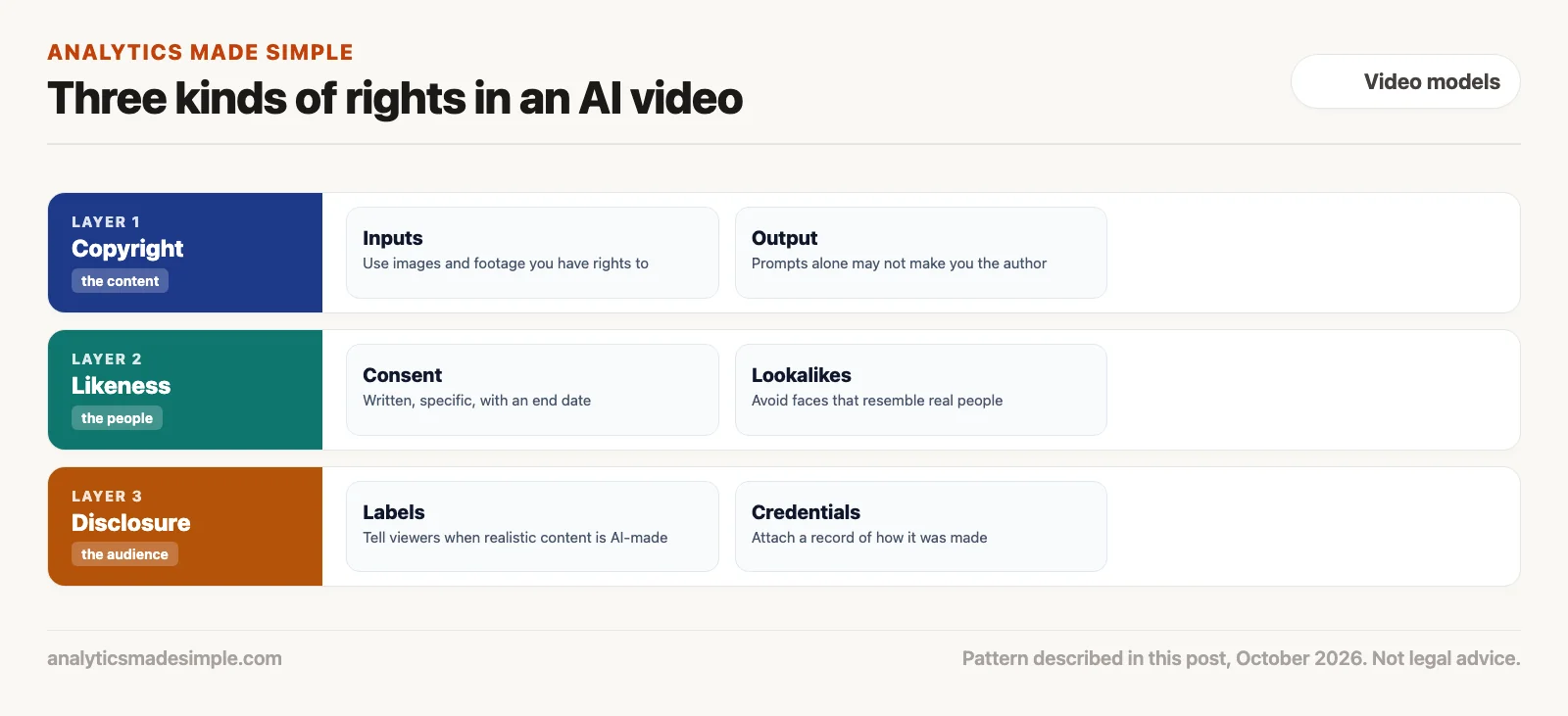
What you can legally generate with AI video comes down to three questions: do you have the rights to what you put in, do you have consent from any real person who appears, and have you told viewers it is AI-made where the law requires it. A clip that looks great can still be one you are not allowed to publish.
Say you have made a short ad with an AI video tool, and it looks finished. Before it goes out, your manager asks who the woman in the background is, whether the tool lets you use its output in ads, and whether the clip needs a label in Europe. You realize nobody checked any of that.
This post explains the main rules in plain words, four checks to run before a clip goes out, four kinds of AI video ranked by risk, and a short program that runs the checklist for you. It is general information, not legal advice. Laws differ by country and state, so for real campaigns, ask a lawyer.
Three kinds of rights in an AI video
Copyright: what goes in and what comes out
Use only images, footage, and music you have the rights to as inputs. If your starting image is someone else’s photo, the video built from it carries the same problem.
Owning the output is less simple than it sounds. In its January 2025 report on copyrightability, the U.S. Copyright Office concluded that prompts alone do not make you the author of what an AI produces. Human creative choices, such as your own footage in the clip or how you arrange and edit the results, can be protected. In practice, a clip made only from a prompt may be something others can copy.
Copying someone else’s work can be expensive. U.S. law allows statutory damages, an amount set by the court instead of proven losses, of up to $150,000 per work for willful infringement under 17 U.S.C. § 504. Some vendors offer to cover you contractually. Adobe, for example, sells intellectual property (IP) indemnification, a promise to defend you against certain claims about copyright and similar rights, for select Firefly outputs to enterprise customers who buy that coverage, with conditions and exclusions. Read the actual terms for the tool you use.
Likeness: the people in the picture
Many places give people control over commercial use of their name, face, and voice, often called the right of publicity. Examples include California’s Civil Code § 3344 and New York’s Civil Rights Law § 51. A fake endorsement can also break federal false-advertising law under the Lanham Act, 15 U.S.C. § 1125.
California added rules for digital replicas, meaning AI copies of a real performer, in 2024 through two Assembly Bills (AB), the name California uses for bills that start in its lower house. AB 2602 covers contracts that allow a digital replica of a living performer, and AB 1836 covers replicas of performers who have died. If you hire someone for a digital double, get written consent that says where the replica can appear, for how long, and what happens when it ends.
Some deepfakes are now a federal crime. The TAKE IT DOWN Act, signed May 19, 2025, makes it illegal to knowingly publish intimate images of a person without consent, including AI-made ones, and gave platforms a year to set up a process for removing them within 48 hours of a valid request.
Disclosure: what you tell viewers
In the European Union, Article 50 of the AI Act has applied since August 2, 2026, according to the European Commission’s guidance. Companies whose tools generate content must mark it in a way machines can detect, with tools already on the market given until December 2, 2026. Anyone who publishes a deepfake, meaning realistic AI content showing real-looking people, places, or events, must say clearly that it is AI-made the first time viewers see it. Clearly artistic, satirical, or fictional work only needs a disclosure that does not spoil it.
A common way to attach a record of how a file was made is Content Credentials, built on the open C2PA standard. Many tools can add them, and they help show viewers and platforms where a clip came from.
Four checks before an AI clip goes out
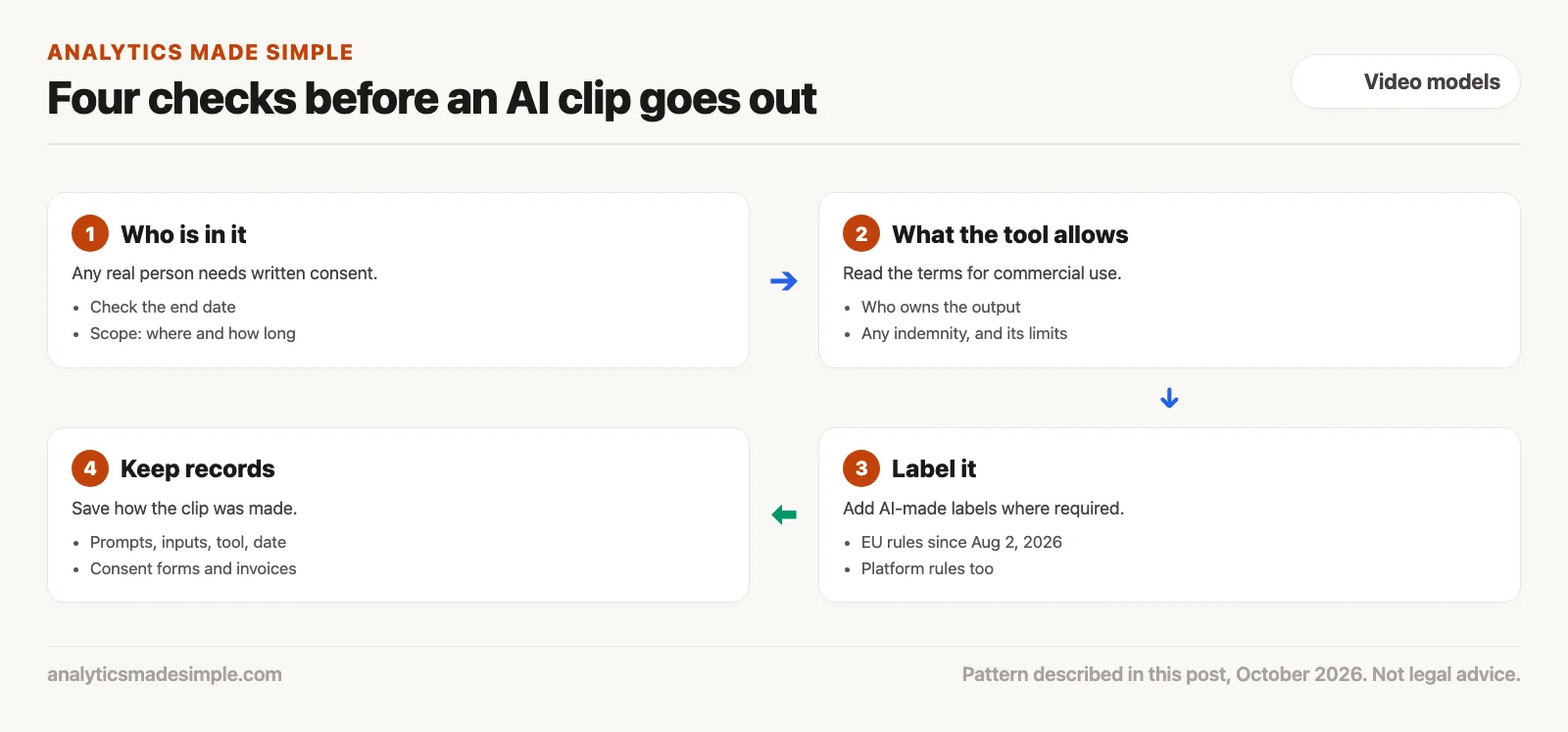
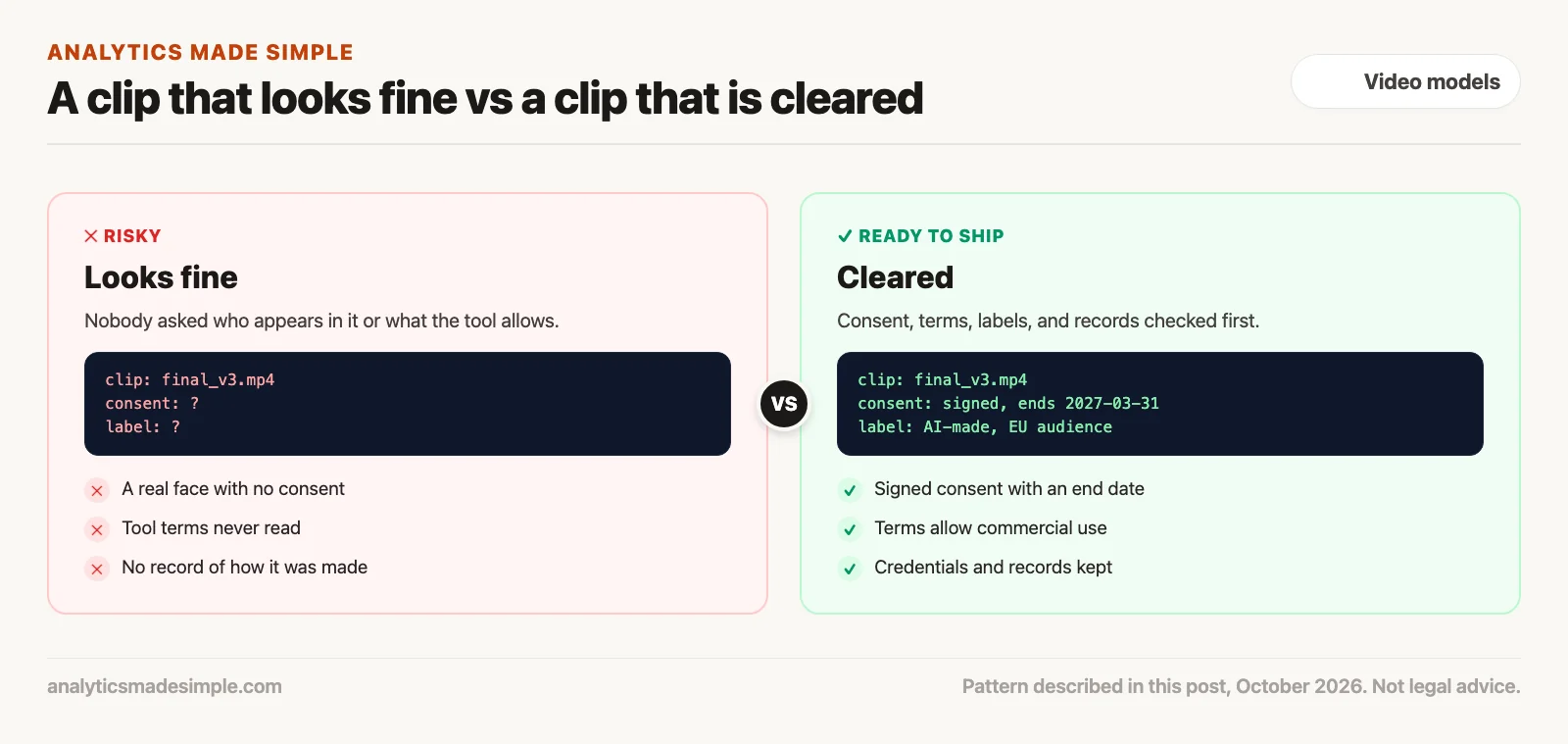
- Who is in it: If a real person appears or a face looks like someone real, you need written consent that covers this use and has not expired. If you cannot get it, change the face.
- What the tool allows: Read the terms for commercial use, who owns the output, and whether any indemnity applies to the model you used.
- Labels: Add an AI-made label wherever the law or the platform requires one, such as realistic content shown in the EU.
- Records: Keep the prompts, input images, tool and model, date, consent forms, and invoices, so you can answer questions later.
Four kinds of AI video, by risk
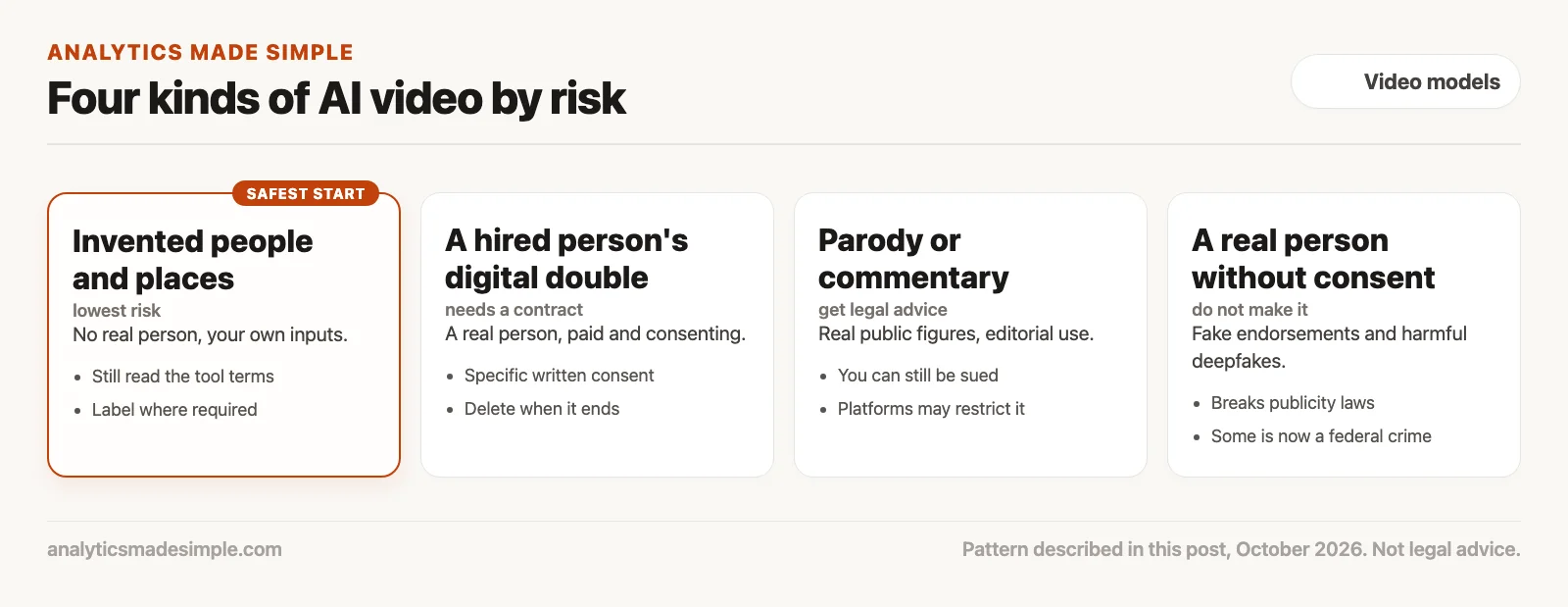
- Invented people and places: The lowest risk. No real person appears, and you used your own inputs. You still need to follow the tool’s terms and label where required.
- A hired person’s digital double: Possible with a clear contract. Pay the person, say exactly where the replica can appear and for how long, and delete the material when the agreement ends.
- Parody or commentary about public figures: Free speech protections exist, but they are a defense in court, not a shield against being sued, and platforms may limit this content. Brands should get legal advice before going near it.
- A real person without consent: Do not make it. Fake endorsements can break publicity and false-advertising laws, and intimate deepfakes are now a federal crime in the U.S.
A checklist you can run
The short Python program below runs the four checks on a list of clips. The people and clips are made up for practice, and it needs nothing beyond Python. It does not decide anything legal for you. It only makes sure the questions get asked and the paperwork exists.
# A pre-release checklist for AI video clips. Not legal advice: it only makes sure
# the questions get asked and the paperwork exists before a clip goes out.
from datetime import date

today = date(2026, 10, 3)

# Signed consent forms on file: person -> last day the consent covers.
consents = {"Actor A": date(2027, 3, 31), "Actor B": date(2026, 9, 30)}

# Made-up clips for practice.
clips = [
    {"name": "spring ad, cut 1", "real_people": ["Actor A"], "shown_in_eu": True,
     "ai_label": True, "content_credentials": True, "vendor_terms_checked": True},
    {"name": "spring ad, cut 2", "real_people": ["Actor B", "Actor C"], "shown_in_eu": True,
     "ai_label": False, "content_credentials": False, "vendor_terms_checked": True},
    {"name": "abstract background", "real_people": [], "shown_in_eu": False,
     "ai_label": False, "content_credentials": True, "vendor_terms_checked": False},
]

for clip in clips:
    problems = []
    for person in clip["real_people"]:
        until = consents.get(person)
        if until is None:
            problems.append(f"no signed consent for {person}")
        elif until < today:
            problems.append(f"consent for {person} ended {until}")
    if clip["real_people"] and clip["shown_in_eu"] and not clip["ai_label"]:
        problems.append("realistic people shown in the EU: add a clear AI-made label")
    if not clip["content_credentials"]:
        problems.append("no content credentials attached")
    if not clip["vendor_terms_checked"]:
        problems.append("check the tool's terms for commercial use")
    status = "OK  " if not problems else "HOLD"
    print(f"{status} {clip['name']}" + (": " + "; ".join(problems) if problems else ""))
Running it prints:
OK   spring ad, cut 1
HOLD spring ad, cut 2: consent for Actor B ended 2026-09-30; no signed consent for Actor C; realistic people shown in the EU: add a clear AI-made label; no content credentials attached
HOLD abstract background: check the tool's terms for commercial use
In plain words, the program keeps a list of signed consents with their end dates and checks each clip against it. The first cut passes. The second is held because one actor’s consent ran out, another never signed, it shows realistic people in the EU without a label, and it has no content credentials. The background clip has no people in it, but nobody has checked the tool’s terms yet.
Quick recap
- Use inputs you have rights to, and know that prompts alone may not make you the author.
- Real people need written consent that covers the use and has not expired.
- In the EU, realistic AI content needs a clear label, and generators must mark their output.
- Keep records, and ask a lawyer before a real campaign, because rules differ by place and change often.
Your next step this week
Pick one AI clip you have made or plan to make. Write down who appears in it, which tool and model made it, where it will be shown, and whether you have consent and the tool’s terms on file. If any answer is “not sure,” fix that before the clip goes out.
Series notes
This is Part 5 of Video models from scratch. Previous: cost, credits, and quality. Next: when real footage still wins.
Sources
- European Commission, Transparency obligations under Article 50 of the AI Act, checked October 3, 2026.
- U.S. Copyright Office, Copyright and Artificial Intelligence, Part 2: Copyrightability, January 2025.
- U.S. Congress, S.146, TAKE IT DOWN Act, signed May 19, 2025.
- 17 U.S.C. § 504 and 15 U.S.C. § 1125, via Cornell Legal Information Institute.
- California Civil Code § 3344, AB 2602, and AB 1836; New York Civil Rights Law § 51.
- Adobe, Firefly approach to generative AI, including IP indemnification for enterprise customers.
- Coalition for Content Provenance and Authenticity, C2PA.
Keep going
Same lessons in your feed
Short diagrams, hooks, and weekly tutorials on Substack, Instagram, X, and Facebook.