
No single AI model is best at everything, so picking one for your whole company is usually a mistake. Qwen (Alibaba’s model family), Claude (from Anthropic), ChatGPT (from OpenAI), and Llama (from Meta) each do different jobs best. Choose by the languages you need and how careful the work must be. Also weigh how much ready-made tooling you want and what the license lets you do.
Imagine your company works in two dozen countries and your boss asks you to settle an argument. The executives want one AI contract to keep things simple. The engineers want a model they can run on the company’s own servers so no data leaves. Marketing says the Western models mangle Japanese politeness and local phrases. And legal will only trust Claude to review contracts. Can one model really keep all of them happy?
Usually not. Alibaba’s free Qwen models compete with paid ones on many jobs, but choosing between Qwen, Claude, ChatGPT, and Llama is not just about test scores. Each has different strengths, licenses, hardware needs, and languages. This guide shows when Qwen fits and when another model is the better tool.
The single-model trap: why one size fails enterprise reality
Forcing a whole company onto one AI model wastes money, slows things down, and can break privacy rules. Most companies do better with a mix: small models you run yourself for quick, high-volume jobs, and a stronger paid model for the hardest thinking work.
One model for everything sounds tidy in a meeting, but it falls apart on real work. Imagine your warehouse staff use handheld scanners that have to read labels instantly, sometimes with no internet connection. Sending every scan to a large model far away adds a wait and a charge to each one. It also stops working when the connection drops.
Meanwhile, your legal team reviews long contracts. They need careful reasoning and a model that is less likely to invent legal cases. A small model running on a laptop may give them summaries that are too shallow.
And if your support team answers customers in Japanese or Korean, test whichever model you pick on real messages. A model trained mostly on English can stumble on local politeness, casual phrasing, and messages that mix writing systems.
Putting every job on one model usually means overpaying for some jobs and underserving others. Instead of betting on a single brand, keep a simple chart of which model handles which job. Then send each task to the best fit.
The four-way landscape at a glance
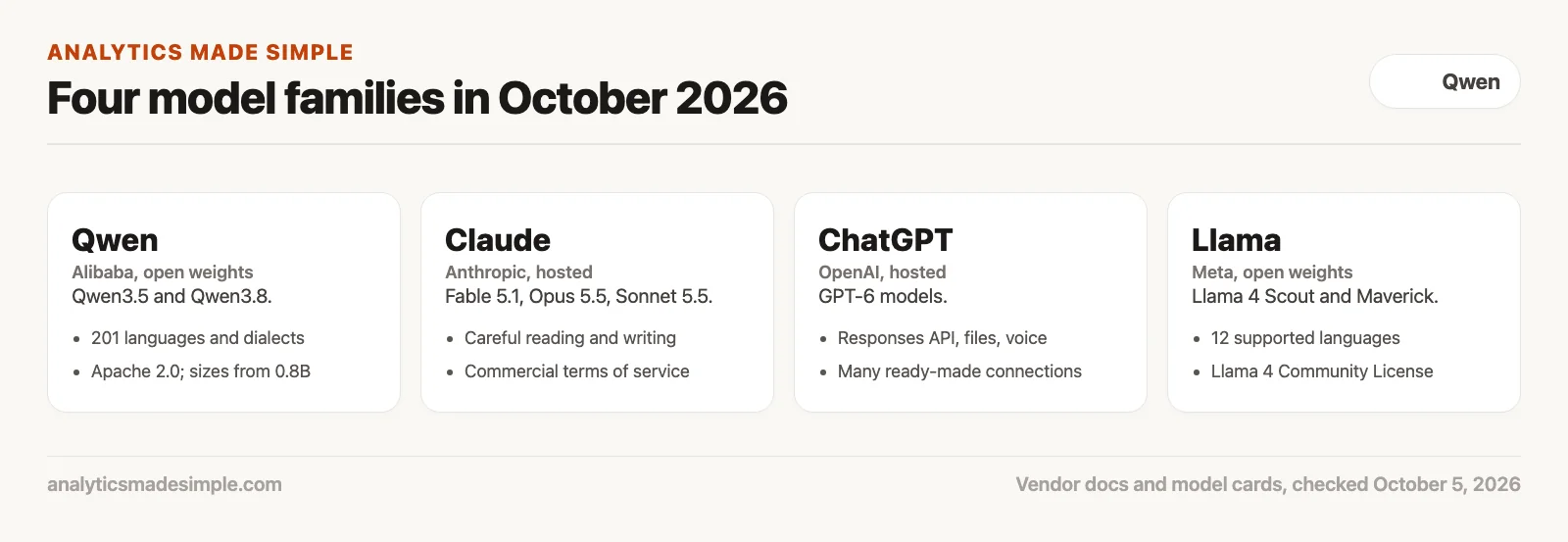
Four model families lead today. Qwen is strong in many languages and comes in small sizes. Claude is strong at careful analysis and following detailed instructions. ChatGPT has the most ready-made tools. Llama has the biggest Western community for models you can run yourself. The right pick depends on license, hardware, and languages.
To see past the marketing, it helps to know what each family is really built for.
Alibaba’s Qwen is an open model family (one you can download and run yourself) built for many languages. As of October 2026, the Qwen3.5 models run from 0.8 billion to 122 billion parameters, the learned numbers that set a model’s size and skill, and Qwen3.8-27B is the newest mid-size model. They use the permissive Apache 2.0 license (checked October 5, 2026).
Anthropic’s Claude comes in four current models: Fable 5.1, Opus 5.5, Sonnet 5.5, and Haiku 5.5. Anthropic’s models page (checked October 8, 2026) says they do well at reasoning, coding, many languages, and long documents, and it points Opus 5.5 at long-running coding and knowledge work. When a team needs a close reading of vague legal language, or reasoning across very long documents, Claude is a common choice.
OpenAI’s ChatGPT is the most ready-to-use. Its API, the service programs use to connect, handles files, code, images, and voice, and a huge number of other apps already connect to it.
Meta’s Llama is the best-known open model in North American companies. Its current generation, Llama 4 Scout and Maverick, is offered ready to run by the major cloud providers, Amazon Web Services (AWS), Google Cloud, and Microsoft Azure, and it has a large community of developers building tools around it.
The chart below compares the four families by skills, hardware needs, and best uses.
Where Qwen clearly wins: multilingual breadth and edge sizes
Qwen stands out in two ways. It understands many Asian and European languages well, and it comes in tiny sizes that run on small devices with no internet connection. For fast offline work, or text that mixes writing systems, Qwen is often the strongest choice.
Qwen’s biggest strength is languages. Most Western models learned mainly from English text and treat other writing systems as an afterthought. They also break characters like Chinese or Japanese into many small tokens (the chunks of text a model reads), which makes answers slower and more expensive.
Alibaba built Qwen for many languages from the start. The Qwen3.5 model card lists 201 languages and dialects (checked October 5, 2026). By comparison, Meta lists 12 supported languages for Llama 4, and Japanese, Chinese, and Korean are not among them. Test any model on your own messages before you trust it with customers.
Its second strength is small sizes. Qwen3.5 comes in 0.8, 2, and 4 billion parameter versions. Meta’s smallest models are still the 1 and 3 billion parameter Llama 3.2 releases from 2024, because Llama 4 has no small sizes. Models this small run on battery-powered devices, store checkout machines, and phones.
For a fleet of warehouse scanners, putting Qwen3.5-2B right on the handheld devices lets them read documents offline, without a phone signal and without any cloud fees. Its common 4-bit file is about 1.3 GB.
Claude still rules on nuanced English and deep analysis
Claude is among the best at careful English writing, summarizing complex documents, legal analysis, and following long, detailed instructions. When tone, subtlety, and consistent logic really matter, Claude is often a better fit than the open models.
Open models have closed much of the gap on test scores. But paid frontier models, the most advanced ones, still tend to do better on high-stakes work that needs careful reasoning.
In legal work, when analysts ask a model to compare two contracts and find clauses that contradict each other about who pays for what, Claude tends to give stronger results. It catches subtle contradictions, follows layered instructions, and does not simply flatter the user or drift off topic.
Claude is also good at following “do not” instructions. When told never to assume which country’s law applies, or to avoid certain legal terms, it sticks to those rules more reliably than most open models.
If your work is writing polished investor reports, summarizing complex health cases, or reorganizing a large codebase across hundreds of files, paying for Claude is often worth it.
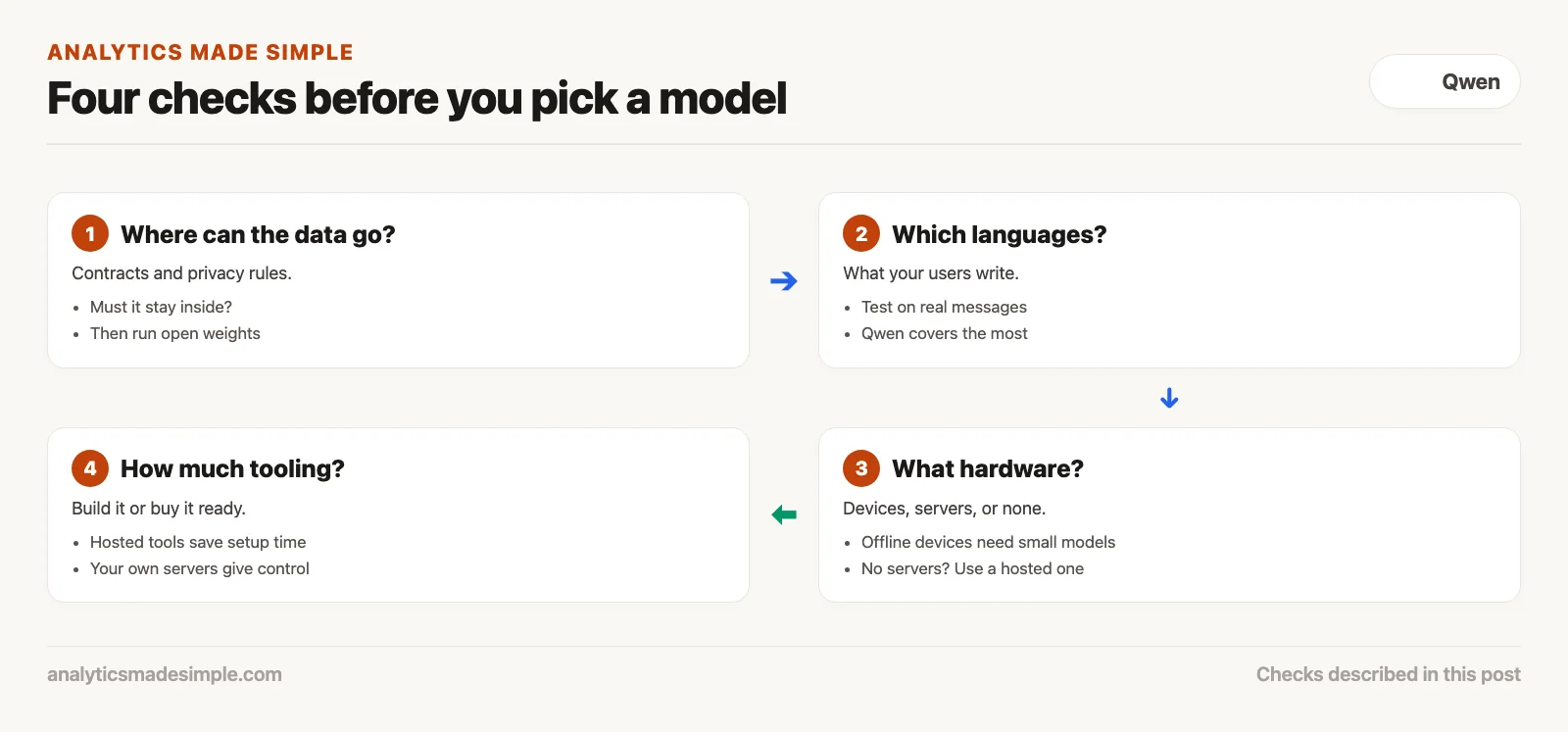
To choose the right model for each job, go through four checks: where the data is allowed to go, which languages you need, what hardware you have, and how much ready-made tooling you want.
ChatGPT dominates on turnkey SaaS and developer tools
OpenAI’s platform is the easiest pick when you want something working fast without running servers. Its tools can read files, run code, speak, and connect to many other apps, all ready to use, which is hard to match with a model you host yourself.
For teams without deep technical staff, or for quick prototypes, speed usually matters more than owning the setup. OpenAI has spent years making its tools easy to use, so people who are not engineers can build multi-step assistants in hours.
OpenAI’s Responses API keeps track of conversations, searches uploaded files, and runs Python code for you. It replaced the older Assistants API, which OpenAI removed on August 26, 2026. Say finance wants an internal assistant where analysts upload Excel sheets, run a trend analysis, and download charts. On OpenAI’s platform, that takes very little custom code.
OpenAI also handles voice, images, and documents in one place. Product teams can build a customer-facing mobile app with talking, reading, and picture features without stitching several vendors together.
If your team has no one dedicated to running AI infrastructure, ChatGPT saves months of setup and lets you focus on what customers actually see.
Llama holds the line for Western enterprise adoption
Meta’s Llama is the most popular open model in North American companies, thanks to its large community and built-in support from the big cloud providers. If your company already buys through AWS (Amazon’s cloud computing service), Google Cloud, or Azure, Llama is usually the easiest to get approved.
Meta’s Llama has had a huge effect on open models. It is the default open model in many North American tech companies, universities, and IT departments.
That popularity has real benefits. Every major cloud provider offers ready-to-run Llama with business support promises, called service level agreements (SLAs). If your company already has a yearly contract with Amazon or Microsoft, starting with Llama needs no new vendor checks or reviews of a foreign supplier.
Developers have also built thousands of add-ons around Llama: specialized versions, compressed versions, and testing tools. Popular serving tools like vLLM and Ollama usually support new Llama releases on the day they come out.
Llama’s main limits are weaker coverage of non-Western languages and a license with a catch. Companies with over 700 million monthly users must ask Meta for a special license.
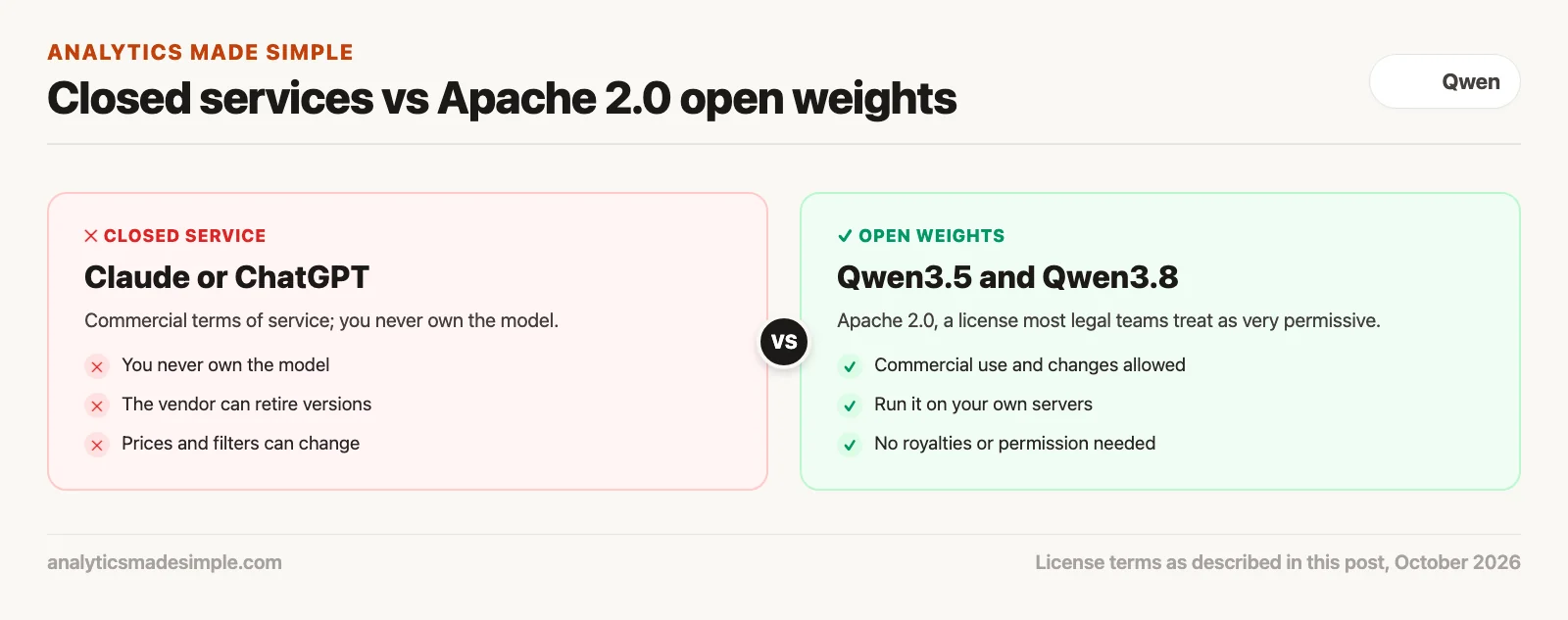
License terms can decide what you are allowed to do, so it pays to understand them before you choose. The chart below compares open models with closed ones.
Comparing licenses: open weights vs closed APIs
The license decides what you are free to do. Most Qwen models use Apache 2.0, which allows commercial use, changes, and running on your own servers. Llama’s license adds some limits. Closed services like Claude and ChatGPT give you no ownership of the model at all, so you depend fully on the vendor.
Before a company builds important work on a model, its lawyers should read the license. The four families differ in ways that matter legally.
Alibaba releases its Qwen3.5 and Qwen3.8 models under Apache 2.0, a license most legal teams know and treat as very permissive. You can download the model, change it, build it into products you sell, and run it on your own servers without paying royalties, sharing your code, or asking Alibaba.
Meta’s Llama license has specific limits. Section 2 of the Llama 4 Community License says that if your products had over 700 million monthly users in the month before the release, you must ask Meta for a separate license. And if you use Llama or its outputs to train another model that you share, that model’s name must begin with “Llama” (checked October 5, 2026).
Closed services like Claude and ChatGPT work under commercial terms of service. You own the text they produce, but you never own the model. The vendor can retire versions, change its safety filters, raise prices, or close your account.
If you want to own your setup outright and never depend on one vendor, Apache 2.0 open models give you a legal certainty that closed services cannot.
When Qwen is the wrong tool: three honest disqualifiers
Qwen is the wrong choice when your team cannot run AI servers, when the work is mostly polished English writing, or when your company’s buying rules forbid software from Chinese companies. In those cases, a closed Western service or a model from your cloud provider is more practical.
Good engineering means knowing when a tool does not fit. Despite its strengths, there are three clear cases where Qwen is a poor choice.
The first is a team that cannot run AI infrastructure. If your team is four web developers with no experience managing graphics chips or server software, trying to host Qwen yourselves will eat months. In that case, a hosted service like Claude or ChatGPT makes far more sense.
The second is work that is mostly careful English writing, like sensitive corporate messages or creative copy. Qwen’s English is solid, but Claude usually has a more natural rhythm and better judgment about tone.
The third is purchasing and security rules. Some regulated Western industries forbid software from companies based in China, whatever the license says. Defense, critical national infrastructure, and some government agencies are examples. If your company is under rules like these, Llama or a domestic closed service is the way to pass the security review.
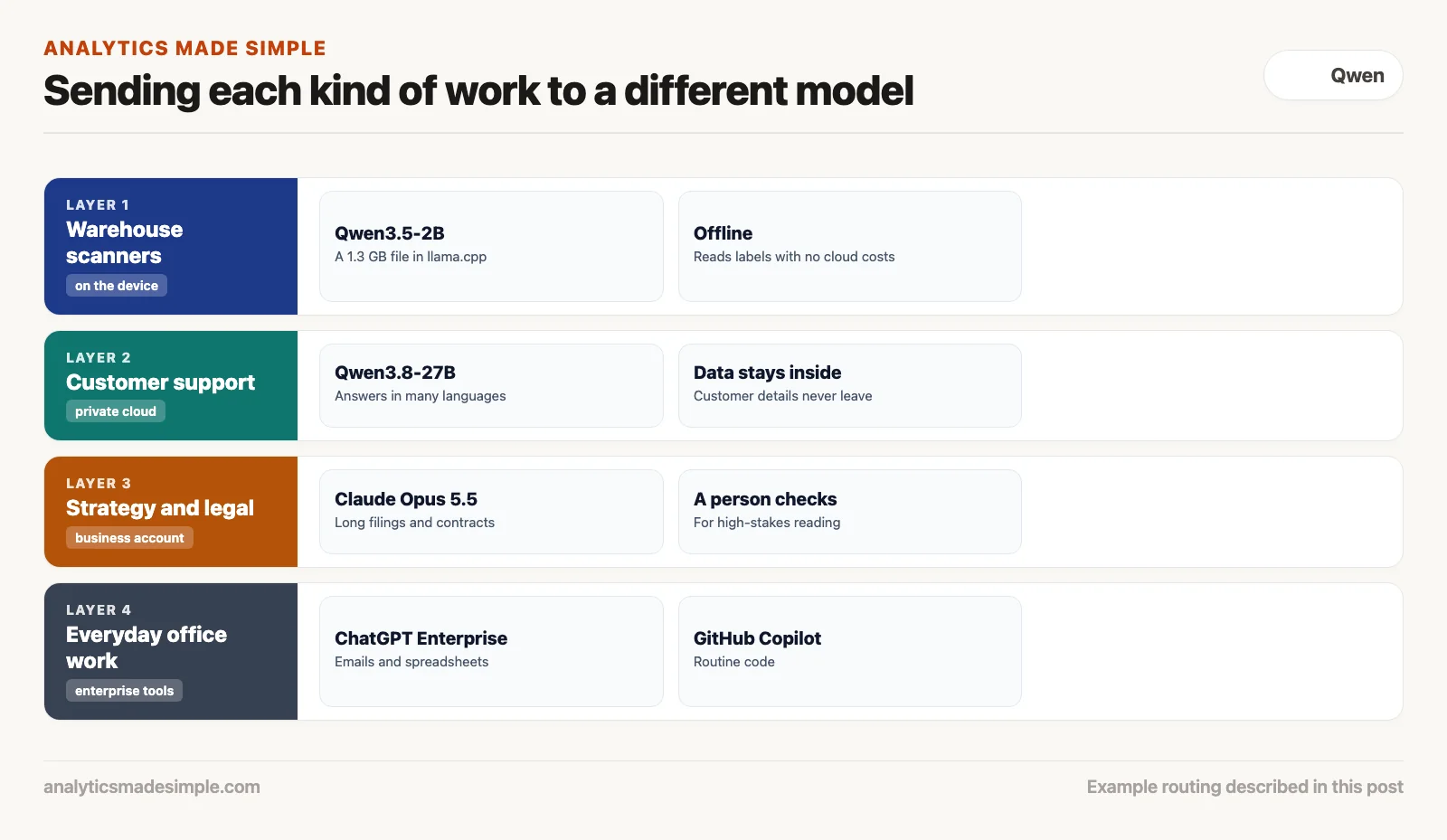
The diagram below shows a company that sends different kinds of work to different models: scanners, customer support, legal analysis, and everyday office work.
Here is a quick summary of how the four families compare.
| What to compare | Qwen (Alibaba) | Claude (Anthropic) | ChatGPT (OpenAI) | Llama (Meta) |
|---|---|---|---|---|
| Languages | 201 languages and dialects (Qwen3.5) | Many; test your own | Many; test your own | 12 supported (Llama 4) |
| Smallest sizes | 0.8B, 2B, 4B | None; hosted only | None; hosted only | 1B and 3B (Llama 3.2, 2024) |
| License | Apache 2.0 | Commercial terms | Commercial terms | Llama 4 Community License |
| Run on your own servers | Yes | No | No | Yes |
| Ready-made tools | Model Studio, or build your own | Claude API and Console | Responses API, files, voice | Cloud provider endpoints |
The multi-model routing blueprint
A routing gateway is a small program that looks at each request and sends it to the best model, based on language, type of task, how sensitive the data is, and cost. Putting one in front of your apps gets you better answers for less money while keeping sensitive data where it belongs.
Instead of picking one winner, many teams add a routing layer that decides which model gets each request.
In a retail and shipping company, that often means four tiers.
Tier one, warehouse scanners. Handheld devices run Qwen3.5-2B right on the device using llama.cpp. They read barcode labels and check shelves with no cloud costs.
Tier two, customer support in many languages. Customer chats from Asia and Europe go to Qwen3.8-27B running on the company’s own private cloud servers. It answers in Japanese, German, and Chinese while keeping customer details inside the company’s network.
Tier three, strategy and executive reports. Finance and legal teams use Claude Opus 5.5 through a business account. It summarizes long regulatory filings, investor documents, and supplier contracts, and a person checks anything that matters.
Tier four, everyday office work. Employees and developers use ChatGPT Enterprise and GitHub Copilot to draft emails, finish routine code, and build spreadsheets.
Matching each model’s strength to the right job usually lowers the total AI bill and speeds up answers, because expensive models only handle the work that truly needs them.
A routing gateway can be as simple as one function that looks at the request and picks where to send it. Here is a small Python example.
# A tiny routing gateway: pick where each request goes
PRIVATE_QWEN = "http://private-vpc.internal:8000/v1/chat/completions"  # Qwen3.8-27B on your servers
MODEL_STUDIO = "https://YOUR-WORKSPACE-ID.ap-southeast-1.maas.aliyuncs.com/compatible-mode/v1"  # hosted Qwen
CLAUDE = "https://api.anthropic.com/v1/messages"  # Claude Opus 5.5
OPENAI = "https://api.openai.com/v1/responses"  # GPT-6 models


def route_model_request(prompt: str, is_sensitive: bool, target_lang: str) -> str:
    if is_sensitive:  # private data never leaves your network
        return PRIVATE_QWEN
    if target_lang in ["ja", "zh", "ko", "ar"]:  # languages Llama 4 does not list
        return MODEL_STUDIO
    if "contract" in prompt.lower() or "indemnification" in prompt.lower():
        return CLAUDE
    return OPENAI


examples = [
    ("Driver passport scan for customs", True, "en"),
    ("お届け予定日を教えてください", False, "ja"),
    ("Compare the indemnification clauses in these two contracts", False, "en"),
    ("Draft a friendly reminder email about Friday's deadline", False, "en"),
]
for prompt, sensitive, lang in examples:
    print(f"{prompt[:40]:<42} -> {route_model_request(prompt, sensitive, lang)}")
Running it prints where each example request would go:
Driver passport scan for customs           -> http://private-vpc.internal:8000/v1/chat/completions
お届け予定日を教えてください                             -> https://YOUR-WORKSPACE-ID.ap-southeast-1.maas.aliyuncs.com/compatible-mode/v1
Compare the indemnification clauses in t   -> https://api.anthropic.com/v1/messages
Draft a friendly reminder email about Fr   -> https://api.openai.com/v1/responses
Monday morning decision checklist
When you choose models for your next projects, go through this list with your product and data teams.
- Check your languages: if most of your users write in Japanese, Chinese, Arabic, or another language with its own alphabet or characters, test Qwen first.
- Check your devices: if the AI must run on laptops, store checkout machines, or warehouse scanners, try Qwen3.5’s 0.8B, 2B, or 4B models, or Meta’s small Llama 3.2 1B and 3B ones from 2024, so they work offline.
- Set privacy limits: if customer data must stay inside your own private cloud network, run an open model like Qwen or Llama on your own servers instead of a public service.
- Use Claude for careful work: for long contracts, detailed compliance reviews, or sensitive executive messages, send the work to Claude.
- Use OpenAI for quick prototypes: when a team without engineers needs a working demo with voice, images, or file search, start with ChatGPT’s tools before building anything custom.
Series notes
This is Part 6 of Learn Qwen, and it closes the planned Qwen track. Previous: open weights vs hosted.
Sources
- Qwen Team, model cards for Qwen3.5-9B and Qwen3.8-27B, checked October 5, 2026.
- Anthropic, Claude models overview, checked October 5, 2026.
- OpenAI, models and deprecations (Assistants API removed August 26, 2026), checked October 5, 2026.
- Meta, Llama 4 model card and prompt formats and Llama 4 Community License, checked October 5, 2026.
- Alibaba Cloud, Model Studio OpenAI-compatible endpoints, checked October 5, 2026.
- Apache Software Foundation, Apache License, Version 2.0.
Keep going
Same lessons in your feed
Short diagrams, hooks, and weekly tutorials on Substack, Instagram, X, and Facebook.