Qwen, the AI model family from Alibaba, is good at translating work documents between languages if you follow a simple routine. Name the source language. Say what kind of text it is; translators call this the register, like a sales flyer or a legal contract. Give it a list of terms that must not change. Then have a person check the one line that matters most. Tools that translate everything through English first can quietly change the meaning.
Imagine you are updating the warranty card that ships with a kitchen knife. Legal gives you one English sentence: bending the blade sideways or using it to pry frozen food voids the guarantee. A general chatbot turns it into Spanish and Chinese that tells customers washing the knife sideways voids it. If nobody catches it before the cards ship, your support inbox fills up with people asking whether the dishwasher ruined their warranty.
How one warranty line gets mixed up
Word-for-word translation fails in customer-facing text because it keeps the technical term instead of matching how people actually talk. When you are translating a technical limit for retail customers, the model needs to describe the action itself, not repeat the dictionary words for it.
These mix-ups rarely happen because the original English was wrong. They happen because the translation keeps the engineer’s words instead of the customer’s. To an engineer, “lateral torque” is an exact description: twisting a rigid blade sideways, away from its cutting plane. A home cook in Guadalajara or Taipei reads the word-for-word Spanish or Chinese version as meaningless textbook language.
So when you paste the clause into Qwen-Max, tell it the audience is home cooks reading an instruction manual, and ask it to describe what the hand does instead of repeating the engineering term. A good result reads like the two lines below. Check that yours names the same actions before you print anything.
Spanish, written for home cooks: “La garantía de reemplazo de 5 años no cubre astilladuras causadas por doblar la hoja hacia los lados o usarla para hacer palanca en alimentos congelados.”
Traditional Chinese, written for home cooks: “若因側向扳動刀刃或用刀撬取冷凍食材導致刀刃崩口,則不在5年換新保固範圍內。”
Look at the key verbs. In Spanish: “doblar hacia los lados” (bending sideways) and “hacer palanca” (prying). In Chinese: “側向扳動” (levering sideways) and “撬取” (prying open). Neither version mentions physics class at all. Both versions still exclude misuse, and neither one suggests that normal dishwashing is a problem.
Why translating twice loses the nuance
Every extra translation step is another chance for the meaning to drift, so translate straight from the original language into the one you need. Do not translate into English first and then translate that English again.
That detour is common at work. Your supplier writes in Japanese. Someone runs it through a translator to get English. Later, someone else turns that English into Spanish for the warehouse team. Each step is a round of the telephone game. A polite humidity warning can come out of the English step blunter or softer than it started. Then the Spanish step copies whatever the English step got wrong.
Qwen makes the direct route practical for many language pairs. The Qwen team says Qwen3 supports 119 languages and dialects (Qwen blog, April 2025). That does not promise a perfect legal translation. It does mean you can paste the Japanese original and ask for Spanish directly, then check the result with the reverse test further down.
Why the same paragraph costs more in some languages
AI models count text in tokens, and the same paragraph can take more tokens in one language than in another. Tokens decide how much of a document fits in one conversation and, on paid services, what you pay. So measure your own documents instead of trusting a headline number.
Language models do not read whole sentences or letters the way you do; they read small numbered chunks of text, called tokens. A tokenizer is the lookup table that chops your text into those pieces. A tokenizer built mostly from English text often gives a common English word like “warranty” a single token. A Chinese phrase or an accented Spanish word may get split into several. Qwen’s tokenizer was built from text in many languages. So it tends to split Chinese and other non-English text into fewer pieces. How many fewer depends on the language and the document.
That matters in three everyday ways:
- Room for longer documents: a long Japanese safety handbook might fill most of one model’s working memory, which is the amount of text it can consider at once. Another model might still have room for your follow-up questions.
- Speed: fewer tokens for the same reply usually means the answer finishes sooner.
- Cost: services that programs connect to (an API, the way one program asks another for work) usually charge per token, so a document that splits into fewer pieces costs less to process.
To compare, send the same paragraph to each service you are considering and read the token count it reports. API replies include it, and most developer consoles show it next to each request. Try one real document per language you use. That gives you a number for your own work, which beats any average.
Picking the right business register
Tell the model what kind of text it is: a store sign, warehouse instructions, or a legal contract. Wording that is fine on a sales flyer can cause legal trouble in a supplier contract. Telling the model who will actually read the text matters more than telling it which language to use.
Most translation mistakes start when someone types “translate this into Japanese” and nothing else. Without that, the model has to guess if you are writing an apology to a boss, a casual guide for teens, or a warehouse packing list. Qwen does its best work when you name one of three common business registers up front.
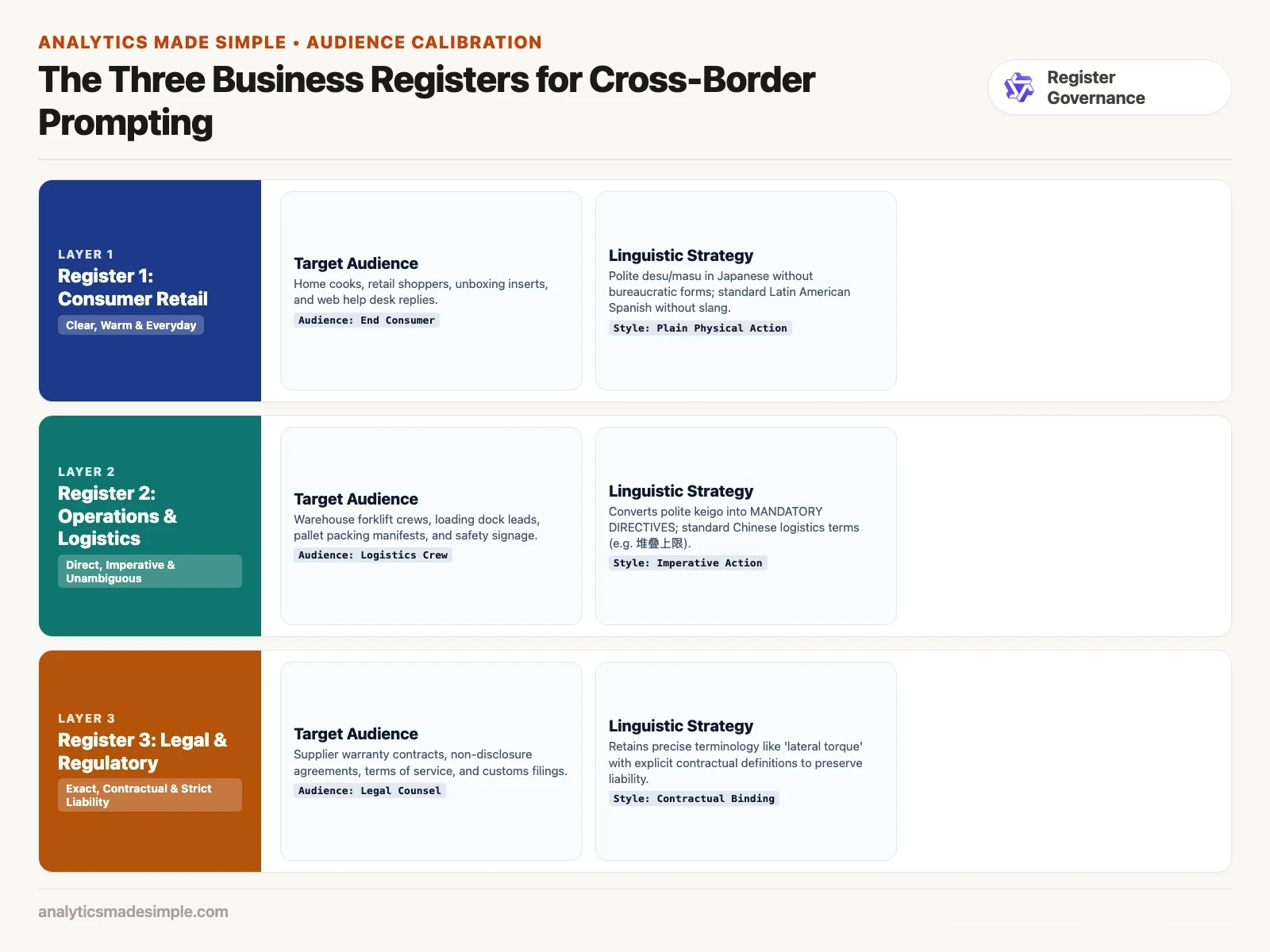
- Register 1, shoppers (friendly, clear, no jargon): for in-box leaflets, website help pages, and customer service replies. The goal is warmth and easy reading. In Japanese, that means polite everyday endings without the stiff, very formal ones. In Spanish, it means standard Latin American phrasing that skips regional slang.
- Register 2, warehouse and shipping (short, direct orders): for delivery checklists, packing sheets, and safety signs. Sentences stay short with active verbs. In German, that means short infinitive-style instructions. In Chinese, it uses standard warehouse terms, such as the phrase for a stack limit, instead of a more conversational description.
- Register 3, legal (exact, careful wording): for warranties, supplier contracts, and terms of service. Every condition must keep its exact legal meaning. A phrase like “lateral torque” stays intact here, with an explicit contractual definition attached, to protect the company’s own wording.
A worked example: reading a Japanese supplier warning
Buying from other countries often means reading supplier warnings where polite wording hides a real shipping rule. A factory in Osaka that ships delicate sensors writes its packing notes in soft, polite language. A word-for-word translation can make those notes sound optional.
Here is a sample notice, written the way a Japanese supplier of moisture-sensitive ceramic parts might phrase it.
本製品は吸湿性に極めて敏感なため、開封後は速やかに防湿保管庫への移管をご検討いただけますと幸甚に存じます。万一、相対湿度が65%を超過した環境下に2時間以上放置された場合、初期通電時の微細クラック発生要因となり得ますので、ご留意のほどお願い申し上げます。A literal English translation reads: “Since this product is sensitive to moisture, we would be very happy if you would kindly consider moving it to moisture-proof storage after opening. If left in an environment with over 65% humidity for 2 hours, it may cause micro-cracks upon initial power-on, so please keep this in mind.”
The words “we would be very happy if you would kindly consider” make it sound optional. Read that way, a night crew could leave the pallets on a humid dock overnight. Then the parts could crack the first time they are switched on.
In Japanese business writing, that much politeness usually wraps a firm rule, not a suggestion. So when you run the notice through Qwen-Max, say it is warehouse instructions and ask for a direct order. The version you want looks like this:
Warehouse version: “MANDATORY HANDLING REQUIREMENT: Highly moisture-sensitive components. Immediately transfer cartons to humidity-controlled storage upon unsealing. CRITICAL LIMIT: Do NOT expose to relative humidity exceeding 65% for more than 2 hours. Going over this limit can cause tiny cracks when the device is first turned on.”
That version keeps the actual rule, the 65 percent humidity and the 2 hours, and drops the extra politeness. If a Japanese-speaking colleague can confirm the rule in one sentence, you are done.
A four-step bounded translation routine
A dependable translation has four steps. Settle the source text first, and choose the kind of text you want. Then list the terms that must never change, and finally translate the result back to check it. Skip the glossary step and you risk translated product names and scrambled SKUs, the codes a warehouse uses to identify one exact product.
Here is a routine that heads off warranty and packaging mix-ups across any language pair in Qwen Chat.
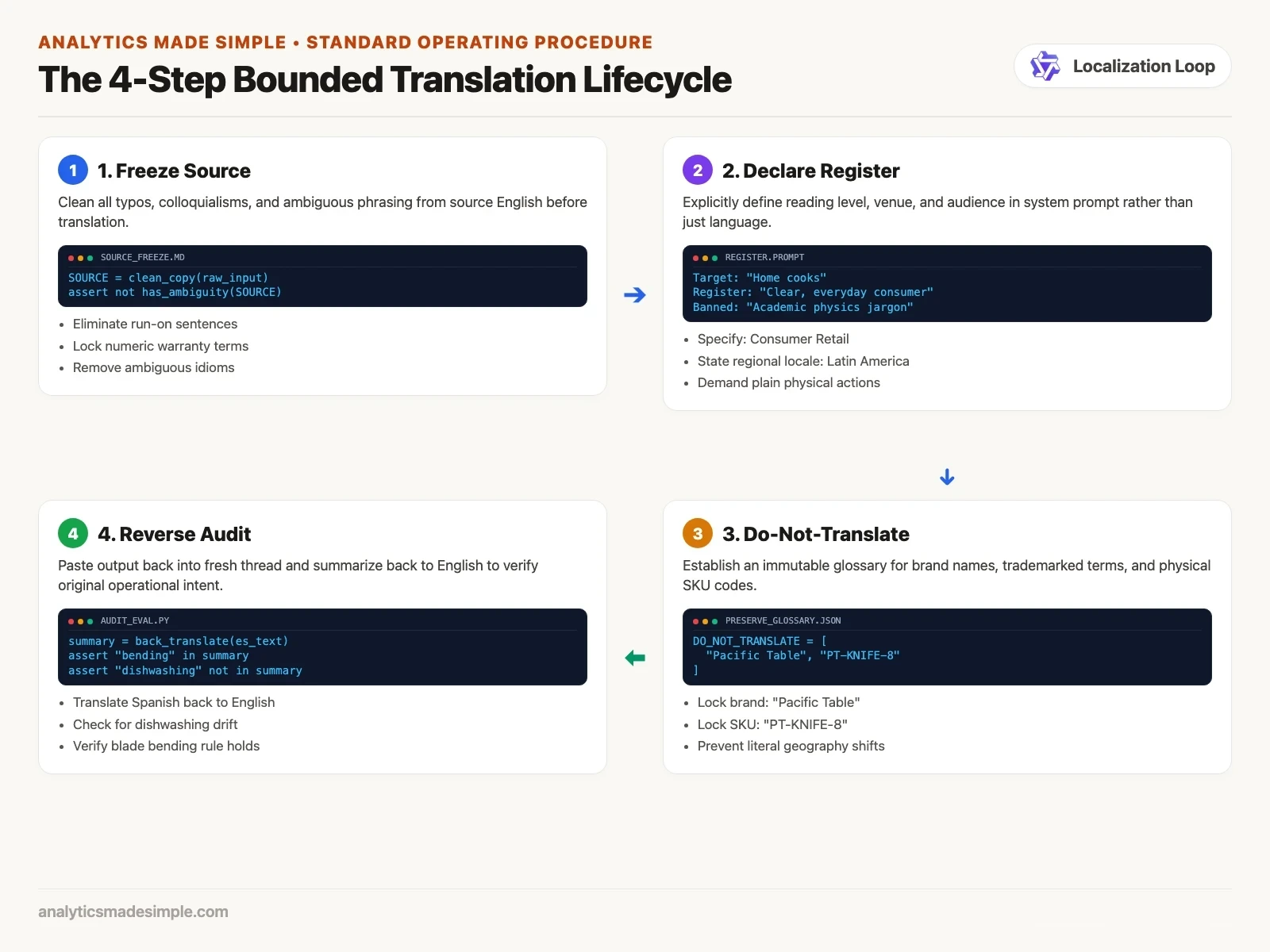
Step 1: lock down and clean the source text. Check that your source English or Chinese paragraph has no typos or run-on sentences. If the input is unclear in English, the translation will multiply that confusion in every target language.
Step 2: name your audience and register. Say plainly who will read this and where, in your prompt. Do not let the model default to formal dictionary phrasing on its own.
Step 3: give it a do-not-translate glossary. Brand names, trademarked product names, physical SKU codes, and legal entity names all need explicit protection. Skip this, and a model will happily translate a brand name like “Pacific Table” into literal geography instead of leaving it alone.
Then run the prompt with a structured template. Here is a working template for localizing an updated packaging insert.
Role: Bilingual Packaging Localization Specialist.
Task: Translate the following English product care notice into Latin American Spanish and Traditional Chinese.

Target Audience: Home cooks and retail kitchenware customers.
Register: Clear, polite, everyday consumer language. Avoid overly technical engineering jargon.

Constraints:
1. Do NOT translate the brand name "Pacific Table" or SKU "PT-KNIFE-8".
2. Translate the concept of "lateral torque" into everyday physical actions (such as twisting, bending sideways, or prying).
3. Preserve all warranty numbers (5-year guarantee, 30-day return) exactly.
4. Output the result in two distinct labeled sections: [Spanish] and [Traditional Chinese].

Source Text:
"Blade chipping caused by lateral torque or prying frozen goods voids the 5-year replacement guarantee."
Step 4: run a reverse check. In a fresh conversation, paste the Spanish or Chinese output back in and ask: “What physical actions void the warranty according to this text? Summarize in two English bullet points.” If the English summary says bending the blade sideways voids coverage, the translation passed. If it mentions dishwashing, you know the meaning drifted somewhere along the way.
Common multilingual traps to avoid
Watch for three common mistakes: trusting your browser’s automatic translation, mixing regional dialects in one document, and assuming units convert on their own. Translation tools translate words. They do not automatically handle a region’s own number and unit conventions.
- The browser plugin trap: do not rely on Chrome’s or Edge’s automatic page translation to check your finished packaging text. Browser translation does not know your audience or your do-not-translate list, so it can bring back the literal errors you just removed. Read the raw text inside Qwen Chat instead, or ask a native-speaking colleague to check the register.
- The regional dialect mashup: Spanish spoken in Madrid uses different words and verb forms than Spanish spoken in Mexico City or Bogotá. The Chinese used in mainland China uses different words for many things than the Chinese used in Taiwan or Hong Kong. Always name the region in your prompt, such as “Mexican Spanish” or “Taiwanese Traditional Chinese.”
- The imperial-versus-metric assumption: if your English document says a blade is 8 inches long, the model will not always convert it to 20 centimeters. Tell it to. In a manual, write something like “add the metric size in brackets after every inch measurement.”
Moving past word-for-word translation
A global business cannot run on swapping words one for one. A word-for-word translation keeps the engineer’s language and confuses ordinary customers. When you tell Qwen-Max who the text is for, give it a do-not-translate list, and run the reverse check, you get copy you can stand behind in each language.
On your next international project, treat translation as a design decision, not an afterthought. Pick Qwen-Max for nuanced public copy, state your target business register up front, and lock your brand terms with a do-not-translate list. The next post covers Qwen’s coding models, including how Qwen-Coder writes small programs, rewrites SQL (the language for asking databases questions), and cleans up data.
Series notes
This is Part 3 of Learn Qwen. Previous: chat surfaces. Next: code and agent variants.
Sources
- Qwen Chat (the free chat app used in the examples)
- Qwen3 announcement, Qwen team blog (119 languages and dialects, about 36 trillion training tokens; April 2025)
- Qwen blog (newer model releases and multilingual notes)
- Qwen on Hugging Face (model cards and the published tokenizer files)
- Alibaba Cloud Model Studio (paid API access to Qwen-Max and Qwen-Plus, with token counts per request)
Keep going
Same lessons in your feed
Short diagrams, hooks, and weekly tutorials on Substack, Instagram, X, and Facebook.