A human voice is required whenever people are being asked to trust someone: an apology, a statement in a crisis, real testimony, or a personal story. AI voices are fine for routine information and useful behind the scenes, but they should not stand in for a person who is supposed to be taking responsibility.
Say your company has a long outage, and customers are angry. Someone suggests using an AI copy of the CEO’s voice to record the apology for the support line, because it is faster than getting the CEO into a studio. It would sound like the CEO. But the people listening are not only asking what happened. They are asking whether anyone is willing to stand behind it.
This post explains why some moments need a real voice, the documentary case that showed the risk, how studios mix AI and human voices well, four tiers for deciding, and a short program that sorts projects into those tiers.
Why some moments need a real person
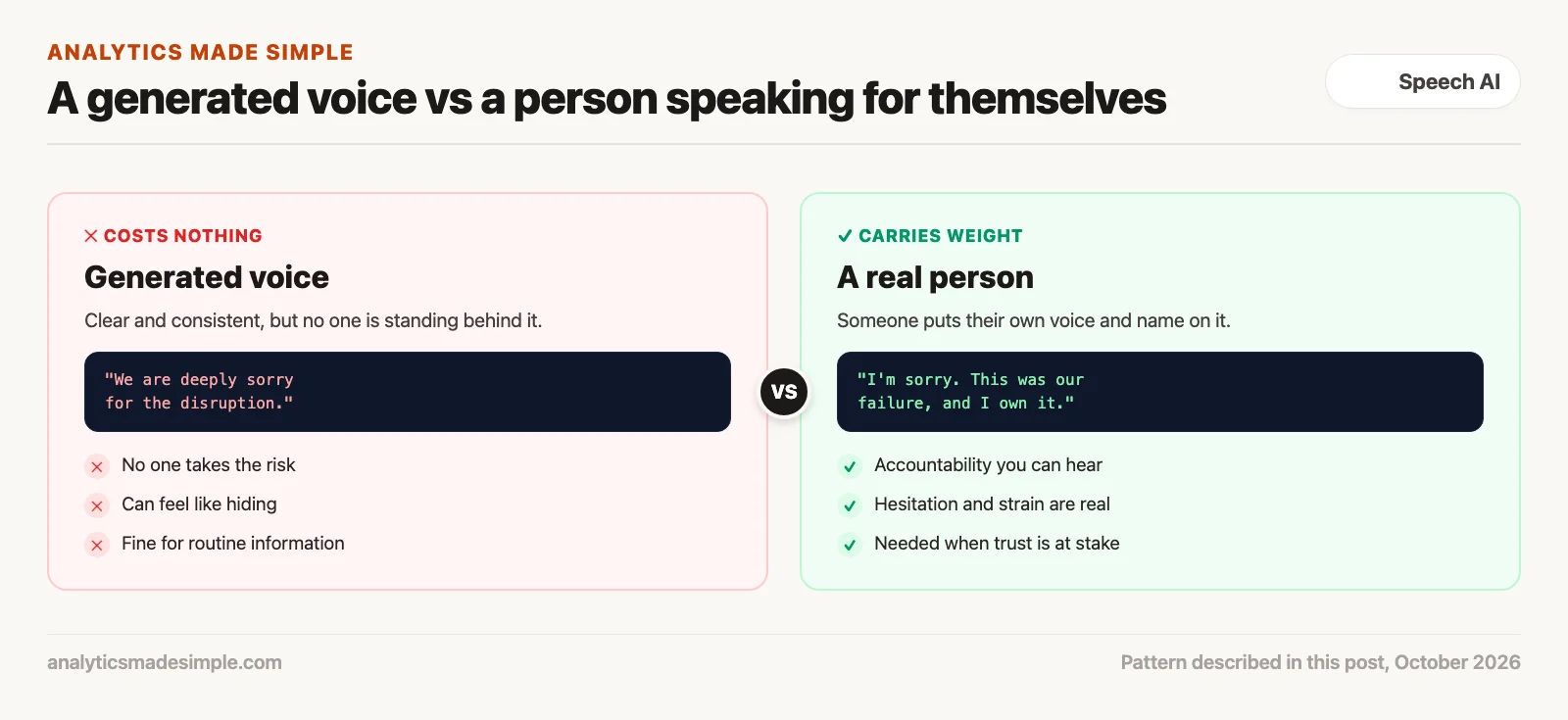
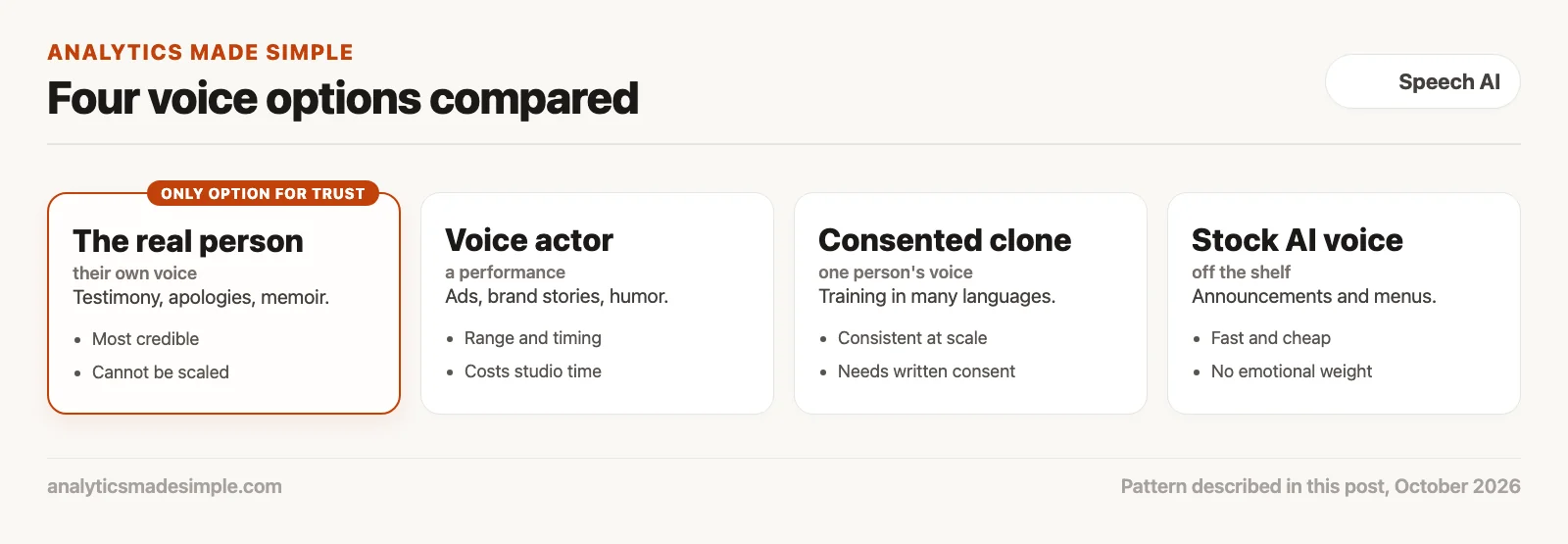
A generated voice is built to sound like a typical person saying the words. It can be clear, warm, and consistent. What it cannot do is take a risk. When a leader apologizes in their own voice, they put their own name and reputation on the line, and listeners hear the effort in the pauses and the strain. That cost is part of what makes an apology believable.
Using a copy of a voice for that moment can read as the opposite: a way to avoid showing up. For routine updates, nobody minds. For an apology, a diagnosis, or a crisis, people expect a person.
The documentary that showed the risk
In 2021, the documentary Roadrunner about the chef and writer Anthony Bourdain used an AI copy of his voice for about three lines, including words from an email he had written but never recorded. There was no on-screen disclosure. When this came out, critics and viewers objected strongly, as The Boston Globe and Variety reported at the time.
The lesson is about honesty more than technology. In documentary and journalism, a recording is evidence that someone said something. Generating words in a real person’s voice, even words they wrote, changes what the audience thinks they are hearing. If you ever use a generated voice in factual work, say so clearly, and never use it for testimony.
The law is moving the same way. In the European Union, Article 50 of the AI Act has applied since August 2, 2026, and requires anyone who publishes a deepfake to disclose that it is AI-made, according to the European Commission.
Why ads with humor still need an actor
AI voices handle plain lines well, like “Save 20 percent this weekend.” They struggle more with lines whose meaning is different from their words. A dry “Oh, wonderful, another update” can be tired, fond, and funny at once, and an actor gets there through timing, breath, and small changes in tone. Asked for sarcasm, a generated voice often overdoes it.
A distinctive voice also becomes part of a brand. When people hear a narrator they know and trust, the brand borrows some of that trust. That is hard to copy, and copying a known voice without consent is not an option anyway.
How studios mix AI and human voices
Studios that use AI well use it around the human performance, not instead of it.
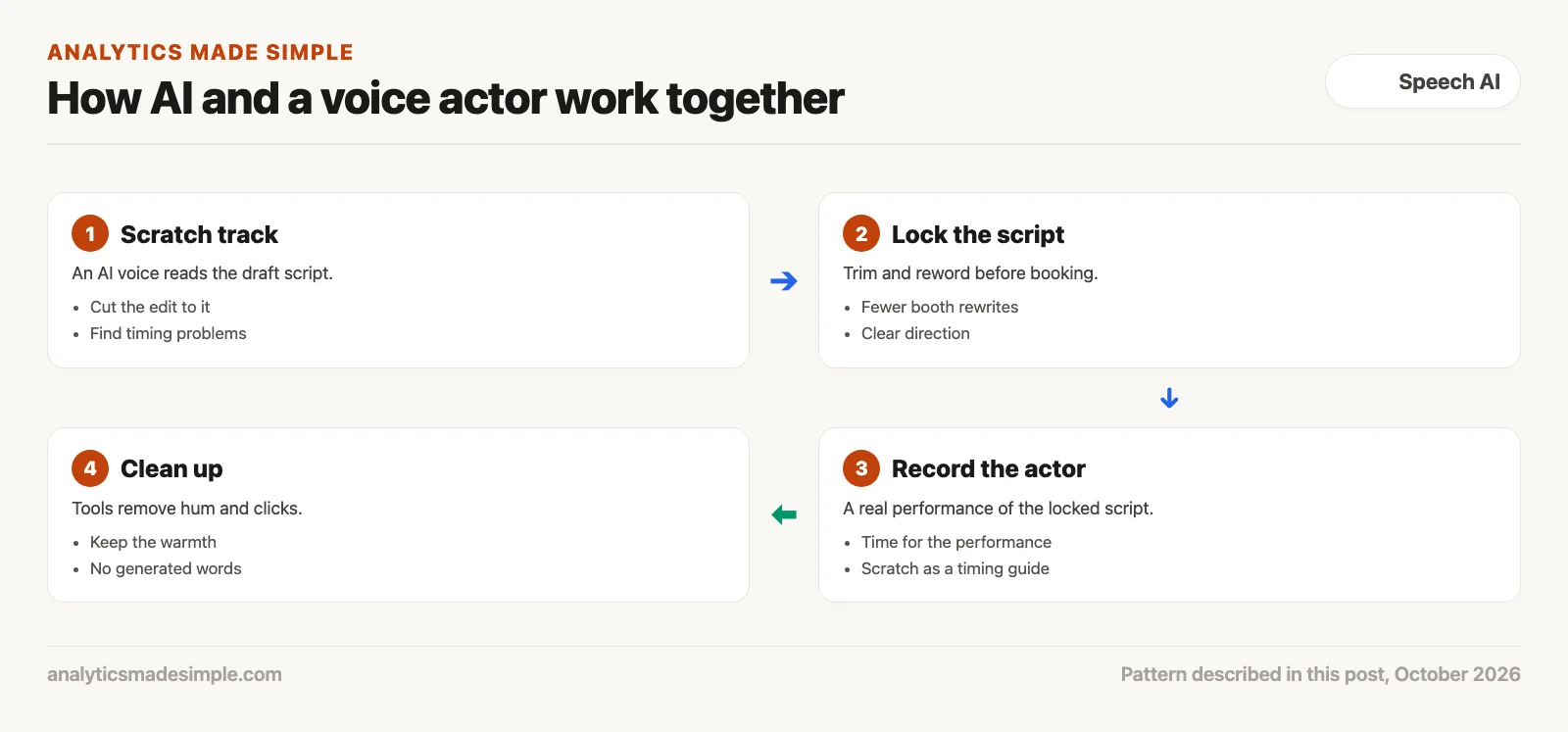
- Scratch track: An AI voice reads the draft script so the editor can cut the video to real timing.
- Lock the script: Trim and reword before booking the studio, so the session is spent on performance.
- Record the actor: The actor records the locked script, using the scratch track only as a timing guide.
- Clean up: Audio tools remove hum, clicks, and echo from the real recording without generating any new words.
Four tiers for deciding
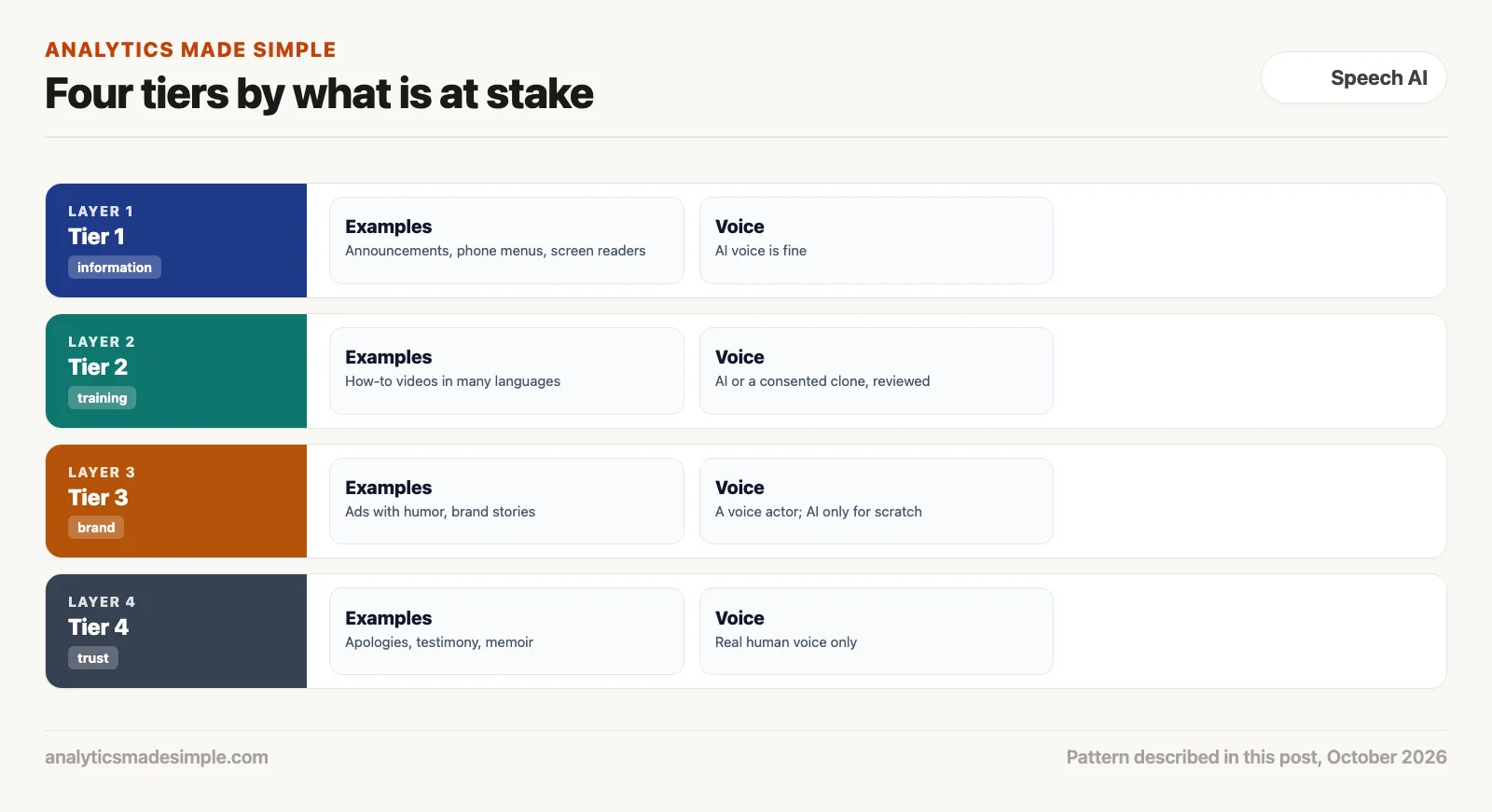
- Tier 1, information: Gate announcements, phone menus, and screen readers. The words change often, and people want clarity. An AI voice is fine.
- Tier 2, training: How-to videos and internal training, often in many languages. An AI voice or a clone made with written consent works well, with a person reviewing the result.
- Tier 3, brand: Ads, brand stories, and anything with humor or drama. Hire a voice actor, and use AI only for the scratch track.
- Tier 4, trust: Apologies, crisis statements, testimony, and memoir. Use the real person’s voice and no AI voice at all, because a synthetic voice in these moments reads as fake sincerity and breaks trust.
A project sorter you can run
The short Python program below sorts five made-up projects into the four tiers using a few yes-or-no questions. It needs nothing beyond Python, and it is a starting point for a conversation, not a rule.
# Sort voice projects into four tiers by what is at stake.
# The projects are made up for practice. The tiers are a starting point, not a rule.
TIER_ADVICE = {
    1: "AI voice is fine (clear information, changes often)",
    2: "AI voice or a consented clone, with a human review",
    3: "hire a voice actor; AI only for the scratch track",
    4: "real human voice only; no AI voice at all",
}

projects = [
    {"name": "gate change announcement", "asks_for_trust": False, "real_testimony": False,
     "needs_humor_or_feeling": False, "internal_training": False},
    {"name": "software how-to in 12 languages", "asks_for_trust": False, "real_testimony": False,
     "needs_humor_or_feeling": False, "internal_training": True},
    {"name": "national ad with dry humor", "asks_for_trust": False, "real_testimony": False,
     "needs_humor_or_feeling": True, "internal_training": False},
    {"name": "CEO apology after an outage", "asks_for_trust": True, "real_testimony": False,
     "needs_humor_or_feeling": True, "internal_training": False},
    {"name": "survivor interview in a documentary", "asks_for_trust": True, "real_testimony": True,
     "needs_humor_or_feeling": True, "internal_training": False},
]


def tier(p):
    if p["asks_for_trust"] or p["real_testimony"]:
        return 4
    if p["needs_humor_or_feeling"]:
        return 3
    if p["internal_training"]:
        return 2
    return 1


for p in projects:
    t = tier(p)
    print(f"Tier {t} | {p['name']}: {TIER_ADVICE[t]}")
Running it prints:
Tier 1 | gate change announcement: AI voice is fine (clear information, changes often)
Tier 2 | software how-to in 12 languages: AI voice or a consented clone, with a human review
Tier 3 | national ad with dry humor: hire a voice actor; AI only for the scratch track
Tier 4 | CEO apology after an outage: real human voice only; no AI voice at all
Tier 4 | survivor interview in a documentary: real human voice only; no AI voice at all
In plain words, the tier function checks the most serious question first. Anything that asks for trust or is real testimony goes to tier 4. Anything that needs humor or feeling goes to tier 3. Internal training goes to tier 2, and the rest is tier 1. The CEO apology lands in tier 4 even though an AI copy would be faster.
Quick recap
- Use a real person whenever listeners are asked to trust someone.
- Disclose any generated voice in factual work, and never use one for testimony.
- Use AI for routine information, training, and scratch tracks around a human performance.
- Sort projects by what is at stake before choosing a voice.
Your next step this week
List the voice projects you have planned for the next few months and sort each one into a tier. For anything in tier 4, book the real person now. For tier 3, budget for an actor and plan to use AI only for the scratch track.
Series notes
This is Part 6 of Voice models from scratch, and it closes the planned voice track. Previous: voice quality engineering.
Sources
- The Boston Globe, A.I. voice of Anthony Bourdain in new ‘Roadrunner’ documentary sparks controversy, July 16, 2021.
- Variety, column on the AI voice in ‘Roadrunner’, 2021.
- European Commission, Transparency obligations under Article 50 of the AI Act, checked October 3, 2026.
Keep going
Same lessons in your feed
Short diagrams, hooks, and weekly tutorials on Substack, Instagram, X, and Facebook.